Department of Ophthalmology, Massachusetts Eye and Ear, Harvard Medical School, Boston, Massachusetts, USA.
Einhorn Clinical Research Center, New York Eye and Ear Infirmary of Mount Sinai, New York, USA.
Br J Ophthalmol. 2019 Feb;103(2):203-207. doi: 10.1136/bjophthalmol-2018-311846. Epub 2018 Apr 26.
BACKGROUND/AIMS: An altered haemodynamic profile for various ocular posterior segment capillary beds has been documented in primary open-angle glaucoma (POAG). POAG may also involve abnormal non-ocular blood flow, and the nailfold capillaries, which are not affected by elevated intraocular pressure (IOP), are readily assessable.
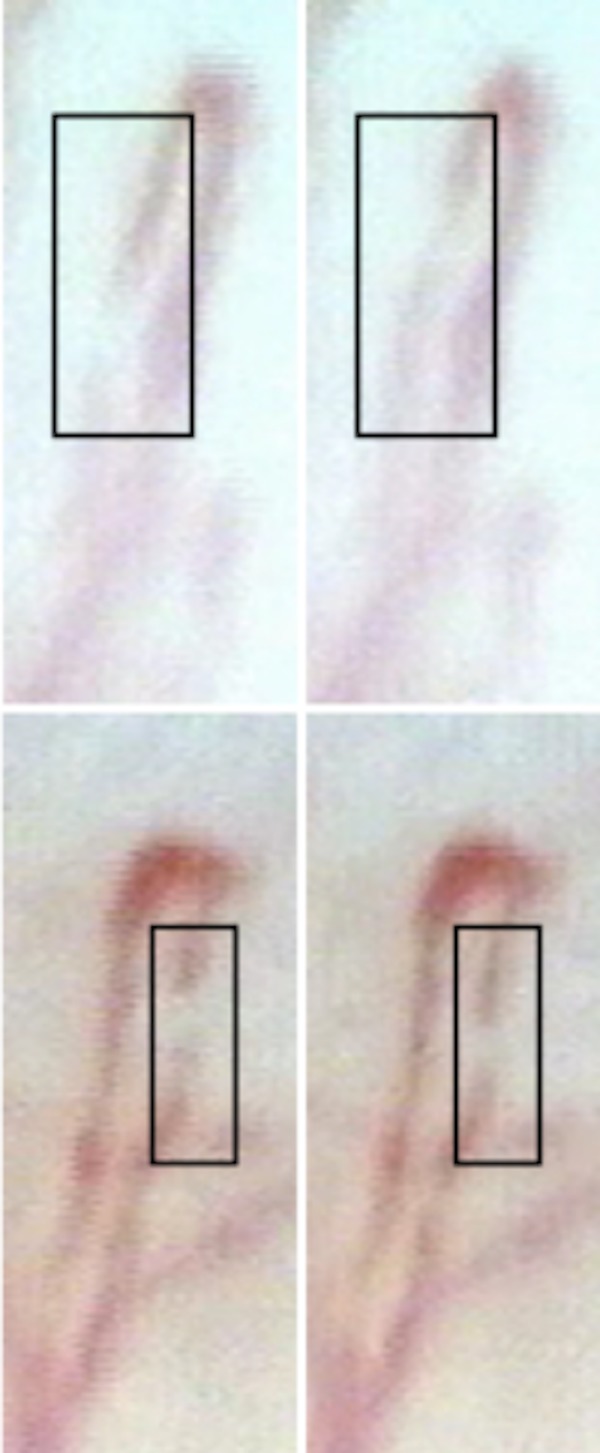
We measured resting nailfold capillary blood flow in 67 POAG and 63 control subjects using video capillaroscopy. Masked readers tracked blood column voids between consecutive, registered image sequence frames, measured vessel diameter and calculated blood flow. We used multiple logistic regression to investigate the relation between nailfold capillary blood flow and POAG. In secondary analyses, we stratified cases by maximum IOP and concurrent topical beta-blocker use.
Mean (±SD) blood flow in picolitres per second was 26.8±17.6 for POAG cases and 50.1±24.2 for controls (p<0.0001). After adjustment for demographic and clinical factors including blood pressure and pulse, every picolitre per second increase in resting nailfold blood flow was associated with a 6% (95% CI 0.92 to 0.96) reduced odds of POAG (p<0.0001). Similar relations between nailfold capillary blood flow and POAG were found for cases stratified by maximum known IOP and for cases stratified by concurrent topical beta-blocker use.
Reduced resting nailfold capillary blood flow is present in POAG independent of covariates such as blood pressure, pulse and IOP.
背景/目的:已在原发性开角型青光眼(POAG)中记录到各种眼部后段毛细血管床的血流动力学改变。POAG 也可能涉及异常的非眼部血流,而甲襞毛细血管不受眼内压(IOP)升高的影响,因此易于评估。
我们使用视频毛细血管镜测量了 67 例 POAG 和 63 例对照受试者的静息甲襞毛细血管血流。掩蔽的读者在连续的、已注册的图像序列帧之间跟踪血液柱空隙,测量血管直径并计算血流。我们使用多元逻辑回归来研究甲襞毛细血管血流与 POAG 之间的关系。在二次分析中,我们根据最大 IOP 和同时使用局部β受体阻滞剂对病例进行分层。
每秒皮升的平均(±SD)血流分别为 POAG 病例 26.8±17.6 和对照组 50.1±24.2(p<0.0001)。在调整了包括血压和脉搏在内的人口统计学和临床因素后,静息甲襞血流中每增加 1 皮升/秒,POAG 的几率就会降低 6%(95%CI 0.92 至 0.96)(p<0.0001)。对于根据最大已知 IOP 和同时使用局部β受体阻滞剂分层的病例,也发现了甲襞毛细血管血流与 POAG 之间的类似关系。
静息甲襞毛细血管血流减少存在于 POAG 中,与血压、脉搏和 IOP 等协变量无关。