Division of Molecular and Cellular Medicine, National Cancer Center Research Institute, Tokyo, Japan.
Graduate School of Medicine, The University of Tokyo, Tokyo, Japan.
Cell Death Dis. 2018 May 1;9(5):468. doi: 10.1038/s41419-018-0487-z.
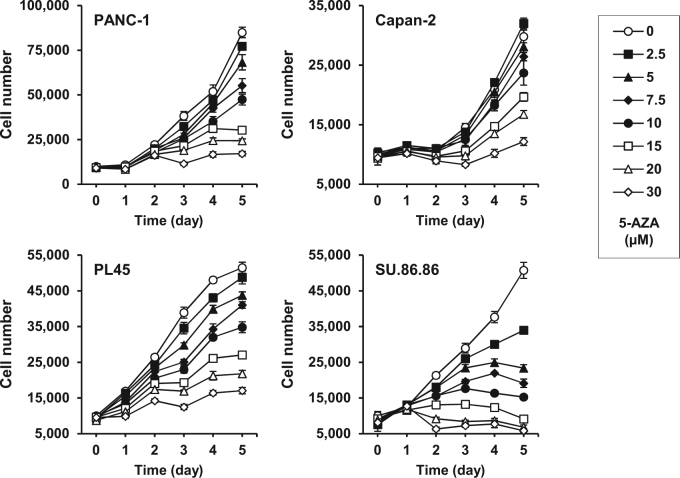
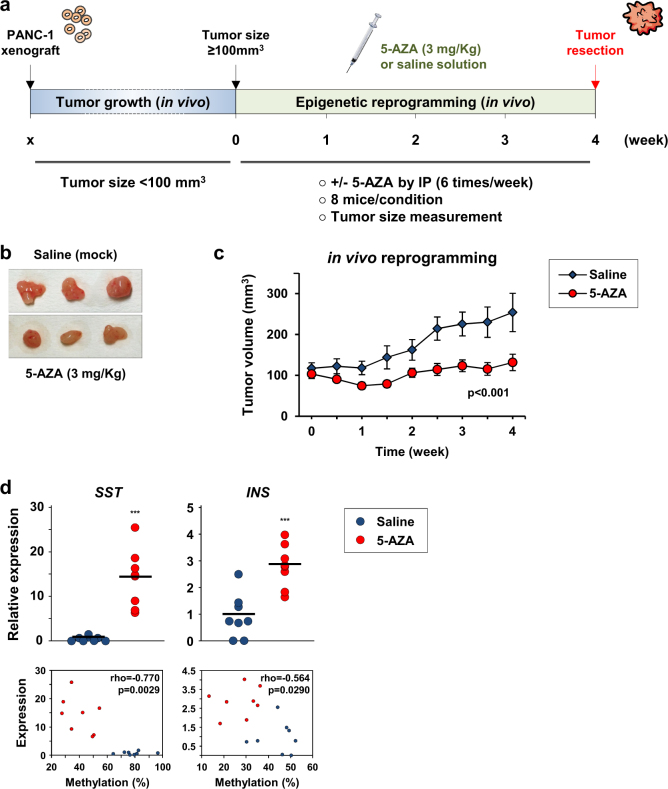
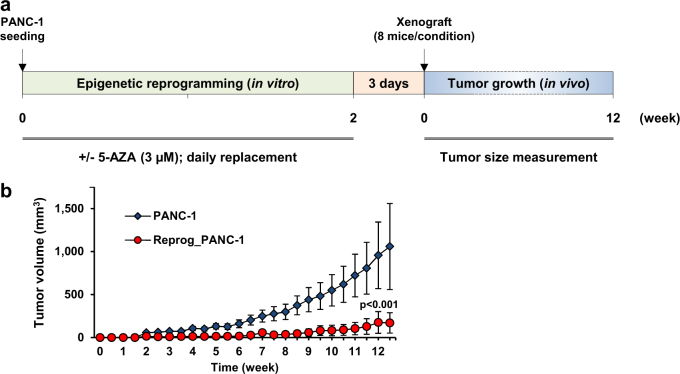
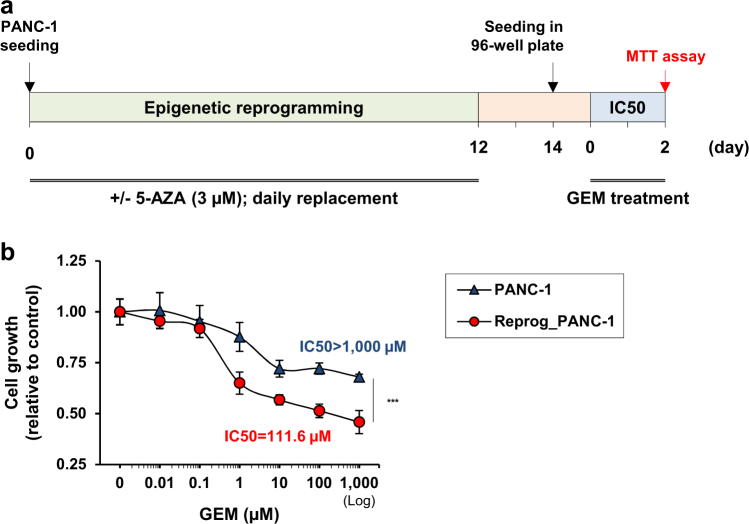
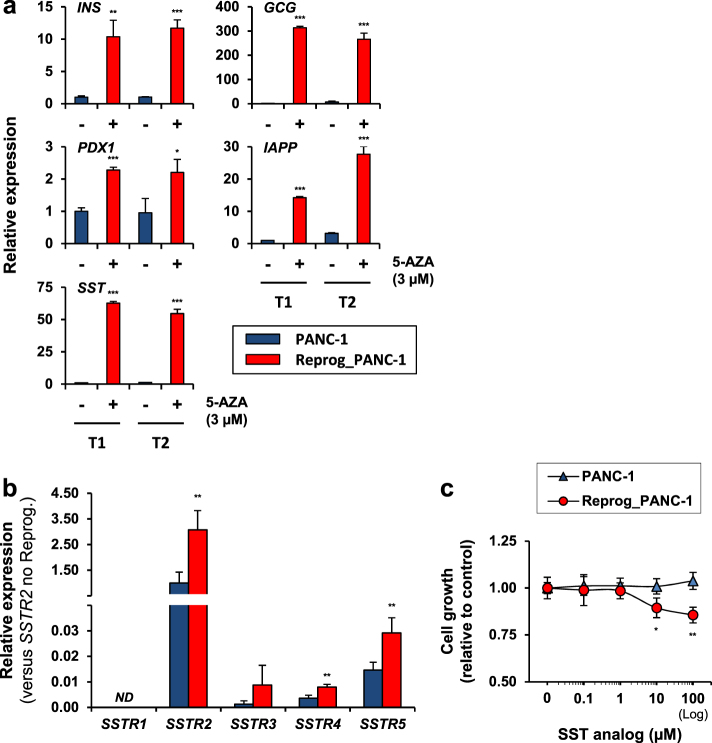
Curative management of pancreatic adenocarcinoma is limited because this malignancy remains resistant to most chemotherapeutic drugs. Strategies that reverse epigenetic alterations offer a unique opportunity for cancer cell reprogramming, which is valuable for development of new treatments. The aim of this work was to reprogram pancreatic ductal adenocarcinoma (PDAC) cells toward a less aggressive and drug-responsive phenotype. The process applied is called "epigenetic reprogramming". To evaluate the efficiency of PDAC epigenetic reprogramming, we assessed tumor growth and drug response in PANC-1 cells after exposure to non-cytotoxic doses of the demethylating agent 5-azacytidine (5-AZA). Here, we showed that an epigenetic regimen using 5-AZA promoted an anti-cancer response by inhibiting PDAC tumor growth in vivo after the engraftment of treated cells. Remarkably, the subsequent addition of gemcitabine (GEM) to the 5-AZA-mediated reprogramming resulted in a marked growth inhibition effect in GEM-resistant pancreatic cancer cells. We observed that various characteristic peptides expressed in the pancreas, which included the antiproliferative hormone somatostatin (SST) and the SST receptor 2 (SSTR2), were significantly upregulated in the epigenetically reprogrammed PDAC cells. The inhibitory effect of octreotide (OCT), an SST analog, was tested on PDAC cells and found to be improved after cell reprogramming. Furthermore, we found that SST gene expression restoration following 5-AZA treatment or following knockdown of the DNA methyltransferase (DNMT) 1 enzyme was associated with the reversion of SST epigenetic silencing through regional CpG demethylation. Lastly, we confirmed the efficacy of 5-AZA-based epigenetic reprogramming in vivo using a PDAC tumor growth model. In conclusion, this study demonstrates that epigenetic reprogramming using the demethylating compound 5-AZA shows anti-cancer effects in PANC-1 cells and is potentially attractive for the treatment of solid tumors.
胰腺腺癌的治疗管理受到限制,因为这种恶性肿瘤仍然对大多数化疗药物具有抗性。逆转表观遗传改变的策略为癌细胞重编程提供了一个独特的机会,这对于开发新的治疗方法非常有价值。本工作的目的是将胰腺导管腺癌(PDAC)细胞重编程为侵袭性较低且对药物敏感的表型。所应用的过程称为“表观遗传重编程”。为了评估 PDAC 表观遗传重编程的效率,我们评估了在暴露于非细胞毒性剂量的去甲基化剂 5-氮杂胞苷(5-AZA)后 PANC-1 细胞中的肿瘤生长和药物反应。在这里,我们表明,使用 5-AZA 的表观遗传方案通过抑制经处理细胞的体内 PDAC 肿瘤生长来促进抗癌反应。值得注意的是,随后将吉西他滨(GEM)添加到 5-AZA 介导的重编程中,导致 GEM 耐药胰腺癌细胞的生长抑制作用明显增强。我们观察到,在重编程的 PDAC 细胞中,胰腺中表达的各种特征肽明显上调,包括抗增殖激素生长抑素(SST)和 SST 受体 2(SSTR2)。奥曲肽(OCT),一种 SST 类似物的抑制作用在 PDAC 细胞上进行了测试,发现细胞重编程后效果得到改善。此外,我们发现 5-AZA 处理后或 DNA 甲基转移酶(DNMT)1 酶敲低后 SST 基因表达的恢复与 SST 表观遗传沉默通过局部 CpG 去甲基化的逆转有关。最后,我们使用 PDAC 肿瘤生长模型在体内证实了基于 5-AZA 的表观遗传重编程的功效。总之,这项研究表明,使用去甲基化化合物 5-AZA 的表观遗传重编程在 PANC-1 细胞中具有抗癌作用,对于治疗实体瘤具有潜在吸引力。