The Wellcome Trust/Cancer Research UK Gurdon Institute and Department of Biochemistry, University of Cambridge, Cambridge, CB2 1QN, UK.
The Wellcome Trust Sanger Institute, Hinxton, Cambridge, CB10 1SA, UK.
Nat Commun. 2018 Apr 27;9(1):1700. doi: 10.1038/s41467-018-03770-3.
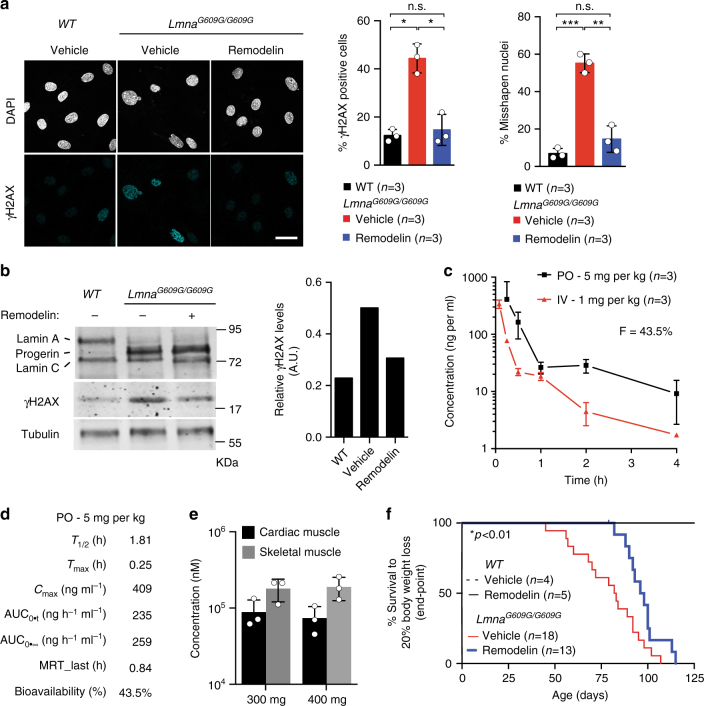
Hutchinson-Gilford Progeria Syndrome (HGPS) is a rare, but devastating genetic disease characterized by segmental premature aging, with cardiovascular disease being the main cause of death. Cells from HGPS patients accumulate progerin, a permanently farnesylated, toxic form of Lamin A, disrupting the nuclear shape and chromatin organization, leading to DNA-damage accumulation and senescence. Therapeutic approaches targeting farnesylation or aiming to reduce progerin levels have provided only partial health improvements. Recently, we identified Remodelin, a small-molecule agent that leads to amelioration of HGPS cellular defects through inhibition of the enzyme N-acetyltransferase 10 (NAT10). Here, we show the preclinical data demonstrating that targeting NAT10 in vivo, either via chemical inhibition or genetic depletion, significantly enhances the healthspan in a Lmna HGPS mouse model. Collectively, the data provided here highlights NAT10 as a potential therapeutic target for HGPS.
亨廷顿舞蹈病-吉福德早衰综合征(HGPS)是一种罕见但破坏性极大的遗传病,其特征是部分性过早衰老,心血管疾病是主要死亡原因。HGPS 患者的细胞积累了异常的前蛋白,一种永久性法呢基化的、毒性形式的核纤层蛋白 A,破坏核形状和染色质组织,导致 DNA 损伤积累和衰老。针对法尼基化或旨在降低前蛋白水平的治疗方法仅提供了部分健康改善。最近,我们发现了 Remodelin,一种小分子药物,通过抑制酶 N-乙酰转移酶 10(NAT10),改善 HGPS 细胞缺陷。在这里,我们展示了临床前数据,证明通过化学抑制或基因耗竭在体内靶向 NAT10 可显著延长 Lmna HGPS 小鼠模型的健康寿命。总之,这里提供的数据强调了 NAT10 作为 HGPS 的潜在治疗靶点。