Koyama Asuka, Hashimoto Mamoru, Fukuhara Ryuji, Ichimi Naoko, Takasaki Akihiro, Matsushita Masateru, Ishikawa Tomohisa, Tanaka Hibiki, Miyagawa Yusuke, Ikeda Manabu
Department of Neuropsychiatry, Faculty of Life Sciences, Kumamoto University, Kumamoto, Japan.
Department of Medical Quality and Safety Management, Kumamoto University Hospital, Kumamoto, Japan.
Dement Geriatr Cogn Dis Extra. 2018 Apr 6;8(1):128-137. doi: 10.1159/000487851. eCollection 2018 Jan-Apr.
Caregiver burden is a serious concern for family caregivers of dementia patients, but its nature is unclear in patients with semantic dementia (SD). This study aimed to clarify caregiver burden for right- (R > L) and left-sided (L > R) predominant SD versus behavioral-variant frontotemporal dementia (bvFTD) patients.
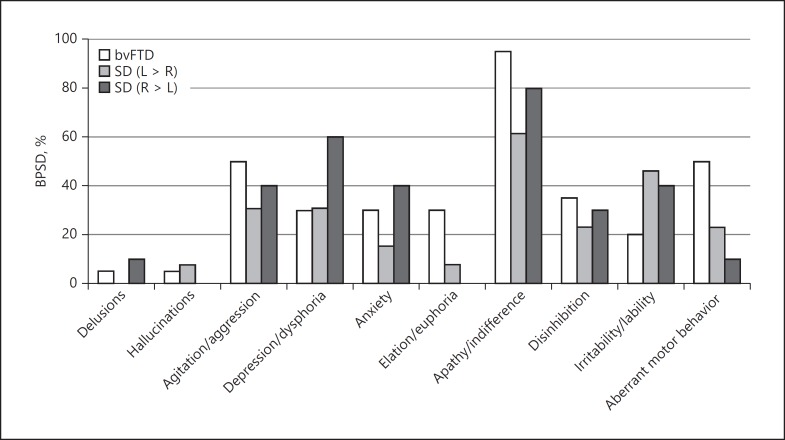
Using the Japanese version of the Zarit Burden Interview (ZBI) and the Neuropsychiatric Inventory, we examined caregiver burden and behavioral and psychological symptoms of dementia (BPSD) in 43 first-visit outpatient/family caregiver dyads (bvFTD, 20 dyads; SD [L > R], 13 dyads; SD [R > L], 10 dyads).
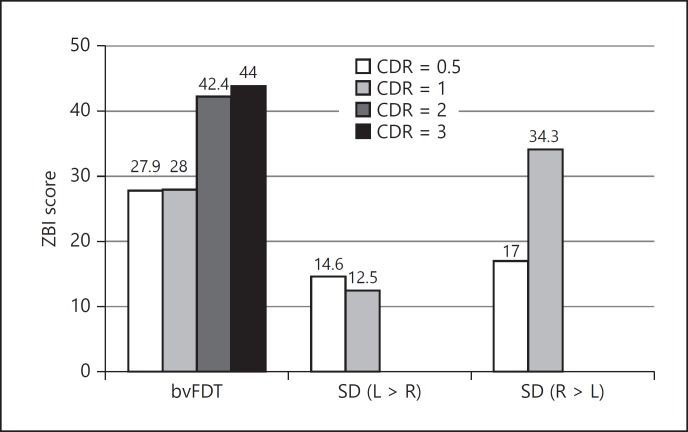
We found a significant difference in ZBI score between the 3 diagnostic groups. Post hoc tests revealed a significantly higher ZBI score in the bvFTD than in the SD (L > R) group. The ZBI scores in the SD (L > R) and SD (R > L) groups were not significantly different, although the effect size was large. Caregiver burden was significantly correlated with BPSD scores in all groups and was correlated with activities of daily living and instrumental activities of daily living decline in the bvFTD and SD (R > L) groups.
Caregiver burden was highest in the bvFTD group, comparatively high in the SD (R > L) group, and lowest in the SD (L > R) group. Adequate support and intervention for caregivers should be tailored to differences in caregiver burden between these patient groups.
照顾者负担是痴呆症患者家庭照顾者的一个严重问题,但在语义性痴呆(SD)患者中其本质尚不清楚。本研究旨在阐明右侧优势(R > L)和左侧优势(L > R)的SD患者与行为变异型额颞叶痴呆(bvFTD)患者的照顾者负担情况。
我们使用日语版的 Zarit 负担访谈量表(ZBI)和神经精神科问卷,对 43 对首次就诊的门诊患者/家庭照顾者(bvFTD 组 20 对;SD[L > R]组 13 对;SD[R > L]组 10 对)进行了照顾者负担以及痴呆的行为和心理症状(BPSD)的检查。
我们发现 3 个诊断组之间的 ZBI 得分存在显著差异。事后检验显示,bvFTD 组的 ZBI 得分显著高于 SD(L > R)组。SD(L > R)组和 SD(R > L)组的 ZBI 得分虽无显著差异,但效应量较大。所有组的照顾者负担均与 BPSD 得分显著相关,且在 bvFTD 组和 SD(R > L)组中,照顾者负担与日常生活活动能力和工具性日常生活活动能力下降相关。
照顾者负担在 bvFTD 组最高,在 SD(R > L)组相对较高,在 SD(L > R)组最低。应根据这些患者组之间照顾者负担的差异,为照顾者提供适当的支持和干预。