Geoffroy Valérie, Payette Geneviève, Mauffrey Florian, Lestin Livie, Constant Philippe, Villemur Richard
Institut Armand-Frappier, Institut National de la Recherche Scientifique, Laval, Québec, Canada.
Lallemand, Montreal, Québec, Canada.
PeerJ. 2018 Apr 23;6:e4679. doi: 10.7717/peerj.4679. eCollection 2018.
The biofilm of a methanol-fed, fluidized denitrification system treating a marine effluent is composed of multi-species microorganisms, among which NL23 and JAM1 are the principal bacteria involved in the denitrifying activities. Strain NL23 can carry complete nitrate (NO[Formula: see text]) reduction to N, whereas strain JAM1 can perform 3 out of the 4 reduction steps. A small proportion of other denitrifiers exists in the biofilm, suggesting the potential plasticity of the biofilm in adapting to environmental changes. Here, we report the acclimation of the denitrifying biofilm from continuous operating mode to batch operating mode, and the isolation and characterization from the acclimated biofilm of a new denitrifying bacterial strain, named GP59.
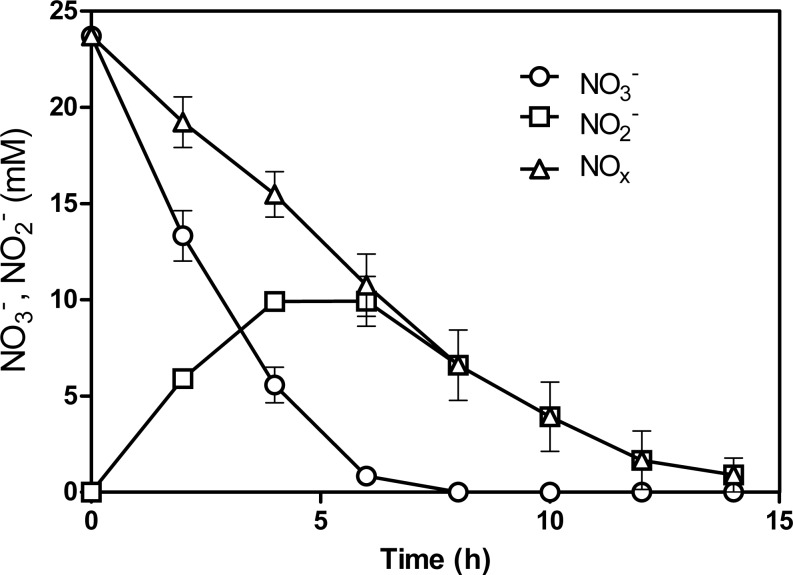
The denitrifying biofilm was batch-cultured under anoxic conditions. The acclimated biofilm was plated on specific medium to isolate denitrifying isolates. Planktonic cultures of strains GP59 and JAM1 were performed, and the growth and the dynamics of NO[Formula: see text], nitrite (NO[Formula: see text]) and NO were determined. The genomes of strains GP59 and JAM1 were sequenced and compared. The transcriptomes of strains GP59 and JAM1 were derived from anoxic cultures.
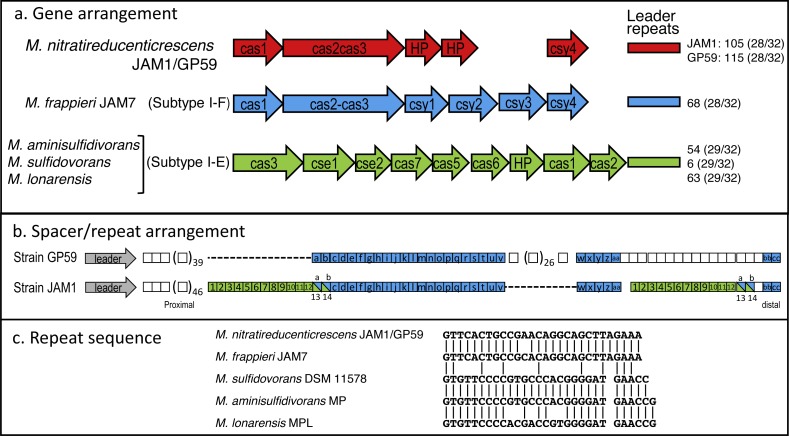
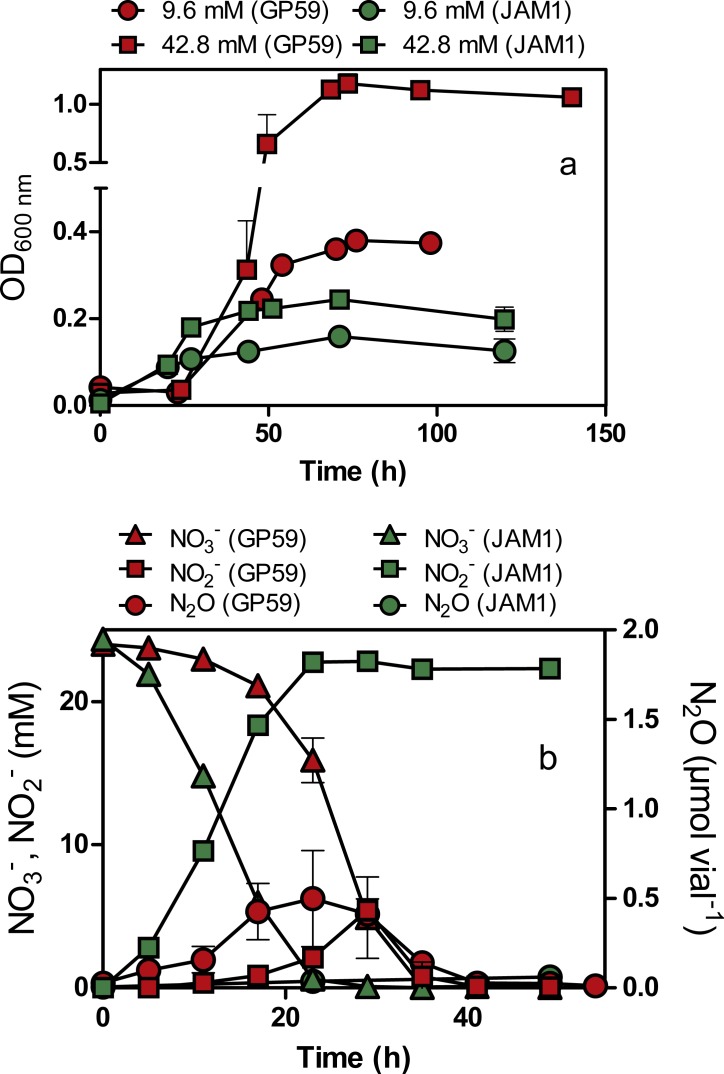
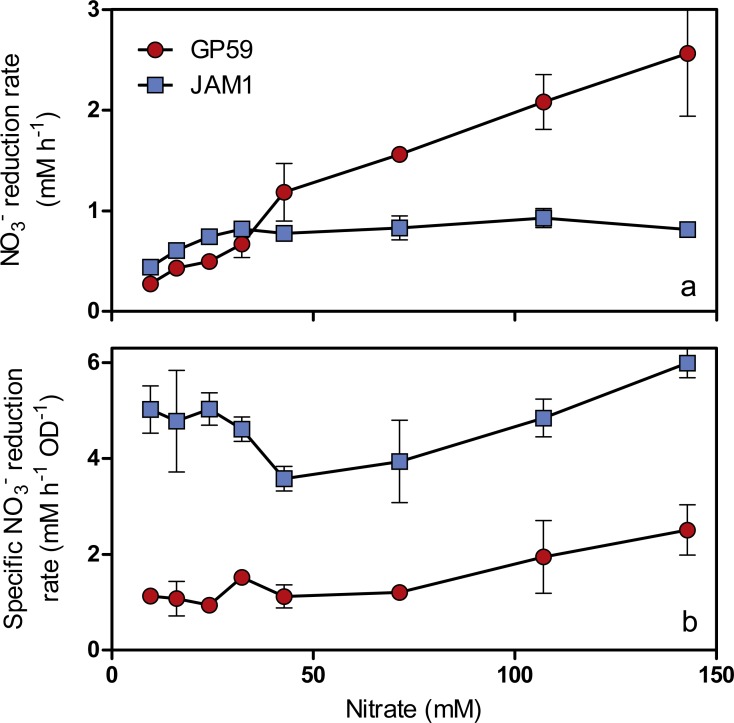
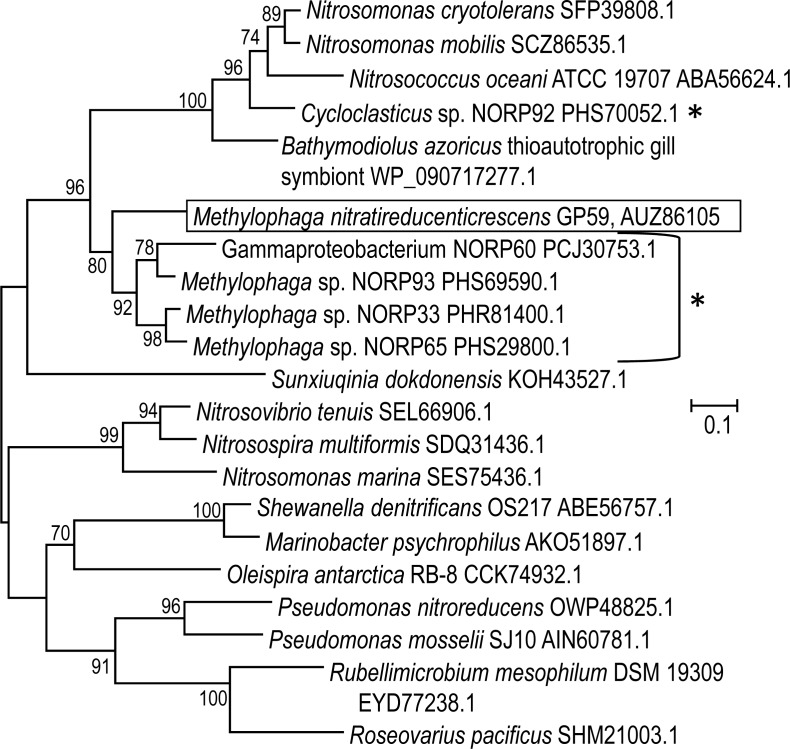
During batch cultures of the biofilm, we observed the disappearance of NL23 without affecting the denitrification performance. From the acclimated biofilm, we isolated strain GP59 that can perform, like NL23, the complete denitrification pathway. The GP59 cell concentration in the acclimated biofilm was 2-3 orders of magnitude higher than JAM1 and NL23. Genome analyses revealed that strain GP59 belongs to the species . The GP59 genome shares more than 85% of its coding sequences with those of strain JAM1. Based on transcriptomic analyses of anoxic cultures, most of these common genes in strain GP59 were expressed at similar level than their counterparts in strain JAM1. In contrast to strain JAM1, strain GP59 cannot reduce NO[Formula: see text] under oxic culture conditions, and has a 24-h lag time before growth and NO[Formula: see text] reduction start to occur in anoxic cultures, suggesting that both strains regulate differently the expression of their denitrification genes. Strain GP59 has the ability to reduce NO[Formula: see text] as it carries a gene encoding a NirK-type NO[Formula: see text] reductase. Based on the CRISPR sequences, strain GP59 did not emerge from strain JAM1 during the biofilm batch cultures but rather was present in the original biofilm and was enriched during this process.
These results reinforce the unique trait of the species among the genus as facultative anaerobic bacterium. These findings also showed the plasticity of denitrifying population of the biofilm in adapting to anoxic marine environments of the bioreactor.
以甲醇为进料的流化反硝化系统处理海水废水时,其生物膜由多种微生物组成,其中NL23和JAM1是参与反硝化活动的主要细菌。菌株NL23能够将硝酸盐(NO[化学式:见原文])完全还原为N,而菌株JAM1能够完成4个还原步骤中的3个。生物膜中存在少量其他反硝化菌,这表明生物膜在适应环境变化方面具有潜在的可塑性。在此,我们报告了反硝化生物膜从连续运行模式到分批运行模式的驯化过程,以及从驯化后的生物膜中分离和鉴定出一种新的反硝化细菌菌株GP59。
反硝化生物膜在缺氧条件下进行分批培养。将驯化后的生物膜接种在特定培养基上以分离反硝化菌株。对菌株GP59和JAM1进行浮游培养,并测定其生长情况以及NO[化学式:见原文]、亚硝酸盐(NO[化学式:见原文])和NO的动态变化。对菌株GP59和JAM1的基因组进行测序并比较。菌株GP59和JAM1的转录组来自缺氧培养物。
在生物膜的分批培养过程中,我们观察到NL23消失但不影响反硝化性能。从驯化后的生物膜中,我们分离出了菌株GP59,它能够像NL23一样完成完整的反硝化途径。驯化后的生物膜中GP59细胞浓度比JAM1和NL23高2 - 3个数量级。基因组分析表明菌株GP59属于该物种。GP59基因组与其编码序列与菌株JAM1的共享率超过85%。基于缺氧培养物的转录组分析,菌株GP59中的这些常见基因大多与其在菌株JAM1中的对应基因以相似水平表达。与菌株JAM1不同,菌株GP59在有氧培养条件下不能还原NO[化学式:见原文],并且在缺氧培养中生长和NO[化学式:见原文]还原开始前有24小时的延迟期,这表明这两种菌株对其反硝化基因的表达调控方式不同。菌株GP59具有还原NO[化学式:见原文]的能力,因为它携带一个编码NirK型NO[化学式:见原文]还原酶的基因。基于CRISPR序列分析,菌株GP59在生物膜分批培养过程中并非从菌株JAM1产生,而是存在于原始生物膜中并在此过程中富集。
这些结果强化了该物种在该属中作为兼性厌氧菌的独特特性。这些发现还表明生物膜中反硝化菌群在适应生物反应器缺氧海洋环境方面具有可塑性。