Mauffrey Florian, Cucaita Alexandra, Constant Philippe, Villemur Richard
INRS-Institut Armand-Frappier, Laval, Québec, Canada.
Laboratoire de santé publique du Québec, Ste-Anne-de-Bellevue, Québec, Canada.
PeerJ. 2017 Nov 28;5:e4098. doi: 10.7717/peerj.4098. eCollection 2017.
strain JAM1 is a methylotrophic, marine bacterium that was isolated from a denitrification reactor treating a closed-circuit seawater aquarium. It can sustain growth under anoxic conditions by reducing nitrate ([Formula: see text]) to nitrite ([Formula: see text]). These physiological traits are attributed to gene clusters that encode two dissimilatory nitrate reductases (Nar). Strain JAM1 also contains gene clusters encoding two nitric oxide (NO) reductases and one nitrous oxide (NO) reductase, suggesting that NO and NO can be reduced by strain JAM1. Here we characterized further the denitrifying activities of JAM1.
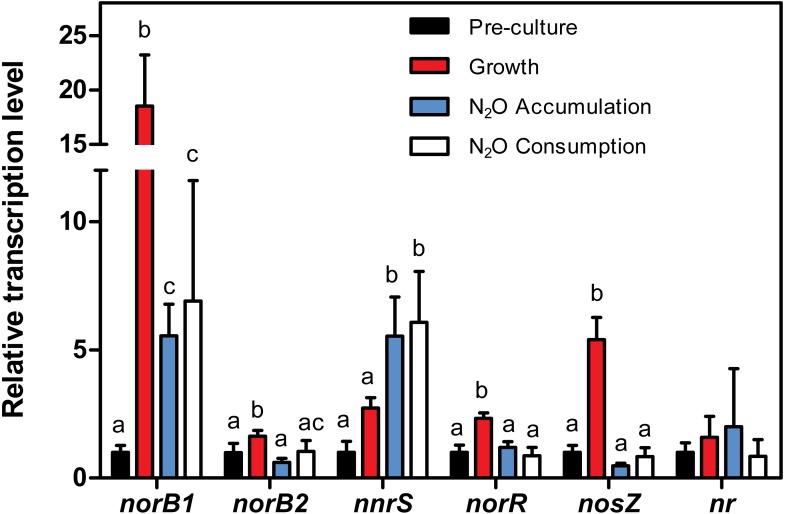
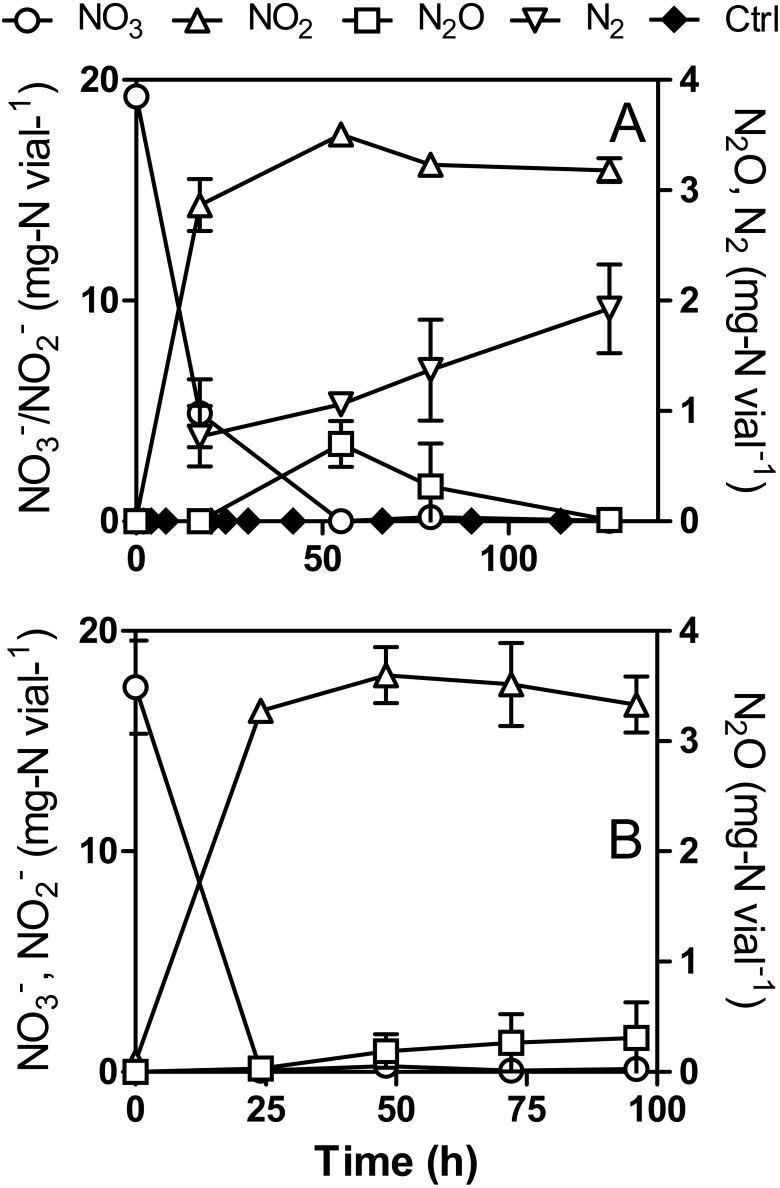
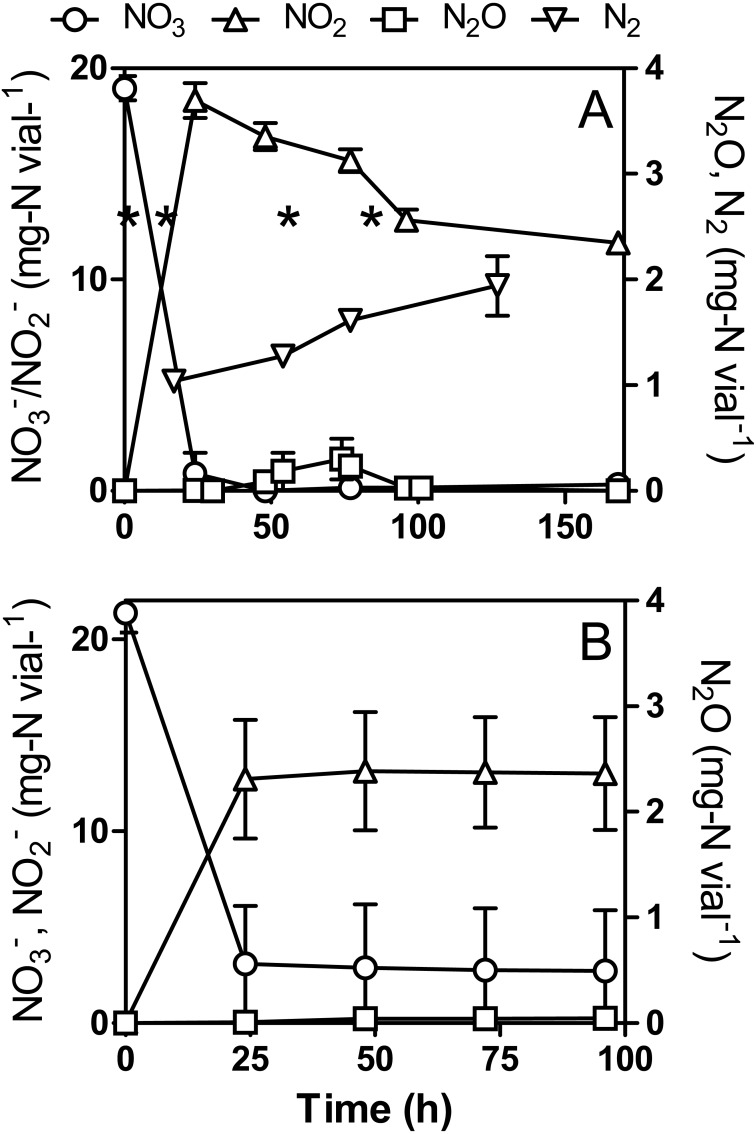
Series of oxic and anoxic cultures of strain JAM1 were performed with NO, [Formula: see text] or sodium nitroprusside, and growth and NO, [Formula: see text], [Formula: see text] and N concentrations were measured. Ammonium ([Formula: see text])-free cultures were also tested to assess the dynamics of NO, [Formula: see text] and [Formula: see text]. Isotopic labeling of NO was performed in NH-amended cultures. Cultures with the JAM1Δ double mutant were performed to assess the involvement of the Nar systems on NO production. Finally, RT-qPCR was used to measure the gene expression levels of the denitrification genes cytochrome -type nitric oxide reductase ( and ) and nitrous oxide reductase (), and also and that encode NO-sensitive regulators.
Strain JAM1 can reduce NO to NO and NO to N and can sustain growth under anoxic conditions by reducing NO as the sole electron acceptor. Although strain JAM1 lacks a gene encoding a dissimilatory [Formula: see text] reductase, [Formula: see text]-amended cultures produce NO, representing up to 6% of the N-input. [Formula: see text] was shown to be the key intermediate of this production process. Upregulation in the expression of c, and during the growth and the NO accumulation phases suggests NO production in strain JAM1 cultures.
By showing that all the three denitrification reductases are active, this demonstrates that JAM1 is one of many bacteria species that maintain genes associated primarily with denitrification, but not necessarily related to the maintenance of the entire pathway. The reason to maintain such an incomplete pathway could be related to the specific role of strain JAM1 in the denitrifying biofilm of the denitrification reactor from which it originates. The production of NO in strain JAM1 did not involve Nar, contrary to what was demonstrated in . JAM1 is the only reported species that has the capacity to grow under anoxic conditions by using [Formula: see text] and NO as sole electron acceptors for its growth. It is also one of a few marine methylotrophs that is studied at the physiological and genetic levels in relation to its capacity to perform denitrifying activities.

JAM1菌株是一种甲基营养型海洋细菌,从处理闭路海水水族箱的反硝化反应器中分离得到。它可以在缺氧条件下通过将硝酸盐([化学式:见原文])还原为亚硝酸盐([化学式:见原文])来维持生长。这些生理特性归因于编码两种异化型硝酸盐还原酶(Nar)的基因簇。JAM1菌株还包含编码两种一氧化氮(NO)还原酶和一种一氧化二氮(N₂O)还原酶的基因簇,这表明JAM1菌株可以还原NO和N₂O。在此,我们进一步表征了JAM1的反硝化活性。
用NO、[化学式:见原文]或硝普钠对JAM1菌株进行一系列有氧和缺氧培养,并测量生长情况以及NO、[化学式:见原文]、[化学式:见原文]和N的浓度。还测试了无铵([化学式:见原文])培养物以评估NO、[化学式:见原文]和[化学式:见原文]的动态变化。在添加NH的培养物中进行NO的同位素标记。用JAM1Δ双突变体进行培养以评估Nar系统对NO产生的影响。最后,使用RT-qPCR测量反硝化基因细胞色素型一氧化氮还原酶(和)和一氧化二氮还原酶()以及编码对NO敏感调节因子的和的基因表达水平。
JAM1菌株可以将NO还原为N₂O,将N₂O还原为N,并且可以在缺氧条件下通过将NO作为唯一电子受体来维持生长。尽管JAM1菌株缺乏编码异化型[化学式:见原文]还原酶的基因,但添加[化学式:见原文]的培养物会产生NO,其含量高达N输入量的6%。[化学式:见原文]被证明是该产生过程的关键中间体。在生长和NO积累阶段,c、和的表达上调表明JAM1培养物中产生了NO。
通过证明所有三种反硝化还原酶都具有活性,可以表明JAM1是众多维持主要与反硝化相关基因的细菌物种之一,但不一定与整个途径的维持相关。维持这种不完整途径的原因可能与其起源的反硝化反应器反硝化生物膜中JAM1菌株的特定作用有关。与中所证明的相反,JAM1菌株中NO的产生不涉及Nar。JAM1是唯一报道的能够在缺氧条件下通过使用[化学式:见原文]和NO作为其生长的唯一电子受体来生长的物种。它也是少数在生理和遗传水平上研究其反硝化活性能力的海洋甲基营养型细菌之一。