Paul Marek A, Kamali Parisa, Chen Austin D, Ibrahim Ahmed M S, Wu Winona, Becherer Babette E, Medin Caroline, Lin Samuel J
Division of Plastic Surgery, Beth Israel Deaconess Medical Center, Harvard Medical School, Boston, Mass.; Department of Plastic Surgery, Lower Silesian Trauma Center, Wroclaw, Poland; and Division of Plastic and Reconstructive Surgery, Louisiana State University Health Sciences Center, New Orleans, La.
Plast Reconstr Surg Glob Open. 2018 Mar 19;6(3):e1615. doi: 10.1097/GOX.0000000000001615. eCollection 2018 Mar.
Rhinoplasty is 1 of the most common aesthetic and reconstructive plastic surgical procedures performed within the United States. Yet, data on functional reconstructive open and closed rhinoplasty procedures with or without spreader graft placement are not definitive as only a few studies have examined both validated measurable objective and subjective outcomes of spreader grafting during rhinoplasty. The aim of this study was to utilize previously validated measures to assess objective, functional outcomes in patients who underwent open and closed rhinoplasty with spreader grafting.
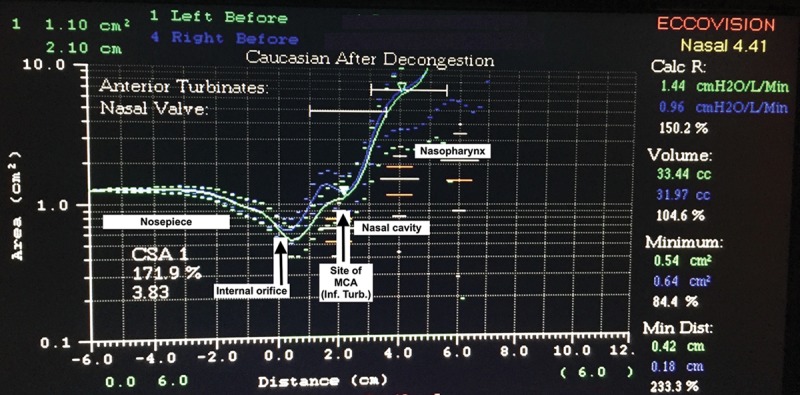
We performed a retrospective review of consecutive rhinoplasty patients. Patients with internal nasal valve insufficiency who underwent an open and closed approach rhinoplasty between 2007 and 2016 were studied. The Cottle test and Nasal Obstruction Symptom Evaluation survey was used to assess nasal obstruction. Patient-reported symptoms were recorded. Acoustic rhinometry was performed pre- and postoperatively. Average minimal cross-sectional area of the nose was measured.
One hundred seventy-eight patients were reviewed over a period of 8 years. Thirty-eight patients were included in this study. Of those, 30 patients underwent closed rhinoplasty and 8 open rhinoplasty. Mean age was 36.9 ± 18.4 years. The average cross-sectional area in closed and open rhinoplasty patients increased significantly ( = 0.019). There was a functional improvement in all presented cases using the Nasal Obstruction Symptom Evaluation scale evaluation.
Closed rhinoplasty with spreader grafting may play a significant role in the treatment of nasal valve collapse. A closed approach rhinoplasty including spreader grafting is a viable option in select cases with objective and validated functional improvement.
隆鼻术是美国最常见的美容和整形重建外科手术之一。然而,关于功能性重建开放式和封闭式隆鼻手术(无论是否放置鼻小柱支撑移植物)的数据并不明确,因为只有少数研究同时考察了隆鼻术中鼻小柱支撑移植物植入的经过验证的可测量客观和主观结果。本研究的目的是利用先前验证的测量方法来评估接受开放式和封闭式隆鼻术并植入鼻小柱支撑移植物患者的客观功能结果。
我们对连续的隆鼻患者进行了回顾性研究。研究对象为2007年至2016年间接受开放式和封闭式鼻内瓣膜功能不全修复隆鼻手术的患者。采用科特尔试验和鼻阻塞症状评估调查来评估鼻阻塞情况。记录患者报告的症状。术前和术后进行鼻声反射测量。测量鼻子的平均最小横截面积。
在8年的时间里,共对178例患者进行了评估。本研究纳入了38例患者。其中,30例患者接受了封闭式隆鼻术,8例接受了开放式隆鼻术。平均年龄为36.9±18.4岁。封闭式和开放式隆鼻患者的平均横截面积显著增加(P = 0.019)。使用鼻阻塞症状评估量表评估,所有呈现病例的功能均有改善。
带鼻小柱支撑移植物的封闭式隆鼻术可能在鼻瓣膜塌陷的治疗中发挥重要作用。在某些客观且经证实功能有改善的病例中,包括植入鼻小柱支撑移植物的封闭式隆鼻术是一种可行的选择。