Department of Emergency, Yongchuan Hospital of Chongqing Medical University, Chongqing, China.
Department of Neurology, Baotou Central Hospital, Inner Mongolia, China.
Biomed Res Int. 2018 Mar 7;2018:8518631. doi: 10.1155/2018/8518631. eCollection 2018.
Persistent postural-perceptual dizziness (PPPD) is a common vestibular disorder. This study was conducted to assess whether the addition of cognitive behavior therapy (CBT) could significantly improve the efficacy and acceptability of sertraline in treating PPPD.
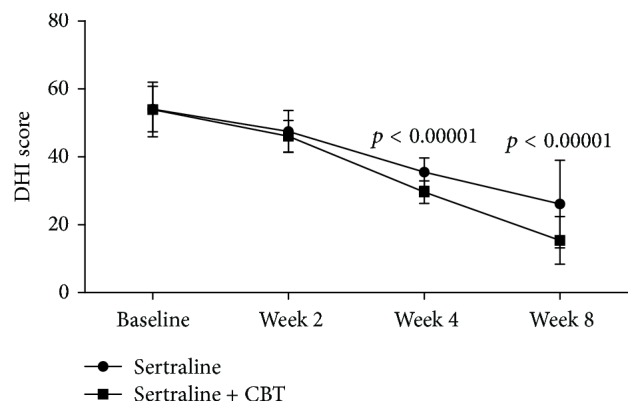
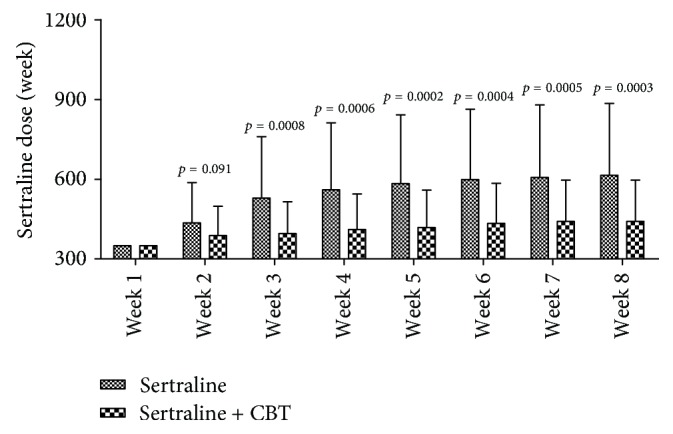
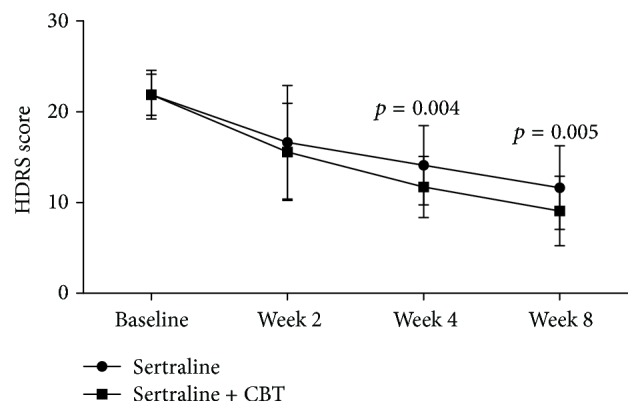
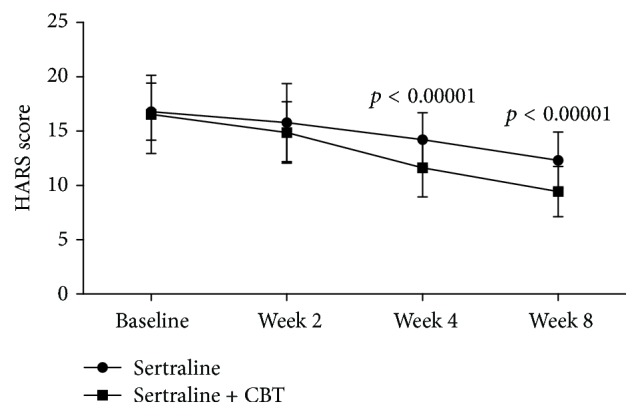
PPPD patients were recruited and randomly assigned to control and experiment groups. Patients in both groups received sertraline 50-200 mg/day, and only patients in the experiment group received CBT (twice a week, one hour per time). The treatment was continued for eight weeks. At baseline, week 2, week 4, and week 8, the 25-item Dizziness Handicap Inventory (DHI), Hamilton Anxiety Rating Scale (HARS), and Hamilton Depression Rating Scale (HDRS) were used to assess the self-perceived handicapping effects caused by PPPD, anxiety, and depressive symptoms, respectively. The dose of sertraline used and the adverse events in both groups were recorded and analyzed.
In total, 91 PPPD patients were randomly assigned to the control group ( = 45) and experiment group ( = 46). After eight weeks of treatment, the average DHI scores, HDRS scores, and HARS scores were significantly decreased in both groups. But compared to the control group, the experiment group had significantly lower average DHI score, HDRS score, and HARS score at weeks 4 and 8. Moreover, the dose of sertraline used in the experiment group was significantly lower than that in the control group, and adverse events occurred more frequently in the control group than in the experiment group (48.9% versus 26.1%, = 0.025).
These results demonstrated that the addition of CBT could significantly improve the efficacy and acceptability of sertraline in treating PPPD and reduce the dose of sertraline used.
持续性姿势-感知性头晕(PPPD)是一种常见的前庭障碍。本研究旨在评估认知行为疗法(CBT)的加入是否能显著提高舍曲林治疗 PPPD 的疗效和可接受性。
招募 PPPD 患者并随机分配至对照组和实验组。两组患者均接受舍曲林 50-200mg/天治疗,实验组患者在此基础上接受 CBT(每周两次,每次 1 小时)。治疗持续八周。在基线、第 2 周、第 4 周和第 8 周,使用 25 项眩晕障碍量表(DHI)、汉密尔顿焦虑量表(HARS)和汉密尔顿抑郁量表(HDRS)分别评估 PPPD 引起的自我感知障碍效应、焦虑和抑郁症状。记录并分析两组患者的舍曲林使用剂量和不良反应。
共有 91 例 PPPD 患者被随机分配至对照组(n=45)和实验组(n=46)。经过八周的治疗,两组患者的 DHI 评分、HDRS 评分和 HARS 评分均显著降低。但与对照组相比,实验组在第 4 周和第 8 周时的 DHI 评分、HDRS 评分和 HARS 评分均显著更低。此外,实验组的舍曲林使用剂量明显低于对照组,且对照组的不良反应发生率明显高于实验组(48.9%比 26.1%,P=0.025)。
这些结果表明,CBT 的加入能显著提高舍曲林治疗 PPPD 的疗效和可接受性,并降低舍曲林的使用剂量。