Burns Ethan A, Collins Alexander D, Jack Robert A, McCulloch Patrick C, Lintner David M, Harris Joshua D
Houston Methodist Orthopedics and Sports Medicine, Houston, Texas, USA.
Orthop J Sports Med. 2018 Apr 17;6(4):2325967118767398. doi: 10.1177/2325967118767398. eCollection 2018 Apr.
The body mass index (BMI) in the United States (US) is rising and may be contributing to increased anterior cruciate ligament reconstruction (ACLR) rates. It is currently unknown whether the BMI is increasing in patients who undergo ACLR.
To determine whether (1) the BMI changed in pediatric and adult patients who previously underwent ACLR or revision ACLR over a 10-year eligibility period, (2) the BMI changed at a greater rate in pediatric or adult patients, and (3) the percentage of overweight and obese patients in the ACLR population was different than that of the general overweight population.
Case series; Level of evidence, 4.
A retrospective investigation of patients who underwent ACLR by 6 surgeons from June 3, 2005, to June 3, 2015, was conducted. Patients were divided into pediatric (<18 years) and adult (≥18 years) categories. BMI at the time of surgery was defined as underweight (<18.5 kg/m), normal (18.5-24.9 kg/m), overweight (25.0-29.9 kg/m), and obese (≥30.0 kg/m). Patients with an indeterminate BMI were excluded. Comparisons of overweight and obese patients were made with general population trends determined by the Centers for Disease Control and Prevention (CDC) in a single US state. Pearson () and Spearman () correlations were used to determine correlations, Student tests were used for 2-variable comparisons, analyses of variance were used for multivariable comparisons, and analyses of covariance were used for comparing linear relationships.
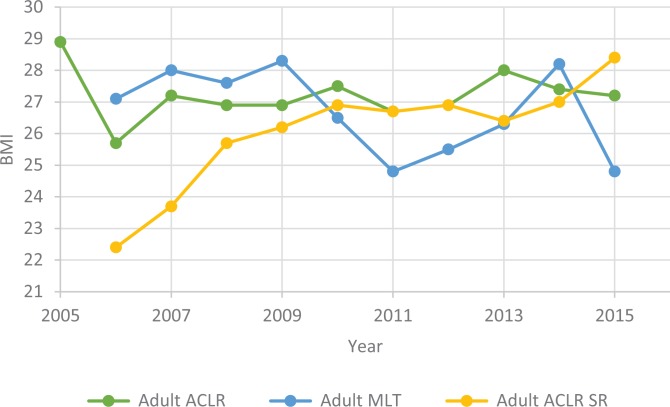
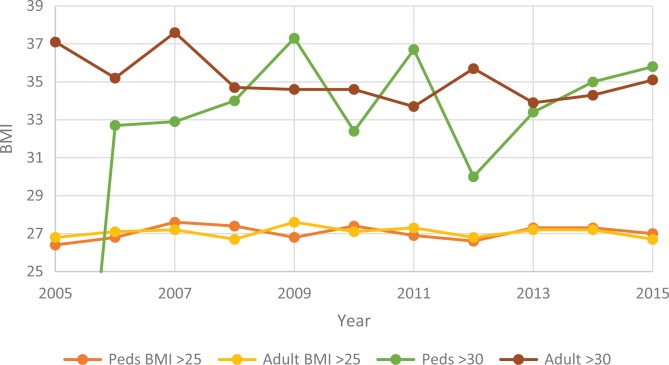
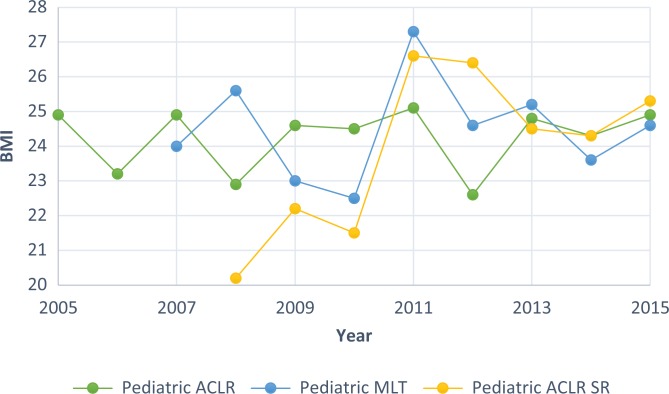
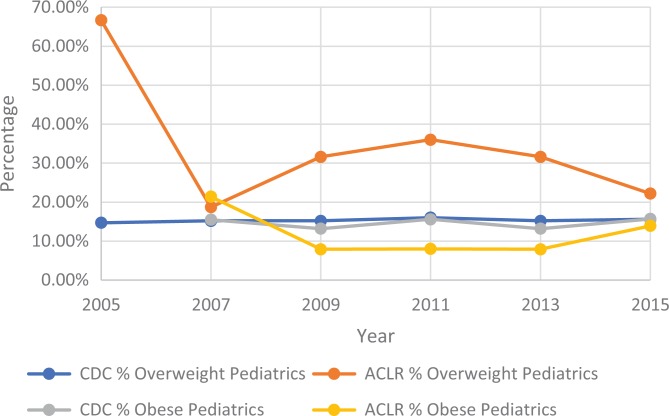
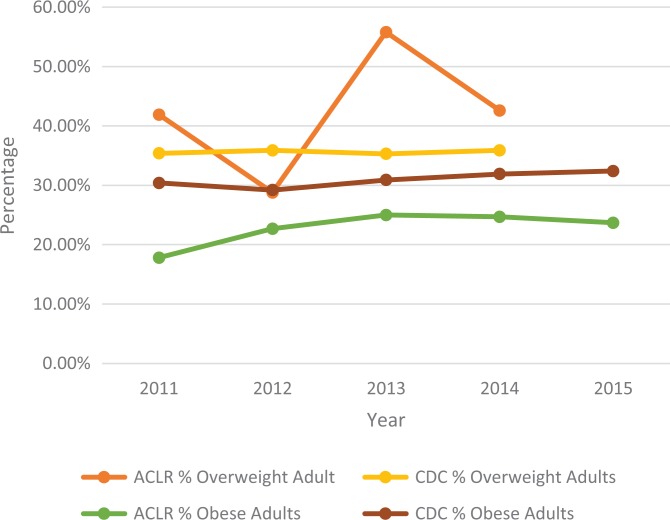
There were 1305 patients (733 male, 572 female; 409 pediatric, 896 adult) included. Adults requiring surgical revision demonstrated a strong positive correlation with respect to BMI over time ( = 0.906, < .01). No other statistically significant trends in the BMI over time were found. The proportion of overweight pediatric patients undergoing ACLR was significantly greater than that of the general overweight pediatric population ( < .05), and the proportion of obese pediatric and adult patients in the general population was greater than that of the obese patients in the study cohort ( < .05).
Between 2005 and 2015, the BMI for pediatric and adult patients who underwent ACLR did not demonstrate a significant change over time. However, there was a statistically significant strong positive correlation for increasing BMI in adult patients requiring revision, although the mean BMI in patients who underwent revision was less than that of the general population. In addition, the percentage of overweight pediatric patients undergoing ACLR was significantly greater than that of the general population of overweight patients in a single US state reported by the CDC.
美国的体重指数(BMI)正在上升,这可能导致前交叉韧带重建(ACLR)率增加。目前尚不清楚接受ACLR的患者的BMI是否也在增加。
确定(1)在10年的合格期内,先前接受过ACLR或翻修ACLR的儿科和成年患者的BMI是否发生变化;(2)儿科或成年患者的BMI变化率是否更高;(3)ACLR人群中超重和肥胖患者的百分比与一般超重人群是否不同。
病例系列;证据级别,4级。
对2005年6月3日至2015年6月3日期间由6位外科医生进行ACLR的患者进行回顾性调查。患者分为儿科(<18岁)和成年(≥18岁)两类。手术时的BMI定义为体重过轻(<18.5kg/m²)、正常(18.5 - 24.9kg/m²)、超重(25.0 - 29.9kg/m²)和肥胖(≥30.0kg/m²)。BMI不确定的患者被排除。将超重和肥胖患者与美国疾病控制与预防中心(CDC)确定的单个美国州的一般人群趋势进行比较。使用Pearson()和Spearman()相关性来确定相关性,使用Student检验进行双变量比较,使用方差分析进行多变量比较,使用协方差分析来比较线性关系。
共纳入1305例患者(男性733例,女性572例;儿科409例,成年896例)。需要手术翻修的成年患者的BMI随时间呈现出很强的正相关性( = 0.906, <.01)。未发现其他随时间变化的BMI有统计学意义的趋势。接受ACLR的超重儿科患者的比例显著高于一般超重儿科人群( <.05),并且一般人群中肥胖儿科和成年患者的比例高于研究队列中的肥胖患者比例( <.05)。
在2005年至2015年期间,接受ACLR的儿科和成年患者的BMI随时间未显示出显著变化。然而,需要翻修的成年患者的BMI增加存在统计学意义的强正相关性,尽管接受翻修的患者的平均BMI低于一般人群。此外,接受ACLR的超重儿科患者的百分比显著高于CDC报告的单个美国州的一般超重患者人群。