Jakab András, Tuura Ruth, Kottke Raimund, Kellenberger Christian J, Scheer Ianina
1Center for MR-Research, University Children's Hospital, Steinwiesstrasse 75, 8032 Zurich, Switzerland.
2Computational Imaging Research Lab (CIR), Department of Biomedical Imaging and Image-guided Therapy, Medical University of Vienna, Lazarettgasse 14, 1090 Vienna, Austria.
Eur Radiol Exp. 2017;1(1):26. doi: 10.1186/s41747-017-0031-4. Epub 2017 Dec 22.
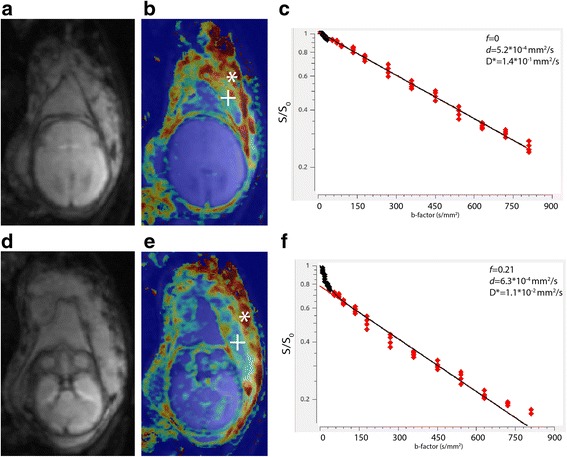
Our purpose was to test the within-subject (test-retest) reproducibility of the perfusion fraction, diffusion coefficient, and pseudo-diffusion coefficient measurements in various foetus organs and in the placenta based on the intra-voxel incoherent motion (IVIM) principle.
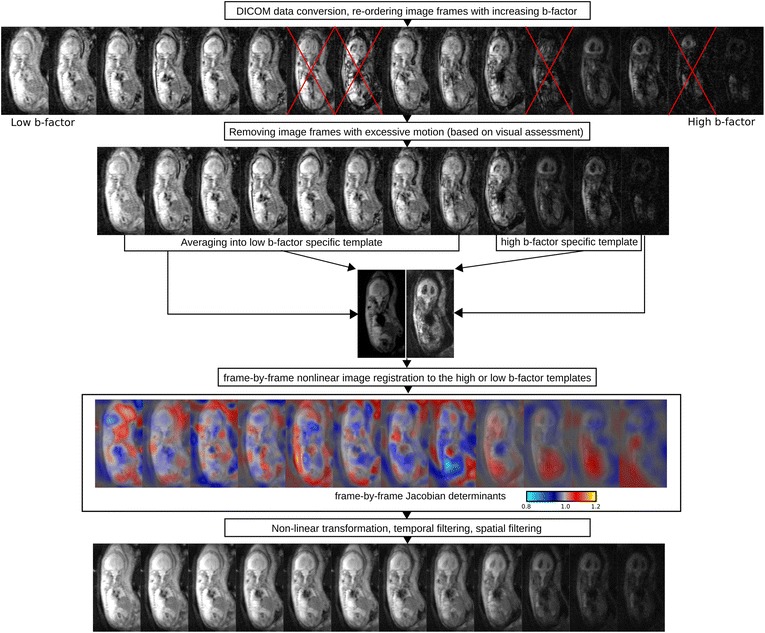
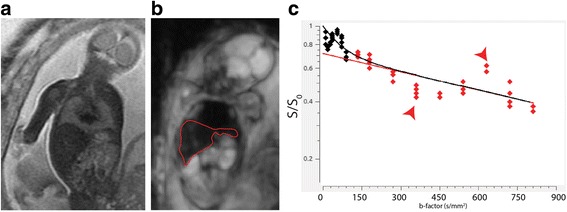
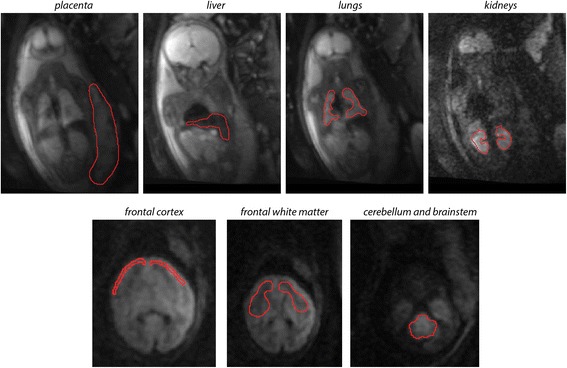
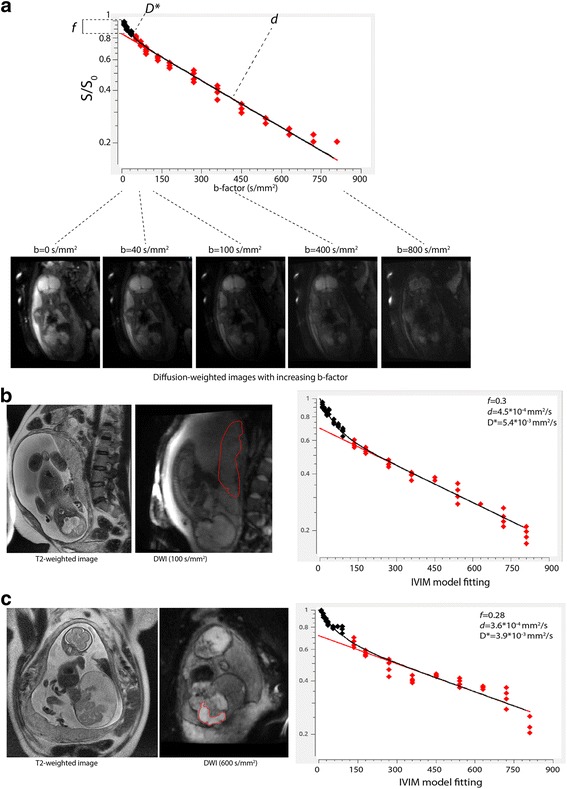
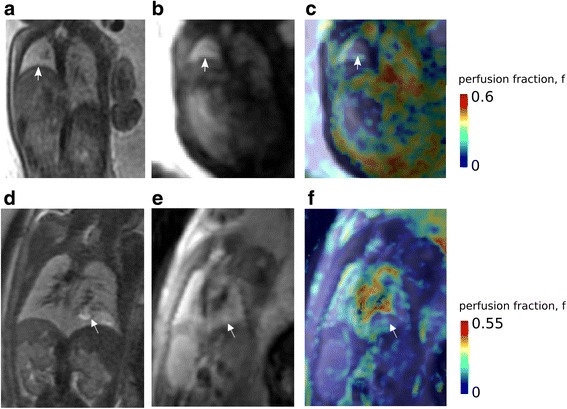
In utero diffusion-weighted IVIM magnetic resonance imaging (MRI) was performed in 15 pregnant women (pregnancy age 21-36 weeks) on 1.5-T and 3.0-T clinical scanners with b-factors in the range of 0-900 s/mm in 16 steps. A bi-exponential model was fitted on the volume-averaged diffusion values. Perfusion fraction (f), diffusion coefficient (d), and pseudo-diffusion coefficient (D*) were calculated. Within-subject reproducibility was evaluated as test-retest variability (VAR %) of the IVIM parameters in the foetal frontal cortex, frontal white matter, cerebellum, lungs, kidneys, liver, and in the placenta.
For the foetal lungs, liver and the placenta, test-retest variability was in the range of 14-20% for f, 12-14% for d, and 17-25% for D*. The diffusion coefficients of the investigated brain regions were moderately to highly reproducible (VAR 5-15%). However, f and D* showed inferior reproducibility compared to corresponding measures for the lungs, liver, and placenta. The IVIM parameters of the foetal kidney were revealed to be highly variable across scans.
IVIM MRI potentially provides a novel method for examining microvascular perfusion and diffusion in the developing human foetus. However, reproducibility of perfusion and diffusion parameters depends greatly upon data quality, foetal and maternal movements, and foetal-specific image post-processing.
我们的目的是基于体素内不相干运动(IVIM)原理,测试灌注分数、扩散系数和伪扩散系数测量在各种胎儿器官和胎盘中的受试者内(重测)重复性。
对15名孕妇(孕龄21 - 36周)在1.5T和3.0T临床扫描仪上进行子宫内扩散加权IVIM磁共振成像(MRI),b值范围为0 - 900 s/mm,共16步。对体积平均扩散值拟合双指数模型。计算灌注分数(f)、扩散系数(d)和伪扩散系数(D*)。通过IVIM参数在胎儿额叶皮质、额叶白质、小脑、肺、肾、肝以及胎盘中的重测变异性(VAR%)评估受试者内重复性。
对于胎儿肺、肝和胎盘,f的重测变异性在14 - 20%范围内,d为12 - 14%,D为17 - 25%。所研究脑区的扩散系数具有中度到高度的重复性(VAR 5 - 15%)。然而,与肺、肝和胎盘的相应测量相比,f和D的重复性较差。胎儿肾脏的IVIM参数在各次扫描中显示出高度变异性。
IVIM MRI可能为研究发育中的人类胎儿的微血管灌注和扩散提供一种新方法。然而,灌注和扩散参数的重复性在很大程度上取决于数据质量、胎儿和母体运动以及胎儿特异性图像后处理。