Department of Public Health, Graduate School of Medicine, The University of Tokyo.
Department of Social and Behavioral Sciences, Harvard T.H. Chan School of Public Health.
J Epidemiol. 2018 Nov 5;28(11):452-457. doi: 10.2188/jea.JE20170152. Epub 2018 Apr 28.
Participation in community activities (eg, sports and hobby groups or volunteer organizations) is believed to be associated with better health status in the older population. We sought to (1) determine whether a greater diversity of group membership is associated with better self-rated health and (2) identify the key dimension of the membership diversity (eg, gender, residential area, or age).
We performed a cross-sectional study of 129,740 participants aged 65 years and older who were enrolled in the Japan Gerontological Evaluation Study in 2013. We assessed the diversity of group membership using (1) a continuous variable (range 0-4) accounting for the total degree of each diversity dimension or (2) dummy variables for each dimension. We estimated prevalence ratios (PRs) and 95% confidence intervals (CIs) for better self-rated health according to the diversity of group membership, using Poisson regression and robust variance with multiple imputation, adjusted for other covariates.
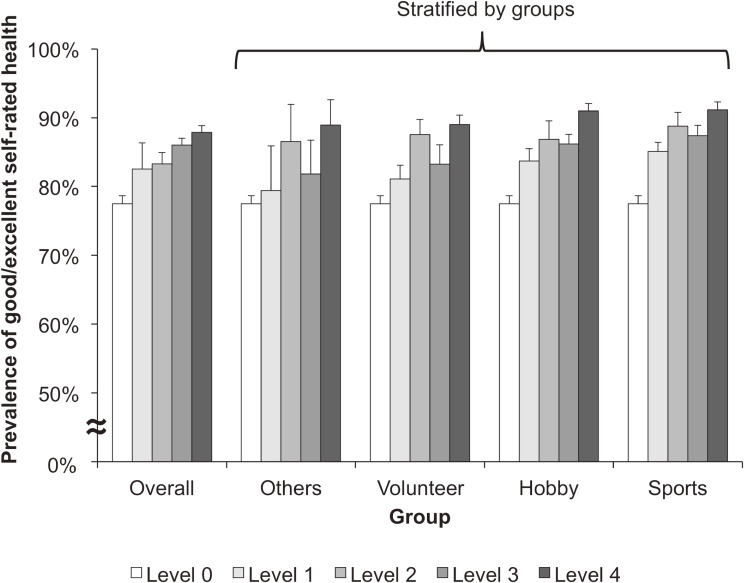
The participants involved in social groups with greater diversity had better self-rated health: the PR per one point unit increase in diversity was 1.03 (95% CI, 1.02-1.04). Participation in gender-diverse groups was associated with the best profile of health (PR 1.07; 95% CI, 1.04-1.09).
Among the older population in Japan, higher group diversity is associated with better self-rated health. Gender is the key dimension of diversity that is associated with better self-rated health.
参与社区活动(例如,体育和兴趣小组或志愿者组织)被认为与老年人群体更好的健康状况有关。我们试图(1)确定更多样化的群体参与是否与更好的自我评估健康状况相关,(2)确定成员多样性的关键维度(例如,性别、居住区域或年龄)。
我们对 2013 年参加日本老年评估研究的 129740 名 65 岁及以上的参与者进行了一项横断面研究。我们使用(1)一个连续变量(范围为 0-4)来衡量每个多样性维度的总体程度,或(2)每个维度的虚拟变量来评估群体参与的多样性。我们使用泊松回归和稳健方差进行多重插补,调整了其他协变量,根据群体参与多样性估计了更好的自我评估健康的患病率比(PR)和 95%置信区间(CI)。
参与多样性更高的社会团体的参与者自我评估的健康状况更好:多样性每增加一个单位,PR 为 1.03(95%CI,1.02-1.04)。参与性别多样化的团体与最佳健康状况相关(PR 为 1.07;95%CI,1.04-1.09)。
在日本的老年人群体中,更高的群体多样性与更好的自我评估健康状况相关。性别是与更好的自我评估健康状况相关的多样性的关键维度。