Department of Experimental Research, State Key Laboratory of Oncology in South China, Collaborative Innovation Center for Cancer Medicine, Sun Yat-Sen University Cancer Center, 651 Dongfeng Road East, Guangzhou, 510060, China.
YinZhou hospital affiliated to medical school of NingBo University, NingBo, 315000, ZheJiang Province, China.
J Exp Clin Cancer Res. 2018 May 2;37(1):97. doi: 10.1186/s13046-018-0765-8.
Gastric cancer is the leading cause of cancer related death worldwide. Radiation alone or combined with chemotherapy plays important role in locally advanced and metastatic gastric adenocarcinoma. MDM2-p53 interaction and downstream signaling affect cellular response to DNA damage which leads to cell cycle arrest and apoptosis. Therefore, restoring p53 function by inhibiting its interaction with MDM2 is a promising therapeutic strategy for cancer. APG-115 is a novel small molecule inhibitor which blocks the interaction of MDM2 and p53. In this study, we investigated that the radiosensitivity of APG-115 in gastric adenocarcinoma in vitro and in vivo.
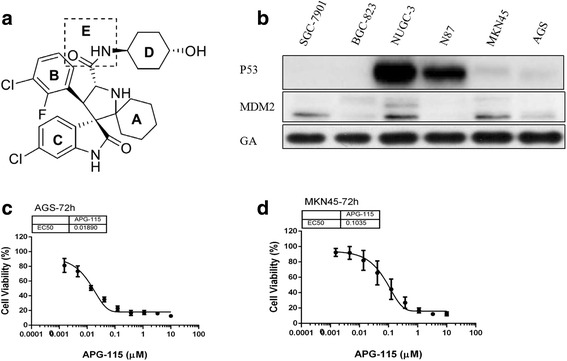
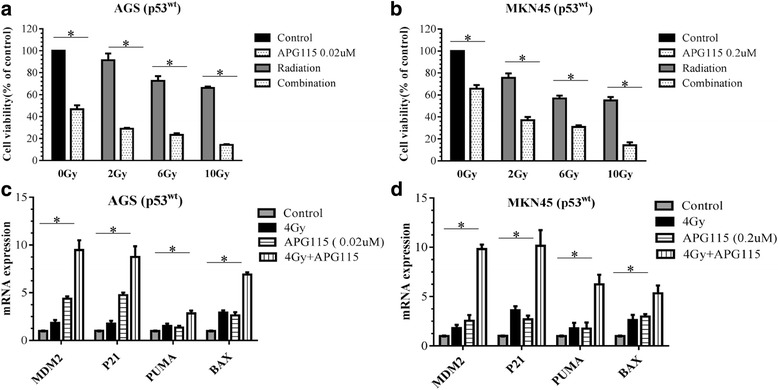
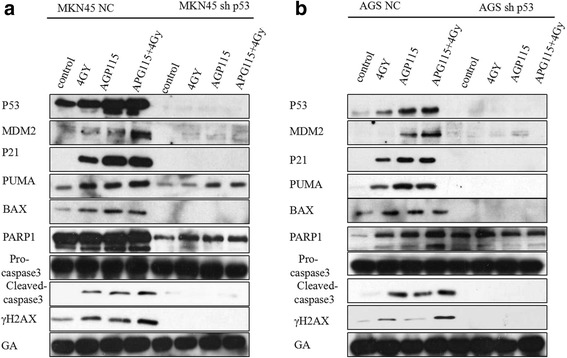
The role of APG-115 in six gastric cancer cells viability in vitro was determined by CCK-8 assay. The expression level of MDM2, p21, PUMA and BAX in AGS and MKN45 cell lines was measured via real-time PCR (RT-PCR). The function of treatment groups on cell cycle and cell apoptosis were detected through Flow Cytometry assay. Clonogenic assays were used to measure the radiosensitivity of APG-115 in p53 wild type gastric cancer cell lines. Western blot was conducted to detect the protein expressions of mdm2-p53 signal pathway. Xenograft models in nude mice were established to explore the radiosensitivity role of APG-115 in gastric cancer cells in vivo.
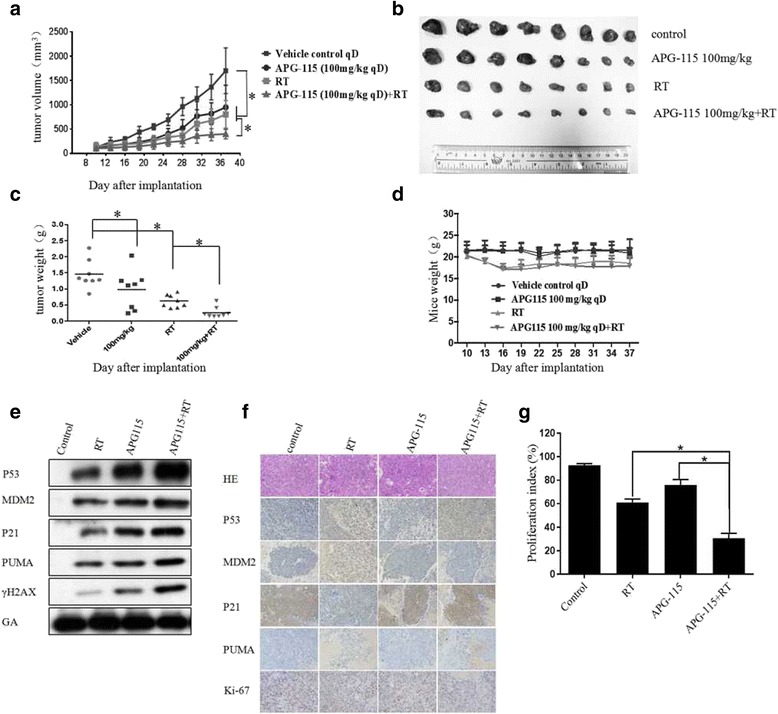
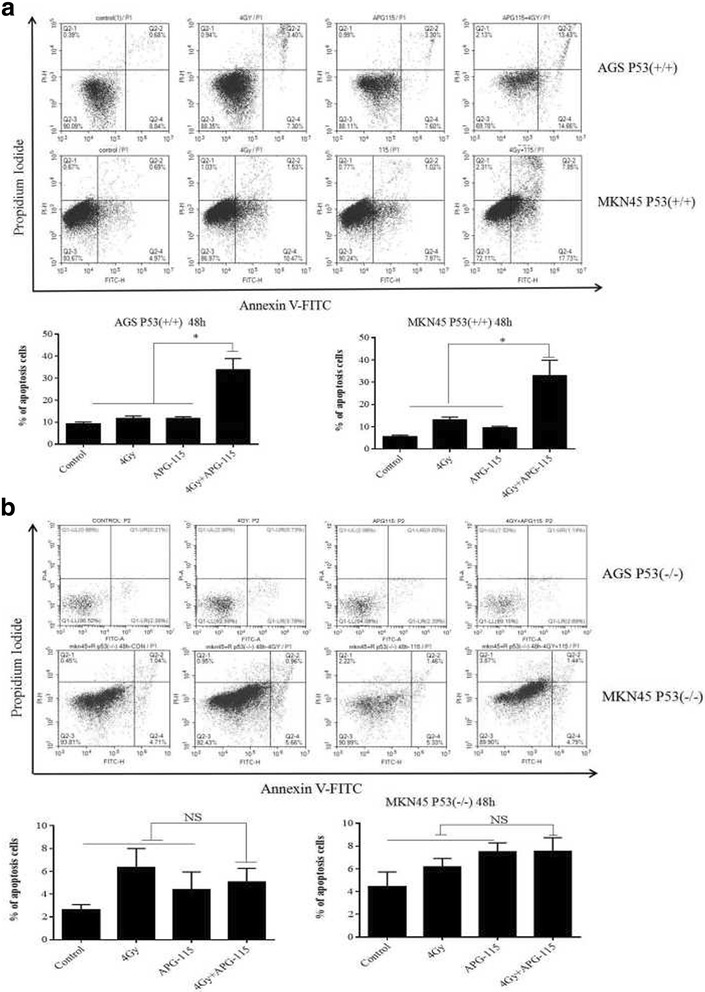
We found that radiosensitization by APG-115 occurred in p53 wild-type gastric cancer cells. Increasing apoptosis and cell cycle arrest was observed after administration of APG-115 and radiation. Radiosensitivity of APG-115 was mainly dependent on MDM2-p53 signal pathway. In vivo, APG-115 combined with radiation decreased xenograft tumor growth much more significantly than either single treatment. Moreover, the number of proliferating cells (Ki-67) significantly decreased in combination group compared with single treatment group.
In summary, we found that combination of MDM2-p53 inhibitor (APG-115) and radiotherapy can enhance antitumor effect both in vitro and in vivo. This is the first report on radiosensitivity of APG-115 which shed light on clinical trial of the combination therapy of radiation with APG-115 in gastric adenocarcinoma.
胃癌是全球癌症相关死亡的主要原因。单独放疗或联合化疗在局部晚期和转移性胃腺癌中发挥重要作用。MDM2-p53 相互作用和下游信号影响细胞对 DNA 损伤的反应,导致细胞周期停滞和细胞凋亡。因此,通过抑制 MDM2 与其相互作用来恢复 p53 功能是癌症的一种有前途的治疗策略。APG-115 是一种新型小分子抑制剂,可阻断 MDM2 和 p53 的相互作用。在这项研究中,我们研究了 APG-115 在体外和体内对胃腺癌的放射敏感性。
通过 CCK-8 测定法确定 APG-115 在六种胃癌细胞活力中的作用。通过实时 PCR(RT-PCR)测量 AGS 和 MKN45 细胞系中 MDM2、p21、PUMA 和 BAX 的表达水平。通过流式细胞术检测治疗组对细胞周期和细胞凋亡的作用。克隆形成试验用于测量 APG-115 在 p53 野生型胃癌细胞系中的放射敏感性。通过 Western blot 检测 mdm2-p53 信号通路的蛋白表达。建立裸鼠异种移植模型以体内探索 APG-115 在胃癌细胞中的放射敏感性作用。
我们发现 APG-115 的放射增敏作用发生在 p53 野生型胃癌细胞中。给予 APG-115 和辐射后观察到凋亡和细胞周期停滞增加。APG-115 的放射敏感性主要取决于 MDM2-p53 信号通路。在体内,APG-115 联合放疗比单独治疗更显著地降低了异种移植肿瘤的生长。此外,与单独治疗组相比,联合组中增殖细胞(Ki-67)的数量明显减少。
总之,我们发现 MDM2-p53 抑制剂(APG-115)与放疗的联合使用可在体外和体内增强抗肿瘤作用。这是关于 APG-115 放射敏感性的首次报道,为在胃腺癌中进行放射联合 APG-115 治疗的临床试验提供了依据。