Division of Pulmonary Medicine, Department of Medicine, Keio University School of Medicine, 35 Shinanomachi, Shinjuku-ku, Tokyo, 160-8582, Japan.
Department of Medicine, Tachikawa Hospital, Tokyo, Japan.
BMC Pulm Med. 2018 May 2;18(1):65. doi: 10.1186/s12890-018-0639-z.
Neutrophil-to-lymphocyte ratio (NLR) is a biomarker of inflammation in chronic obstructive pulmonary disease (COPD) patients. But, a meaningful threshold and the longitudinal changes are unknown. We aimed to investigate the association between NLR and the clinical characteristics of COPD patients and to determine a meaningful threshold and the longitudinal changes for NLR.
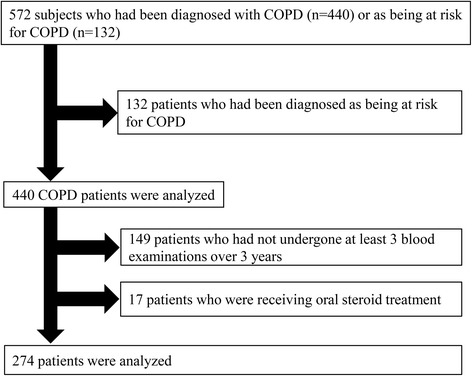
Keio University and its affiliate hospitals conducted an observational COPD cohort study over 3 years. We performed a blood examination and a pulmonary function test. Blood examination was completed at baseline and annually thereafter, at a time when the disease was stable. Two hundred seventy-four patients who had at least 3 blood examinations over 3 years were included.
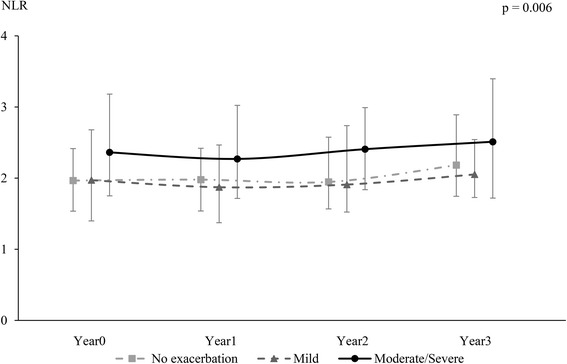
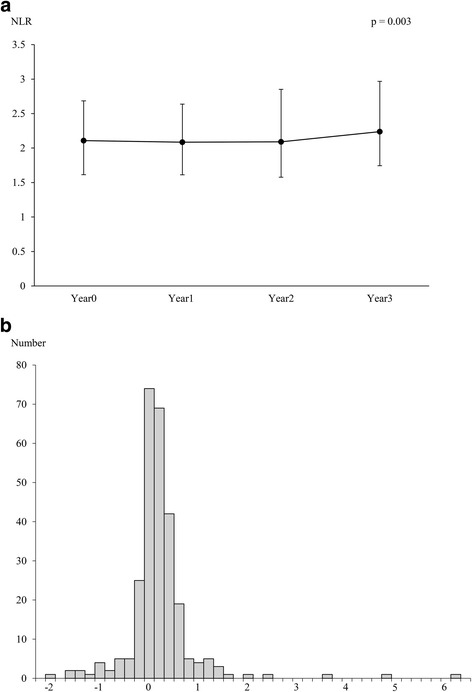
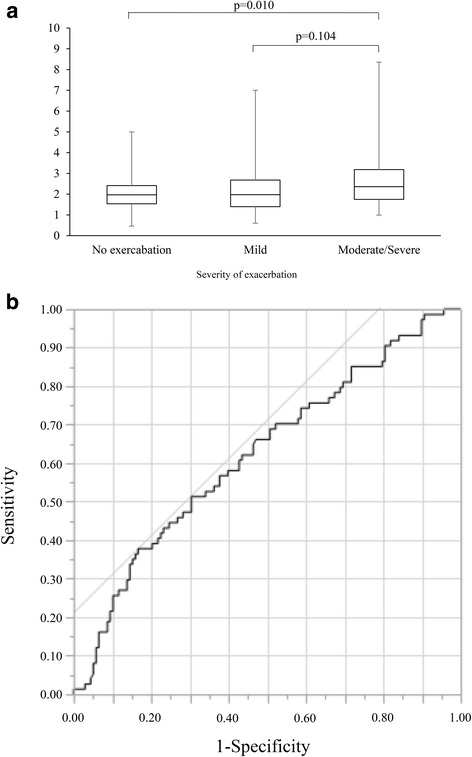
Baseline NLR was correlated with baseline C-reactive protein (CRP) (r = 0.18, p = 0.003) and SAA (r = 0.34, p < 0.001). We defined an NLR score of 2.7 as the arbitrary cut-off value based on upper quartile points. COPD patients with NLR ≥ 2.7 were older (p = 0.037), had a lower BMI (p = 0.005) and a lower %FEV1 (p = 0.0003) compared to patients with NLR < 2.7. Receiver-operating-characteristic (ROC) curves showed the optimal cutoff for the baseline NLR in the predicting moderate/severe exacerbation to be 2.7, which was same as the upper quartile points. Follow-up analysis over 3 years revealed that the differences in the trends of NLR among the three groups based on the categories of exacerbations (moderate or severe, mild, no exacerbation) were significant (p = 0.006).
NLR is associated with COPD severity and exacerbations. For predicting exacerbations, we estimated the threshold of NLR to be 2.7 at baseline.
Clinical trial registered with the University Hospital Medication Information Network ( UMIN000003470 , April 10, 2010).
中性粒细胞与淋巴细胞比值(NLR)是慢性阻塞性肺疾病(COPD)患者炎症的生物标志物。但是,其有意义的阈值和纵向变化尚不清楚。我们旨在研究 NLR 与 COPD 患者临床特征的关系,并确定 NLR 的有意义阈值和纵向变化。
庆应义塾大学及其附属医院进行了一项为期 3 年的 COPD 观察性队列研究。我们进行了血液检查和肺功能检查。血液检查在基线时完成,并在此后每年在疾病稳定时进行。共有 274 名患者在 3 年内至少进行了 3 次血液检查。
基线 NLR 与基线 C 反应蛋白(CRP)(r = 0.18,p = 0.003)和 SAA(r = 0.34,p < 0.001)相关。我们将 NLR 评分 2.7 定义为基于上四分位数点的任意截止值。NLR≥2.7 的 COPD 患者比 NLR<2.7 的患者年龄更大(p = 0.037)、BMI 更低(p = 0.005)和 %FEV1 更低(p = 0.0003)。ROC 曲线显示预测中重度加重的基线 NLR 的最佳截断值为 2.7,与上四分位数点相同。3 年的随访分析显示,基于加重类别(中重度、轻度、无加重),NLR 趋势在三组之间的差异具有统计学意义(p = 0.006)。
NLR 与 COPD 严重程度和加重有关。为了预测加重,我们估计 NLR 的阈值在基线时为 2.7。
临床试验于 2010 年 4 月 10 日在大学医院药物信息网络(UMIN000003470)注册。