Department of Internal Medicine 3-Rheumatology and Immunology, Friedrich-Alexander-University Erlangen-Nürnberg (FAU), Universitätsklinikum Erlangen, 91054, Erlangen, Germany.
Arthritis Res Ther. 2018 May 2;20(1):88. doi: 10.1186/s13075-018-1583-2.
ADAMTS aggrecanases play a major role in cartilage degeneration during degenerative and inflammatory arthritis. The cartilage-specific secreted protein Upper zone of growth plate and cartilage matrix associated protein (Ucma) has been shown to block ADAMTS-triggered aggrecanolysis in experimental osteoarthritis. Here we aimed to investigate whether and how Ucma may affect cartilage destruction and osteophyte formation in the context of inflammatory arthritis.
Ucma-ADAMTS5 protein interactions were studied using slot blot and solid phase binding assays. Chondrocyte cultures were stimulated with ADAMTS5 or IL-1β in the presence or absence of Ucma and aggrecanolysis was assessed by neoepitope formation. Arthritis was induced by transfer of K/BxN serum into wild-type (WT), Ucma-deficient and WT mice treated with recombinant Ucma. Cartilage proteoglycan loss and cartilage damage was assessed by safranin-O stain, aggrecanase-induced neoepitope formation and histomorphometry, respectively. Osteophytes were assessed by histomorphometry, micro-computed tomography, RNA in-situ hybridisation for collagen10a1 and osteocalcin, and staining for TRAP activity. Gene expression analyses were performed using real-time RT-PCR.
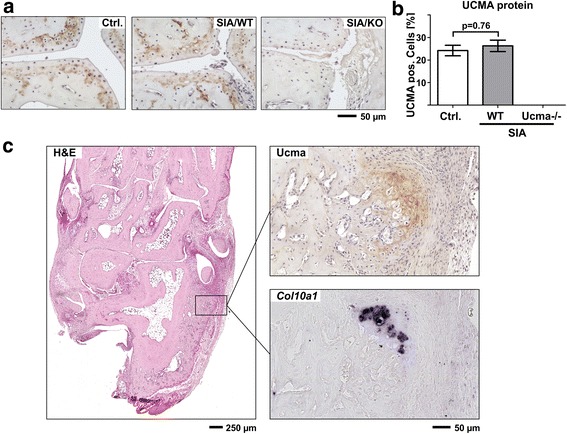
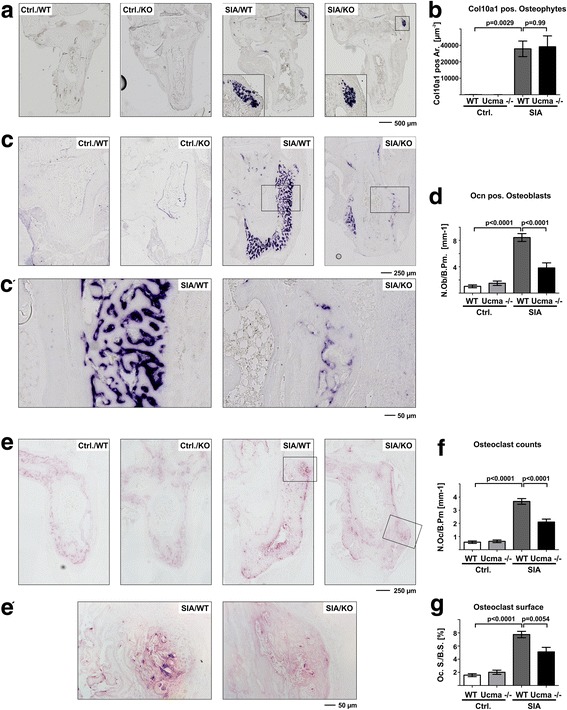
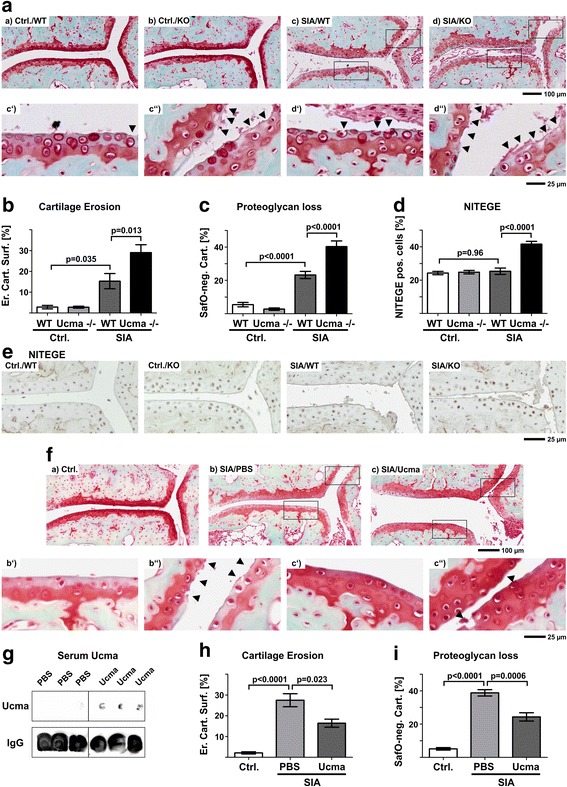
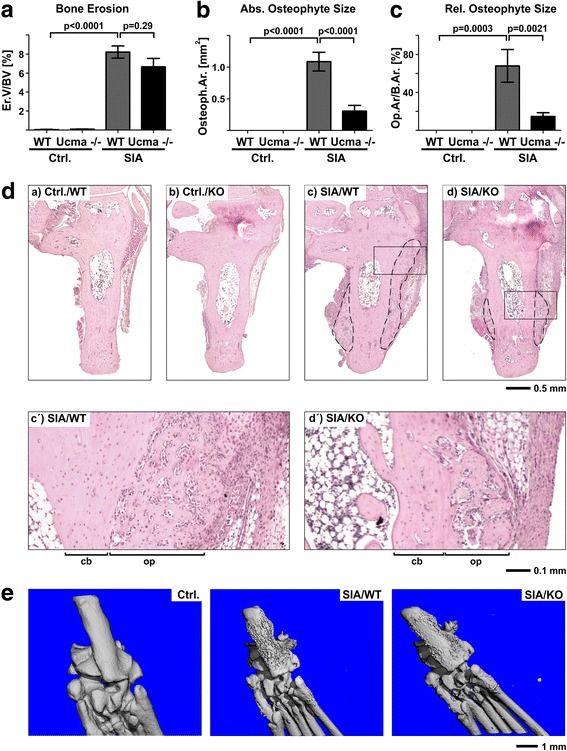
Ucma physically interacted with ADAMTS5 and blocked its aggrecanase activity in chondrocyte cultures. Ucma was highly expressed in the articular cartilage and in osteophytes during arthritis. Ucma had no effect on inflammation and bone erosion. In contrast, Ucma-deficient mice developed significantly more severe cartilage proteoglycan loss and cartilage destruction. Conversely, treatment with Ucma inhibited cartilage degeneration in arthritis. Ucma effectively inhibited ADAMTS5-triggered or IL-1β-triggered aggrecanolysis in vitro and in vivo. Furthermore, osteophyte formation was reduced in Ucma-deficient mice.
These results indicate that Ucma inhibits aggrecanolysis by physical interaction with ADAMTS5 and protects from cartilage degeneration in inflammatory arthritis. Ucma therefore represents an interesting novel and specific target for preventing cartilage degradation in the context of inflammatory arthritis.
ADAMTS 聚集素酶在退行性和炎症性关节炎期间的软骨退变中起主要作用。已表明软骨特异性分泌蛋白生长板上区和软骨基质相关蛋白(Ucma)可阻断实验性骨关节炎中 ADAMTS 触发的聚集素降解。在此,我们旨在研究 Ucma 是否以及如何影响炎症性关节炎背景下的软骨破坏和骨赘形成。
使用槽印迹和固相结合测定法研究 Ucma-ADAMTS5 蛋白相互作用。用 ADAMTS5 或 IL-1β刺激软骨细胞培养物,并在存在或不存在 Ucma 的情况下评估聚集素降解,通过新表位形成进行评估。通过将 K/BxN 血清转移到野生型(WT)、Ucma 缺陷型和用重组 Ucma 治疗的 WT 小鼠中来诱导关节炎。通过番红 O 染色、聚集素酶诱导的新表位形成和组织形态计量学分别评估软骨蛋白聚糖丢失和软骨损伤。通过组织形态计量学、微计算机断层扫描、胶原 10a1 和骨钙素的 RNA 原位杂交以及 TRAP 活性染色评估骨赘。使用实时 RT-PCR 进行基因表达分析。
Ucma 与 ADAMTS5 物理相互作用并在软骨细胞培养物中阻断其聚集素酶活性。Ucma 在关节炎期间在关节软骨和骨赘中高度表达。Ucma 对炎症和骨侵蚀没有影响。相反,Ucma 缺陷型小鼠出现明显更严重的软骨蛋白聚糖丢失和软骨破坏。相反,Ucma 治疗抑制了关节炎中的软骨退化。Ucma 有效抑制了体外和体内 ADAMTS5 触发或 IL-1β 触发的聚集素降解。此外,Ucma 缺陷型小鼠的骨赘形成减少。
这些结果表明,Ucma 通过与 ADAMTS5 的物理相互作用抑制聚集素降解,并防止炎症性关节炎中的软骨退变。因此,Ucma 代表了一种有前途的新型和特异性靶点,可用于预防炎症性关节炎中软骨降解。