Mansu Suzi S Y, Liang Haiying, Parker Shefton, Coyle Meaghan E, Wang Kaiyi, Zhang Anthony L, Guo Xinfeng, Lu Chuanjian, Xue Charlie C L
China-Australia International Research Centre for Chinese Medicine, School of Health and Biomedical Sciences, RMIT University, P.O. Box 71, Bundoora, VIC 3083, Australia.
Guangdong Provincial Hospital of Chinese Medicine, Guangdong Provincial Academy of Chinese Medical Sciences and The Second Clinical College, Guangzhou University of Chinese Medicine, Guangzhou, China.
Evid Based Complement Alternat Med. 2018 Mar 12;2018:4806734. doi: 10.1155/2018/4806734. eCollection 2018.
To conduct a systematic review and meta-analysis to determine the current best available evidence of the efficacy and safety of acupuncture and related therapies for acne vulgaris.
Eleven English and Chinese databases were searched to identify randomized controlled trials (RCTs) of acne vulgaris compared to pharmacotherapies, no treatment, and sham or placebo acupuncture. Methodological quality was assessed using Cochrane Collaboration's risk of bias tool. Meta-analysis was conducted using RevMan software.
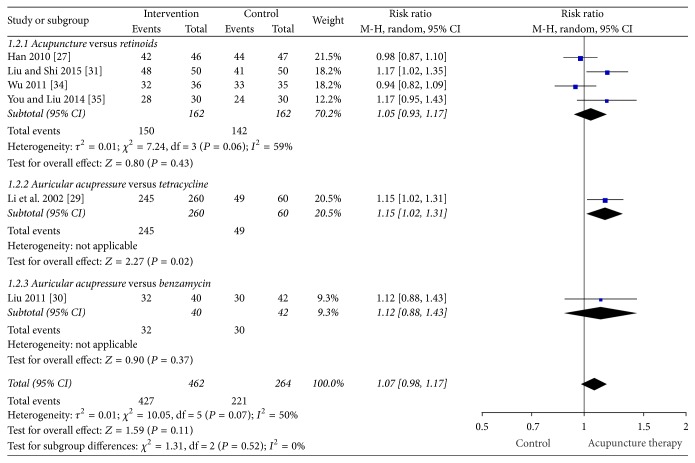
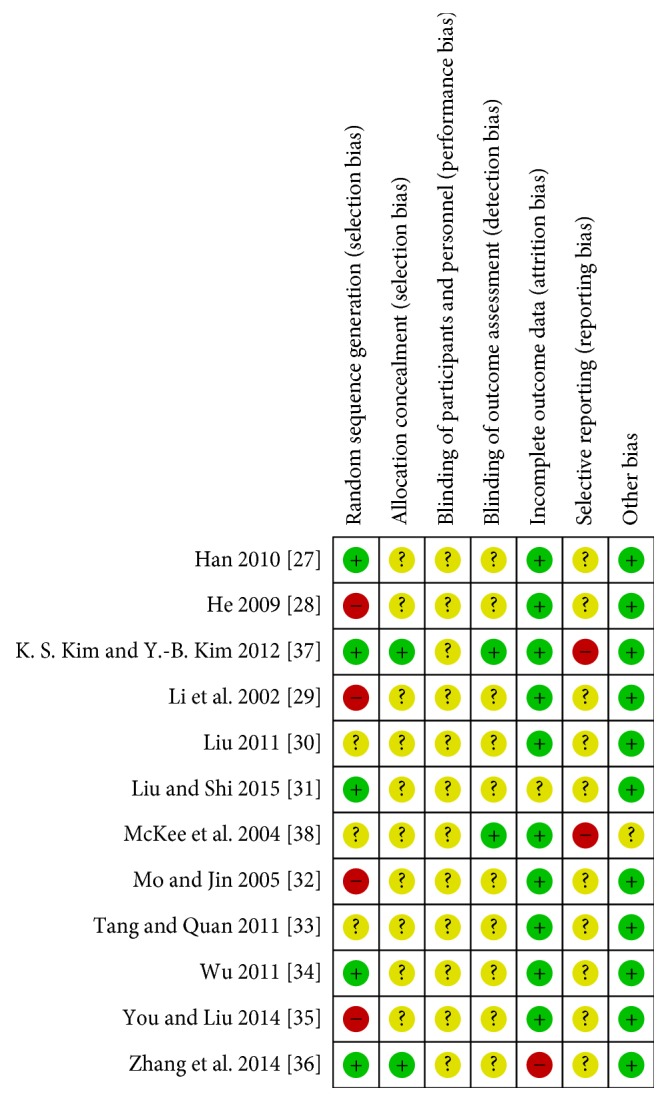
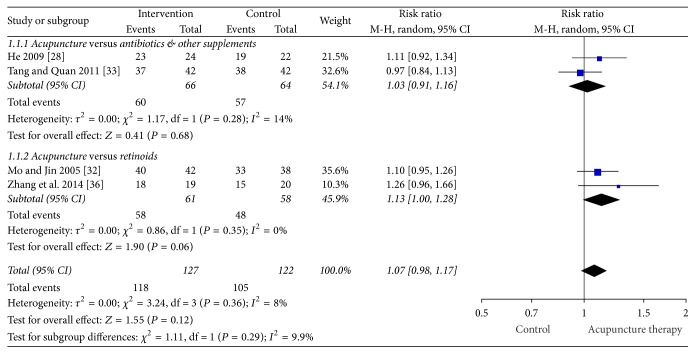
Twelve RCTs were included in the qualitative review and 10 RCTs were included in meta-analysis. Methodological quality of trials was generally low. The chance of achieving ≥30% change in lesion count in the acupuncture group was no different to the pharmacotherapy group (RR: 1.07 [95% CI 0.98, 1.17]; = 8%) and ≥50% change in lesion count in the acupuncture group was not statistically different to the pharmacotherapy group (RR: 1.07 [95% CI 0.98, 1.17]; = 50%).
While caution should be exercised due to quality of the included studies, acupuncture and auricular acupressure were not statistically different to guideline recommended treatments but were with fewer side effects and may be a treatment option. Future trials should address the methodological weaknesses and meet standard reporting requirements stipulated in STRICTA.
进行一项系统评价和荟萃分析,以确定目前关于针灸及相关疗法治疗寻常痤疮的疗效和安全性的最佳现有证据。
检索了11个英文和中文数据库,以识别将寻常痤疮的随机对照试验(RCT)与药物治疗、不治疗以及假针刺或安慰剂针刺进行比较的研究。使用Cochrane协作网的偏倚风险工具评估方法学质量。使用RevMan软件进行荟萃分析。
定性评价纳入了12项RCT,荟萃分析纳入了10项RCT。试验的方法学质量普遍较低。针刺组皮损计数变化≥30%的可能性与药物治疗组无差异(风险比:1.07[95%置信区间0.98,1.17];P=8%),针刺组皮损计数变化≥50%与药物治疗组无统计学差异(风险比:1.07[95%置信区间0.98,1.17];P=50%)。
鉴于纳入研究的质量,应谨慎行事,针刺和耳穴按压与指南推荐的治疗方法在统计学上无差异,但副作用较少,可能是一种治疗选择。未来的试验应解决方法学上的弱点,并符合STRICTA规定的标准报告要求。