Department of Obstetrics and Gynecology, Ruhr-Universität Bochum, Bochum, Germany.
Department of Pathology, Ruhr-Universität Bochum, Bochum, Germany.
BMC Cancer. 2018 May 4;18(1):530. doi: 10.1186/s12885-018-4447-x.
Neuroendocrine carcinoma of the cervix (NECC) is a rare variant of cervical cancer. The prognosis of women with NECC is poor and there is no standardized therapy for this type of malignancy based on controlled trials.
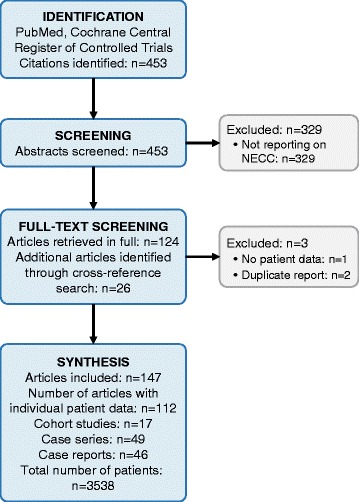
We performed a systematic literature search of the databases PubMed and Cochrane Central Register of Controlled Trials to identify clinical trials describing the management and outcome of women with NECC.
Three thousand five hundred thirty-eight cases of NECC in 112 studies were identified. The pooled proportion of NECC among women with cervical cancer was 2303/163470 (1.41%). Small cell NECC, large cell NECC, and other histological subtypes were identified in 80.4, 12.0, and 7.6% of cases, respectively. Early and late stage disease presentation were evenly distributed with 1463 (50.6%) and 1428 (49.4%) cases, respectively. Tumors expressed synaptophysin (424/538 cases; 79%), neuron-specific enolase (196/285 cases; 69%), chromogranin (323/486 cases; 66%), and CD56 (162/267; 61%). The most common primary treatment was radical surgery combined with chemotherapy either as neoadjuvant or adjuvant chemotherapy, described in 42/48 studies. Radiotherapy-based primary treatment schemes in the form of radiotherapy, radiochemotherapy, or radiotherapy with concomitant or followed by chemotherapy were also commonly used (15/48 studies). There is no standard chemotherapy regimen for NECC, but cisplatin/carboplatin and etoposide (EP) was the most commonly used treatment scheme (24/40 studies). Overall, the prognosis of women with NECC was poor with a mean recurrence-free survival of 16 months and a mean overall survival of 40 months. Immune checkpoint inhibitors and targeted agents were reported as being active in three case reports.
NECC is a rare variant of cervical cancer with a poor prognosis. Multimodality treatment with radical surgery and neoadjuvant/adjuvant chemotherapy with cisplatin and etoposide with or without radiotherapy is the mainstay of treatment for early stage disease while chemotherapy with cisplatin and etoposide or topotecan, paclitaxel, and bevacizumab is appropriate for women with locally advanced or recurrent NECC. Immune checkpoint inhibitors may be beneficial, but controlled evidence for their efficacy is lacking.
宫颈神经内分泌癌(NECC)是一种罕见的宫颈癌变体。患有 NECC 的女性预后较差,并且没有基于对照试验的针对这种恶性肿瘤的标准化治疗方法。
我们对 PubMed 和 Cochrane 对照试验中心注册数据库进行了系统的文献检索,以确定描述 NECC 女性管理和结局的临床试验。
在 112 项研究中发现了 3538 例 NECC。在宫颈癌患者中,NECC 的合并比例为 2303/163470(1.41%)。小细胞 NECC、大细胞 NECC 和其他组织学亚型分别占 80.4%、12.0%和 7.6%。早期和晚期疾病表现分布均匀,分别有 1463 例(50.6%)和 1428 例(49.4%)。肿瘤表达突触素(538 例中有 424 例;79%)、神经元特异性烯醇化酶(285 例中有 196 例;69%)、嗜铬粒蛋白(486 例中有 323 例;66%)和 CD56(267 例中有 162 例;61%)。最常见的主要治疗方法是根治性手术联合化疗,无论是新辅助化疗还是辅助化疗,在 48 项研究中有 42 项进行了描述。以放疗、放化疗或放疗联合同时或随后的化疗为主要治疗方案的放疗也很常用(48 项研究中有 15 项)。对于 NECC,没有标准的化疗方案,但顺铂/卡铂和依托泊苷(EP)是最常用的治疗方案(40 项研究中有 24 项)。总的来说,患有 NECC 的女性预后较差,无复发生存期平均为 16 个月,总生存期平均为 40 个月。有 3 例病例报告称免疫检查点抑制剂和靶向药物有效。
NECC 是宫颈癌的一种罕见变体,预后较差。根治性手术联合新辅助/辅助化疗,使用顺铂和依托泊苷,加或不加放疗,是早期疾病的主要治疗方法,而顺铂和依托泊苷或拓扑替康、紫杉醇和贝伐单抗化疗适用于局部晚期或复发性 NECC 的女性。免疫检查点抑制剂可能有效,但缺乏对其疗效的对照证据。