Xie Ning, Yu Haijuan, Lin Jie, Deng Sufang, Liu Linying, Sun Yang
Department of Gynecology, Clinical Oncology School of Fujian Medical University, Fujian Cancer Hospital, Fuzhou, Fujian, China.
Front Oncol. 2025 Jan 31;15:1463422. doi: 10.3389/fonc.2025.1463422. eCollection 2025.
Neuroendocrine carcinoma of the cervix (NECC) is a rare and highly aggressive subtype of cervical carcinomas with poor prognosis. NECC tends to occur in young age which could severely impair mental and physical health of young patients. Therefore, this study aims to develop an individualized prognostic nomogram for young NECC patients.
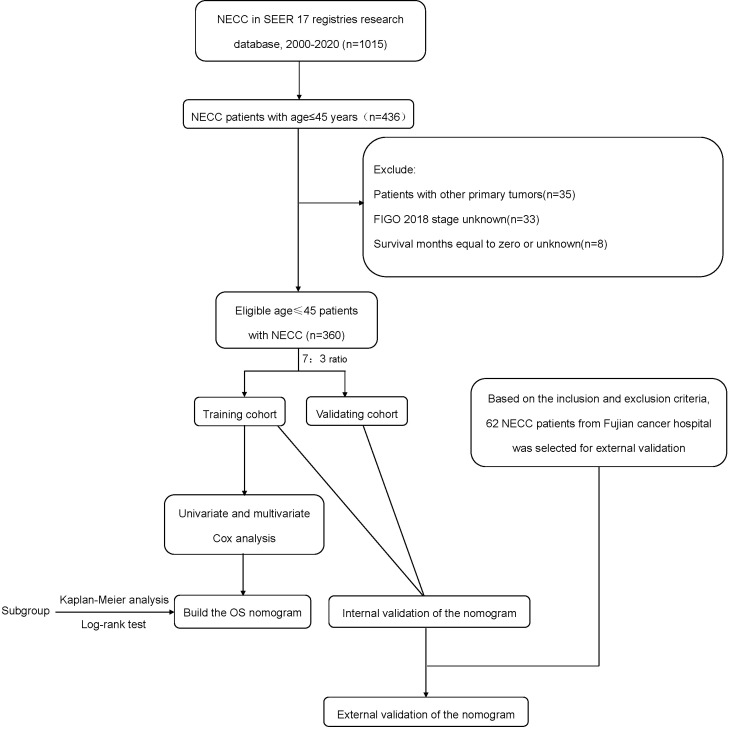
360 young (≤45 years old) NECC patients were retrospectively selected from the Surveillance, Epidemiology and End Results (SEER) database and were randomly located to a training cohort and an internal validation cohort in a ratio of 7:3. Data from Fujian Cancer Hospital was used as an external validation cohort. Independent prognostic factors were identified by univariate and multivariate Cox regression analysis, and a prognostic nomogram for young NECC was developed. The predictive accuracy and clinical utility of the nomogram were assessed by area under the time-dependent receiver operating characteristic (timeROC) curve (AUC), the concordance index (C-index), calibration plots, and decision curve analysis (DCA). Finally, a simplified scoring system for clinical use was constructed by dividing patients into high-risk and low-risk groups.
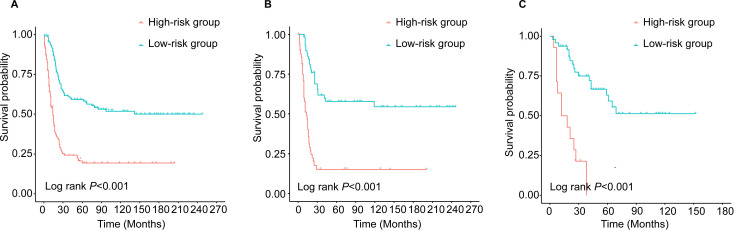
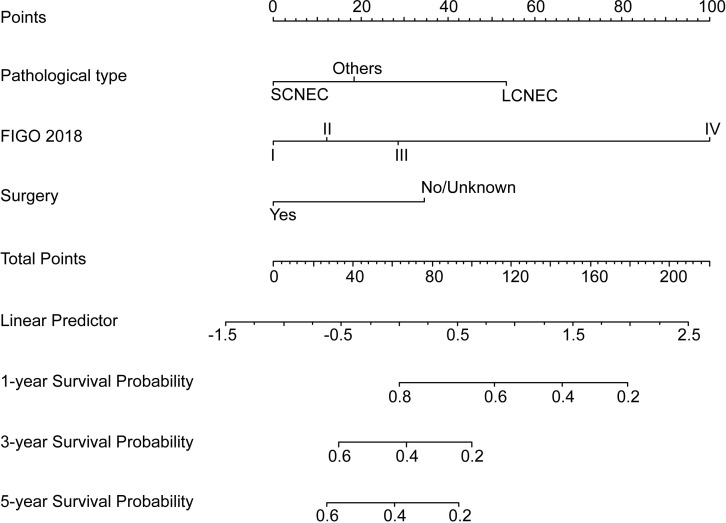
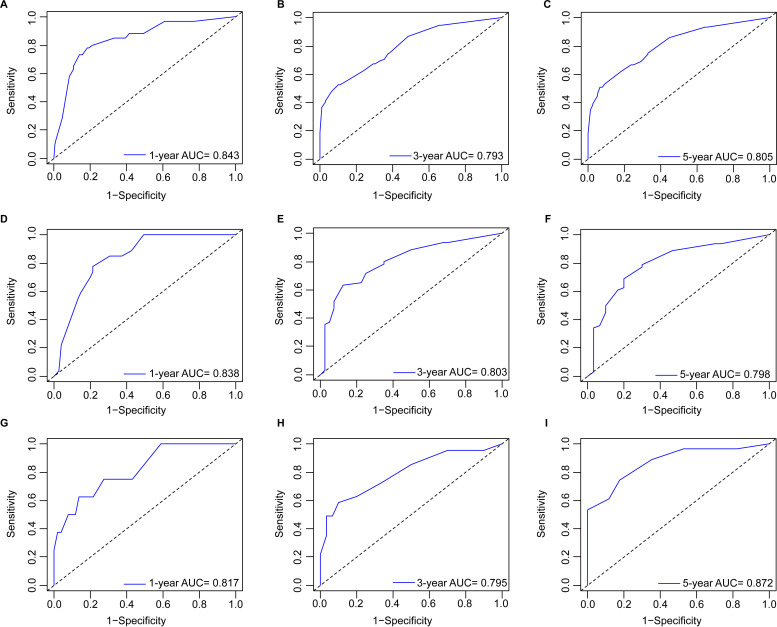
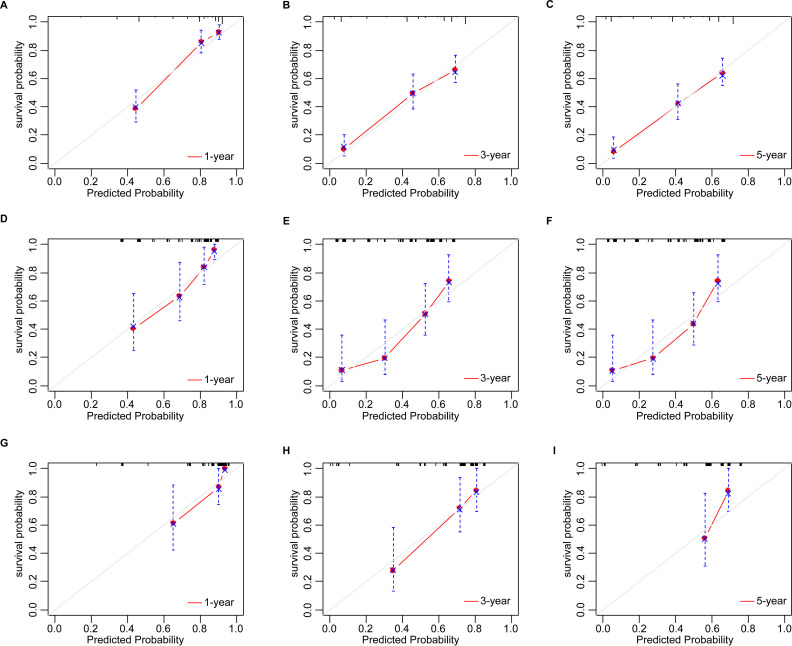
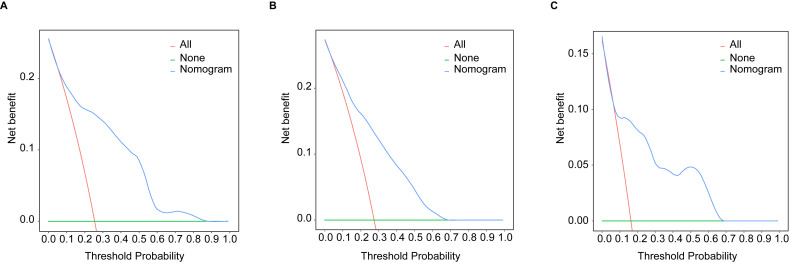
Pathological type, FIGO stage, and surgery were independent risk factors by univariate and multivariate analysis ( < 0.05). The prognostic nomogram consisting of the above three independent risk factors had high accuracy. The AUC values of 5-year overall survival (OS) in the training, internal validation, and external validation cohorts were 0.805, 0.798 and 0.872, respectively. The prognostic nomogram also presented with good C-index and calibration plots. The DCA curve further confirmed that the nomogram had a high clinical net benefit. According to the median prognostic index (median PI=18.6), all patients were categorized into high-risk group and low-risk group. The 5-year OS of the high-risk NECC group was significantly worse than that of the low-risk group among three cohorts (<0.05).
Pathological type, FIGO stage, and surgery were identified as independent prognostic risk factors for young NECC patients. Based on the nomogram, gynecologic oncologists can accurately and easily predict the prognosis of young NECC and provide scientific guidance for individualized treatment.
宫颈神经内分泌癌(NECC)是一种罕见且侵袭性很强的宫颈癌亚型,预后较差。NECC 倾向于发生在年轻患者中,这可能会严重损害年轻患者的身心健康。因此,本研究旨在为年轻 NECC 患者开发一种个体化的预后列线图。
从监测、流行病学和最终结果(SEER)数据库中回顾性选取 360 名年轻(≤45 岁)NECC 患者,并按 7:3 的比例随机分为训练队列和内部验证队列。来自福建肿瘤医院的数据用作外部验证队列。通过单因素和多因素 Cox 回归分析确定独立预后因素,并开发年轻 NECC 的预后列线图。通过时间依赖性受试者操作特征(timeROC)曲线下面积(AUC)、一致性指数(C 指数)、校准图和决策曲线分析(DCA)评估列线图的预测准确性和临床实用性。最后,通过将患者分为高危和低危组构建了临床使用的简化评分系统。
单因素和多因素分析显示,病理类型、国际妇产科联盟(FIGO)分期和手术是独立危险因素(<0.05)。由上述三个独立危险因素组成的预后列线图具有较高的准确性。训练队列、内部验证队列和外部验证队列中 5 年总生存期(OS)的 AUC 值分别为 0.805、0.798 和 0.872。预后列线图还具有良好的 C 指数和校准图。DCA 曲线进一步证实列线图具有较高的临床净效益。根据中位预后指数(中位 PI =
18.6),将所有患者分为高危组和低危组。在三个队列中,高危 NECC 组的 5 年 OS 明显差于低危组(<0.05)。
病理类型、FIGO 分期和手术被确定为年轻 NECC 患者的独立预后危险因素。基于列线图,妇科肿瘤学家可以准确、轻松地预测年轻 NECC 的预后,并为个体化治疗提供科学指导。