Joe Eun-Hye, Choi Dong-Joo, An Jiawei, Eun Jin-Hwa, Jou Ilo, Park Sangmyun
Department of Pharmacology, Ajou University School of Medicine, Suwon 16944, Korea.
Department of Biomedical Sciences, Neuroscience Graduate Program, Ajou University School of Medicine, Suwon 16944, Korea.
Exp Neurobiol. 2018 Apr;27(2):77-87. doi: 10.5607/en.2018.27.2.77. Epub 2018 Apr 24.
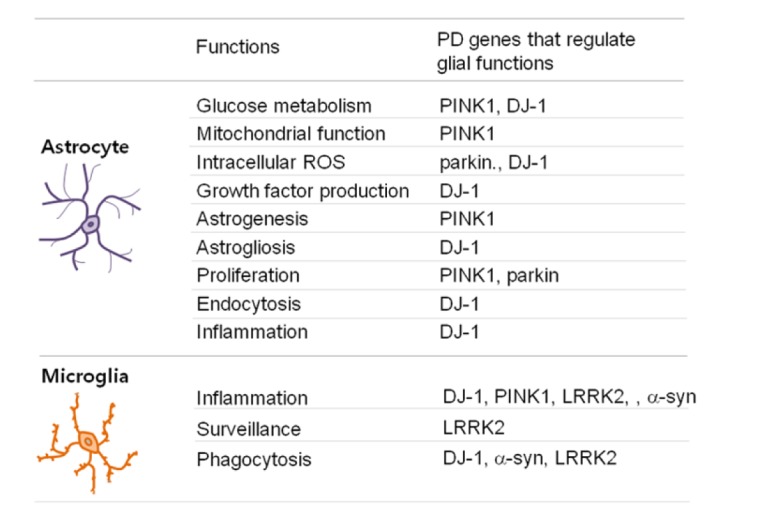
Astrocytes and microglia support well-being and well-function of the brain through diverse functions in both intact and injured brain. For example, astrocytes maintain homeostasis of microenvironment of the brain through up-taking ions and neurotransmitters, and provide growth factors and metabolites for neurons, etc. Microglia keep surveying surroundings, and remove abnormal synapses or respond to injury by isolating injury sites and expressing inflammatory cytokines. Therefore, their loss and/or functional alteration may be directly linked to brain diseases. Since Parkinson's disease (PD)-related genes are expressed in astrocytes and microglia, mutations of these genes may alter the functions of these cells, thereby contributing to disease onset and progression. Here, we review the roles of astrocytes and microglia in intact and injured brain, and discuss how PD genes regulate their functions.
星形胶质细胞和小胶质细胞通过在完整和受损大脑中的多种功能来支持大脑的健康和正常功能。例如,星形胶质细胞通过摄取离子和神经递质来维持大脑微环境的稳态,并为神经元提供生长因子和代谢产物等。小胶质细胞持续监测周围环境,清除异常突触或通过隔离损伤部位和表达炎性细胞因子来应对损伤。因此,它们的缺失和/或功能改变可能与脑部疾病直接相关。由于帕金森病(PD)相关基因在星形胶质细胞和小胶质细胞中表达,这些基因的突变可能会改变这些细胞的功能,从而导致疾病的发生和进展。在这里,我们综述了星形胶质细胞和小胶质细胞在完整和受损大脑中的作用,并讨论了PD基因如何调节它们的功能。