Juan Ta-Kuo, Liu Kuo-Ching, Kuo Chao-Lin, Yang Mei-Due, Chu Yung-Lin, Yang Jiun-Long, Wu Ping-Ping, Huang Yi-Ping, Lai Kuang-Chi, Chung Jing-Gung
Department of Biological Science and Technology, China Medical University, Taichung 404, Taiwan, R.O.C.
Department of Medical Laboratory Science and Biotechnology, China Medical University, Taichung 404, Taiwan, R.O.C.
Oncol Lett. 2018 May;15(5):7716-7724. doi: 10.3892/ol.2018.8286. Epub 2018 Mar 16.
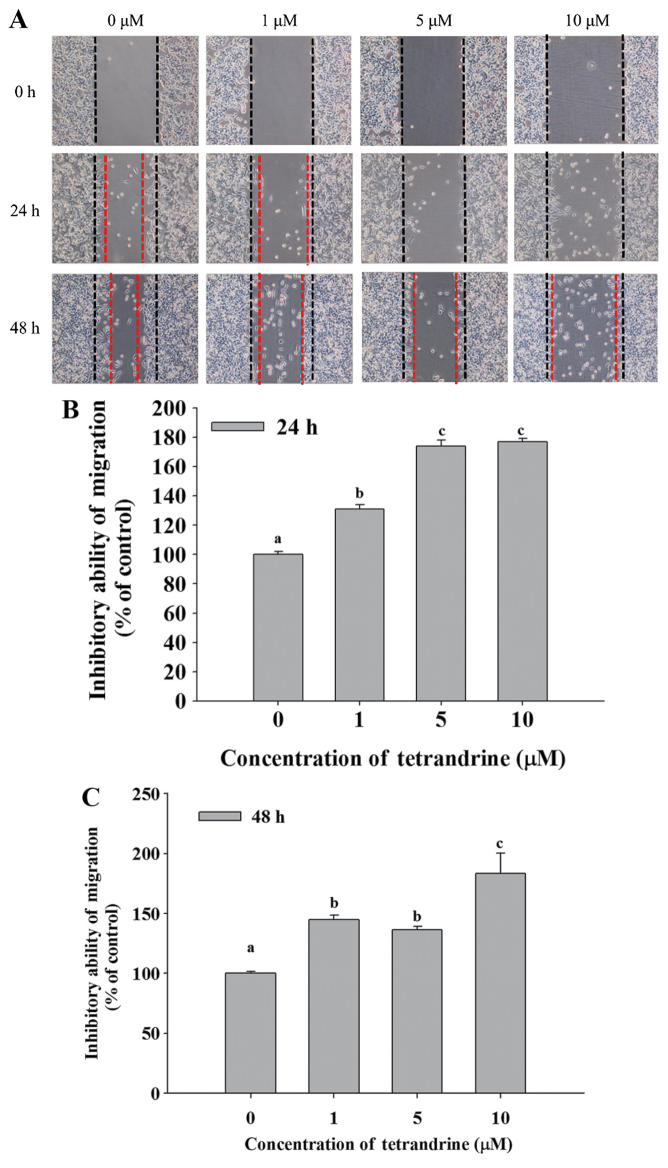
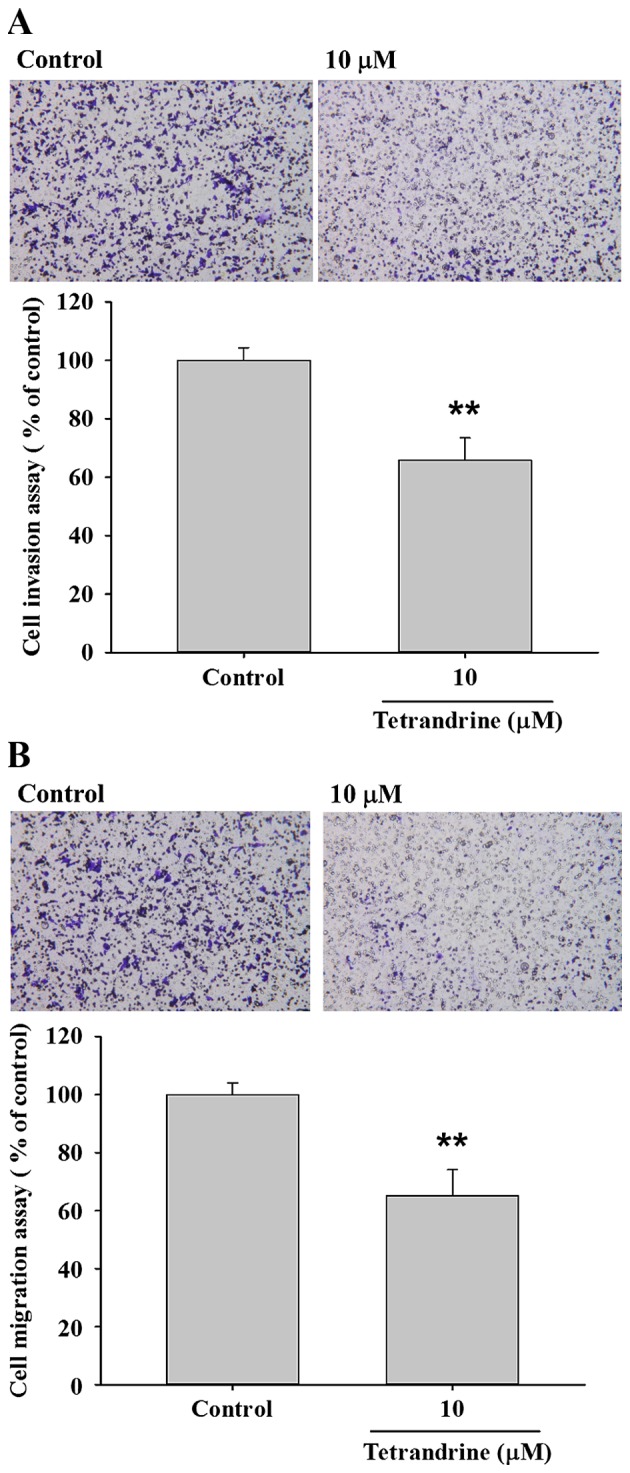
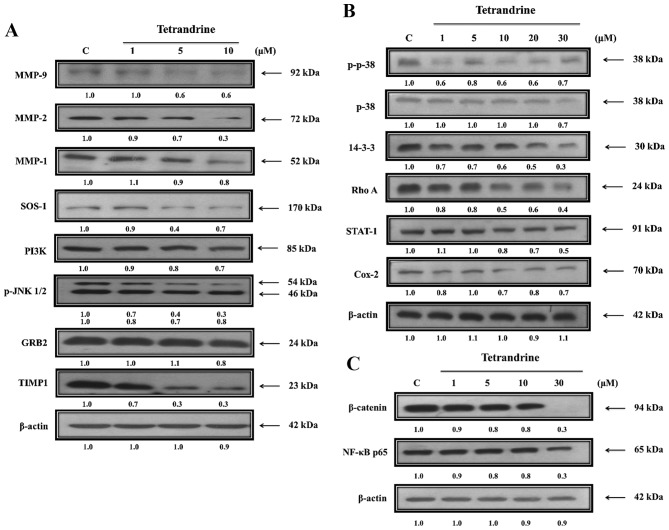
Tetrandrine (TET) exhibits biological activities, including anticancer activity. In Chinese medicine, TET has been used to treat hypertensive and arrhythmic conditions and has been demonstrated to induce cytotoxic effects on human cancer cell lines. However, to the best of the author's knowledge, no previous studies have revealed that TET affects cell metastasis in SW620 human colon cancer cells. The present study demonstrated that TET decreased the cell number and inhibited cell adhesion and mobility of SW620 cells. Furthermore, a wound healing assay was performed to demonstrate that TET suppressed cell movement, and Transwell chamber assays were used to reveal that TET suppressed the cell migration and invasion of SW620 cells. Western blotting demonstrated that TET significantly reduced protein expression levels of SOS Ras/Rac guanine nucleotide exchange factor 1, phosphatidylinositol 3-kinase, growth factor receptor bound protein 2, phosphorylated (p)-c Jun N-terminal kinase 1/2, p-p38, p38, 14-3-3, Rho A, β-catenin, nuclear factor-κB p65, signal transducer and activator of transcription-1 and cyclooxygenase-2, in comparison with untreated SW620 cells. Overall, the results of the present study suggested that TET may be used as a novel anti-metastasis agent for the treatment of human colon cancer in the future.
粉防己碱(TET)具有多种生物活性,包括抗癌活性。在中医中,TET已被用于治疗高血压和心律失常,并且已证明对人癌细胞系具有细胞毒性作用。然而,据作者所知,以前没有研究表明TET会影响SW620人结肠癌细胞的转移。本研究表明,TET可减少SW620细胞的数量,并抑制其细胞粘附和迁移能力。此外,通过伤口愈合试验证明TET可抑制细胞移动,通过Transwell小室试验揭示TET可抑制SW620细胞的迁移和侵袭。蛋白质印迹法表明,与未处理的SW620细胞相比,TET可显著降低SOS Ras/Rac鸟嘌呤核苷酸交换因子1、磷脂酰肌醇3激酶、生长因子受体结合蛋白2、磷酸化(p)-c Jun氨基末端激酶1/2、p-p38、p38、14-3-3、Rho A、β-连环蛋白、核因子-κB p65、信号转导和转录激活因子-1以及环氧化酶-2的蛋白表达水平。总体而言,本研究结果表明,TET未来可能用作治疗人类结肠癌的新型抗转移药物。