Srisuwatchari Witchaya, Vichyanond Pakit
Division of Allergy and Immunology, Department of Pediatrics, Faculty of Medicine Siriraj Hospital, Mahidol University, Bangkok, Thailand.
Asia Pac Allergy. 2018 Apr 27;8(2):e21. doi: 10.5415/apallergy.2018.8.e21. eCollection 2018 Apr.
Prevalence of food allergy is increasing all over the world including in Asia. Diagnosis of food allergy in Asia is usually made after family complaints or by elimination and/or reintroduction foods. This could lead to an inaccurate diagnosis and to incorrect information on epidemiology of food allergy. We, herein, reported results of a 16-year experience (1996-2012) of oral food challenge (OFC) performed in pediatric patients at a major teaching hospital in Thailand.
The major objectives of this report are to review types of foods selected for oral challenges, frequency of positive/negative challenges to these foods and the clinical reactions during challenges among these children.
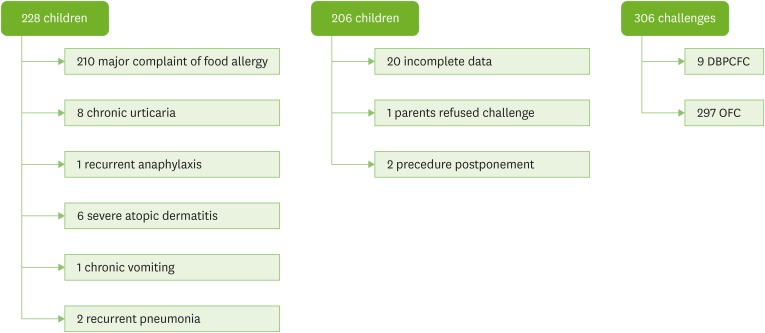
Medical records of 206 children underwent OFC between 1996 and 2012 for various indications at the Allergy clinic of Pediatric Department, Siriraj Hospital, Mahidol University (age range, 4 months to 17 years) were retrospectively reviewed. Data including clinical data, skin prick test results and specific IgE levels were analyzed with respect to challenge results (positive/negative). During the period of the study, 2 separate investigations on shrimp allergy and wheat allergy were conducted.
Sixty of 206 children (29%) had positive OFC, whereas 84 out of 306 OFC (27.5%) were positive. The most common food giving positive challenges in this study was shrimp (40%). Among children less than 3 years of age, the most common food with positive challenge was wheat (70%) whereas among children 3 years of age or older, shellfish was the most common food (42%). Cutaneous reactions were the most common reactions observed.
Only 1 out of 3 children underwent OFC in this study had positive challenges. Shrimp was the most common food causing challenge in this study especially among children older than 3 years of age. Wheat has become another leading food besides cow's milk and egg in causing positive OFC in younger children in Thailand.
食物过敏在包括亚洲在内的全球范围内患病率都在上升。在亚洲,食物过敏的诊断通常是在患者家属提出投诉后,或通过食物排除和/或重新引入的方法来进行。这可能导致诊断不准确,以及关于食物过敏流行病学的错误信息。在此,我们报告了泰国一家主要教学医院对儿科患者进行口服食物激发试验(OFC)16年(1996 - 2012年)的经验结果。
本报告的主要目的是回顾用于口服激发试验的食物类型、这些食物激发试验阳性/阴性的频率以及这些儿童在激发试验期间的临床反应。
回顾性分析了1996年至2012年间在玛希隆大学诗里拉吉医院儿科过敏门诊因各种适应症接受OFC的206名儿童(年龄范围为4个月至17岁)的病历。分析了包括临床数据、皮肤点刺试验结果和特异性IgE水平等数据与激发试验结果(阳性/阴性)的关系。在研究期间,分别对虾过敏和小麦过敏进行了两项调查。
206名儿童中有60名(29%)OFC呈阳性,而306次OFC中有84次(27.5%)呈阳性。本研究中激发试验呈阳性的最常见食物是虾(40%)。在3岁以下儿童中,激发试验呈阳性的最常见食物是小麦(70%),而在3岁及以上儿童中,贝类是最常见的食物(42%)。皮肤反应是观察到的最常见反应。
在本研究中,接受OFC的儿童中只有三分之一激发试验呈阳性。虾是本研究中引起激发试验阳性的最常见食物,尤其是在3岁以上儿童中。在泰国,除了牛奶和鸡蛋外,小麦已成为导致年幼儿童OFC阳性的另一种主要食物。