Department of Sociology, University of California, Irvine, 4171 Social Sciences Plaza, Irvine, CA 92697, USA.
Carolina Population Center, University of North Carolina, 206 West Franklin Street, Chapel Hill, NC 27516, USA; Department of Sociology, University of North Carolina, Hamilton Hall, Chapel Hill, NC 27599-3210, USA.
Soc Sci Med. 2018 Jun;207:89-96. doi: 10.1016/j.socscimed.2018.04.049. Epub 2018 Apr 30.
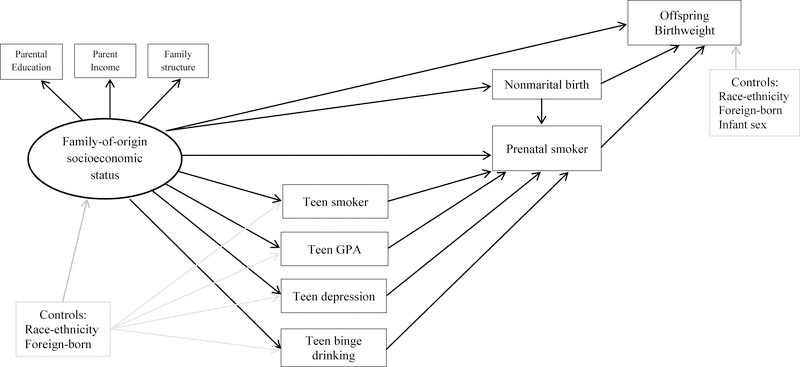
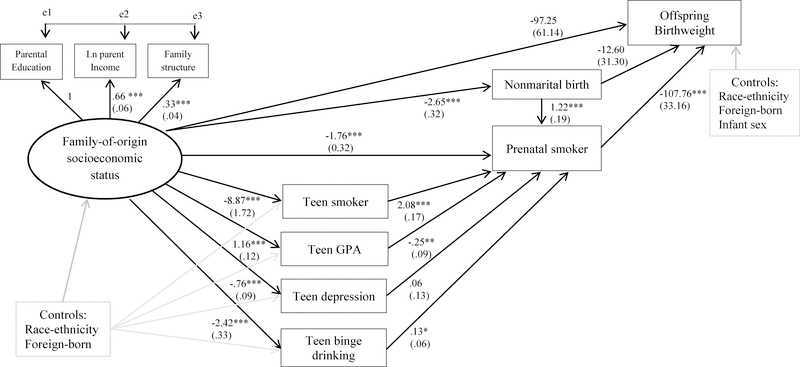
Adverse birth outcomes can lead to problematic long-term outcomes for children, and are also known to transmit socioeconomic disadvantage across generations, thereby amplifying the importance of identifying their social determinants. However, the full set of factors causing adverse birth outcomes remains unknown. Drawing together theory describing intragenerational (life course) processes linking early life adversity to adult health, and intergenerational transmissions of inequality via birthweight, this study tests a chain of risk that originates within early adolescence, impacts young women's risky health behaviors in late adolescence/early adulthood and risky health behaviors during pregnancy, and ultimately decreases offspring's birthweight. We do so using structural equation models and prospective, population-level data on a racially and socioeconomically diverse cohort of young adults (National Longitudinal Study of Adolescent to Adult Health). Results (a) reveal four pathways that fully mediate the association between a young woman's family-of-origin socioeconomic status in adolescence and her offspring's birthweight, and (b) identify a trigger effect-a place in the chain of risk where prevention efforts could be targeted, thereby breaking the chain of risk leading to poor offspring health at birth for vulnerable individuals.
不良生育结局会导致儿童出现长期问题,也会导致代际间的社会经济劣势传递,因此识别其社会决定因素至关重要。然而,导致不良生育结局的全部因素仍不清楚。本研究综合了描述早生命期逆境与成年健康之间的代际(生命历程)过程的理论,以及通过出生体重传递的不平等的代际传递,检验了一条始于青少年早期、影响年轻女性在青少年晚期/成年早期的危险健康行为和怀孕期间的危险健康行为、最终降低后代出生体重的风险链。我们使用结构方程模型和具有代表性的、针对不同种族和社会经济背景的年轻成年人(青少年至成年健康全国纵向研究)的前瞻性人口水平数据来实现这一目标。研究结果表明:(a)有四条途径完全中介了年轻女性青少年时期的家庭社会经济地位与其后代出生体重之间的关联;(b)确定了一个触发效应——风险链中的一个环节,预防措施可以针对这个环节,从而打破导致弱势个体出生时后代健康不良的风险链。