Computational and Biological Learning Laboratory, Department of Engineering, University of Cambridge, Cambridge, United Kingdom.
Department of Psychology, University of Cambridge, Cambridge, United Kingdom.
Elife. 2018 May 8;7:e34779. doi: 10.7554/eLife.34779.
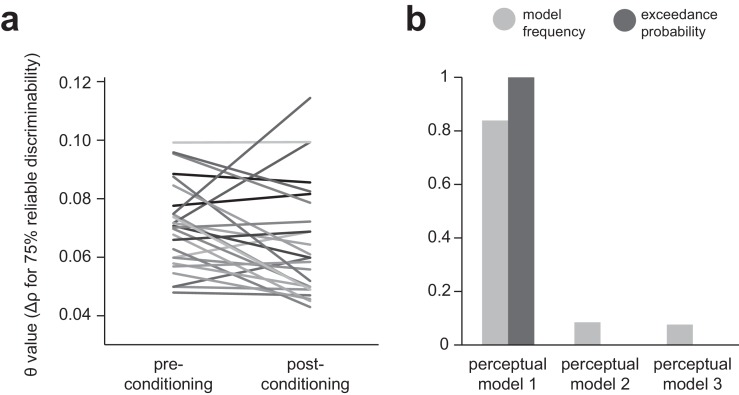
Generalization during aversive decision-making allows us to avoid a broad range of potential threats following experience with a limited set of exemplars. However, over-generalization, resulting in excessive and inappropriate avoidance, has been implicated in a variety of psychological disorders. Here, we use reinforcement learning modelling to dissect out different contributions to the generalization of instrumental avoidance in two groups of human volunteers ( = 26, = 482). We found that generalization of avoidance could be parsed into perceptual and value-based processes, and further, that value-based generalization could be subdivided into that relating to aversive and neutral feedback - with corresponding circuits including primary sensory cortex, anterior insula, amygdala and ventromedial prefrontal cortex. Further, generalization from aversive, but not neutral, feedback was associated with self-reported anxiety and intrusive thoughts. These results reveal a set of distinct mechanisms that mediate generalization in avoidance learning, and show how specific individual differences within them can yield anxiety.
在令人厌恶的决策过程中进行泛化,可以让我们在有限的范例经验后,避免广泛的潜在威胁。然而,过度泛化导致过度和不适当的回避,已经涉及到各种心理障碍。在这里,我们使用强化学习模型来剖析两组人类志愿者(n=26,n=482)在工具性回避的泛化中不同的贡献。我们发现,回避的泛化可以分解为感知和基于价值的过程,并且进一步,基于价值的泛化可以细分为与厌恶和中性反馈相关的过程——相应的回路包括初级感觉皮层、前岛叶、杏仁核和腹内侧前额叶皮层。此外,来自厌恶但不是中性反馈的泛化与自我报告的焦虑和侵入性思维有关。这些结果揭示了一组不同的机制,这些机制在回避学习中进行泛化,并表明其中的特定个体差异如何产生焦虑。