Department of Neuroimaging, Institute of Psychiatry, Psychology & Neuroscience, King's College London, London, United Kingdom.
Neuroscience and Mental Health Group, Institute of Cognitive Neuroscience, University College London, London, United Kingdom; Research Department of Clinical Education and Health Psychology, University College London, London, United Kingdom.
Biol Psychiatry. 2023 Apr 15;93(8):690-703. doi: 10.1016/j.biopsych.2022.09.034. Epub 2022 Oct 10.
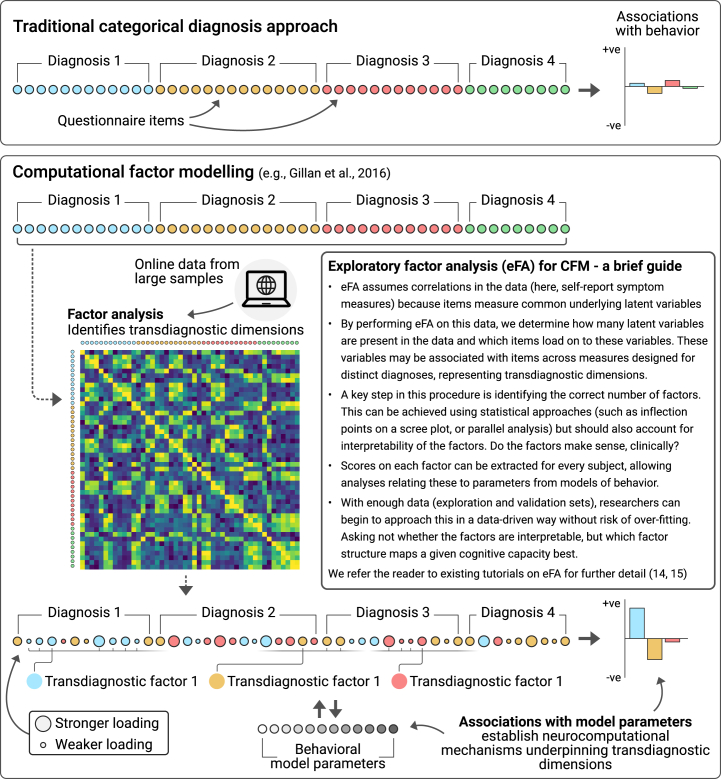
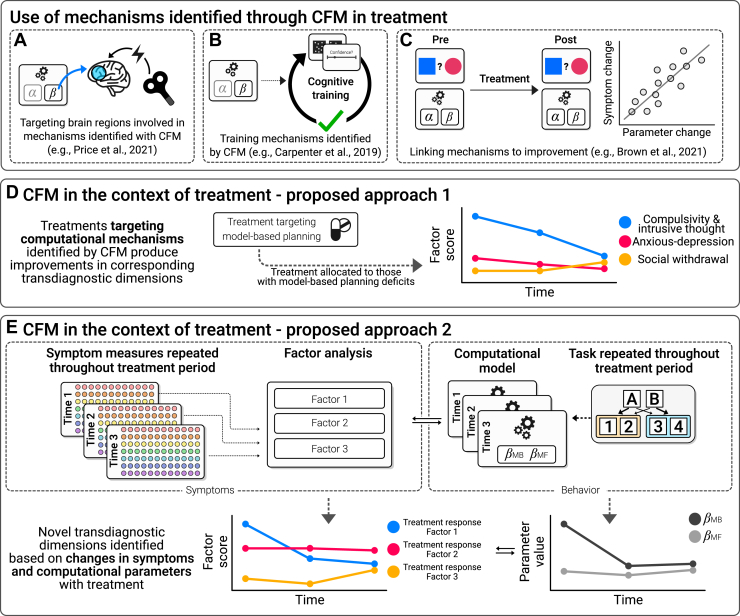
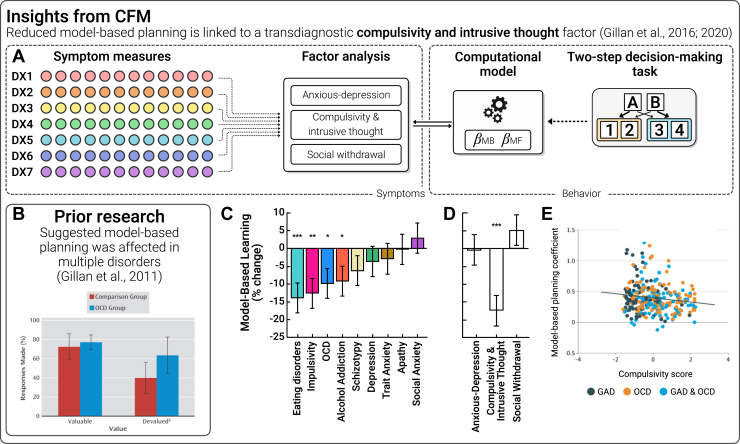
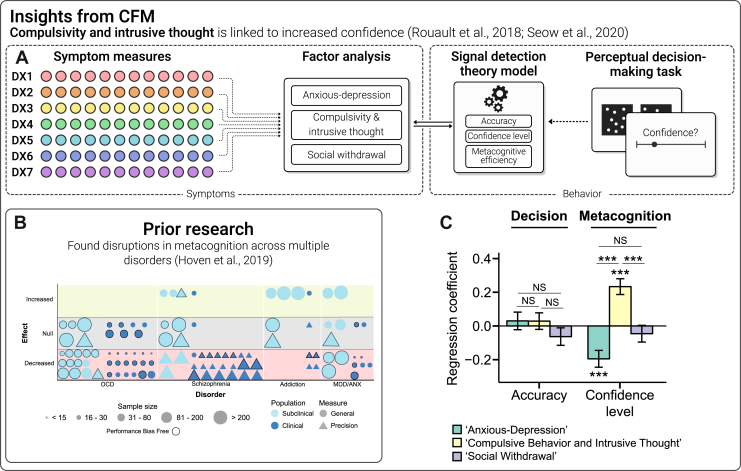
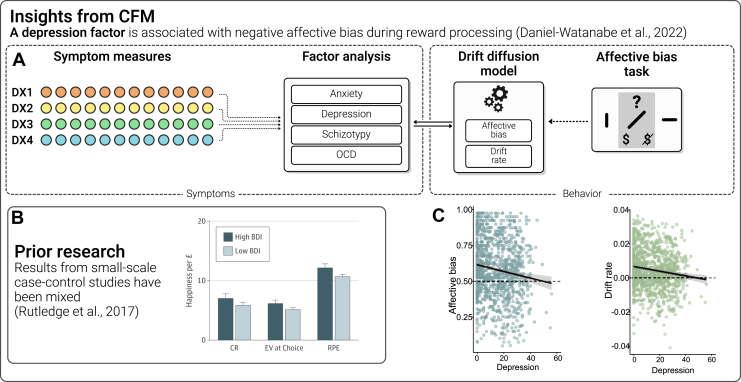
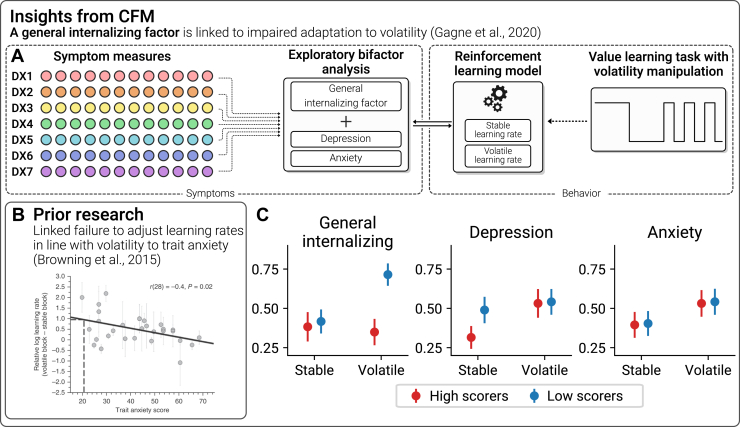
Most psychiatric disorders do not occur in isolation, and most psychiatric symptom dimensions are not uniquely expressed within a single diagnostic category. Current treatments fail to work for around 25% to 40% of individuals, perhaps due at least in part to an overreliance on diagnostic categories in treatment development and allocation. In this review, we describe ongoing efforts in the field to surmount these challenges and precisely characterize psychiatric symptom dimensions using large-scale studies of unselected samples via remote, online, and "citizen science" efforts that take a dimensional, mechanistic approach. We discuss the importance that efforts to identify meaningful psychiatric dimensions be coupled with careful computational modeling to formally specify, test, and potentially falsify candidate mechanisms that underlie transdiagnostic symptom dimensions. We refer to this approach, i.e., where symptom dimensions are identified and validated against computationally well-defined neurocognitive processes, as computational factor modeling. We describe in detail some recent applications of this method to understand transdiagnostic cognitive processes that include model-based planning, metacognition, appetitive processing, and uncertainty estimation. In this context, we highlight how computational factor modeling has been used to identify specific associations between cognition and symptom dimensions and reveal previously obscured relationships, how findings generalize to smaller in-person clinical and nonclinical samples, and how the method is being adapted and optimized beyond its original instantiation. Crucially, we discuss next steps for this area of research, highlighting the value of more direct investigations of treatment response that bridge the gap between basic research and the clinic.
大多数精神障碍并非孤立发生,大多数精神症状维度也并非仅在单一诊断类别中表现出来。目前的治疗方法对大约 25%至 40%的个体不起作用,这也许至少部分归因于在治疗开发和分配中过度依赖诊断类别。在这篇综述中,我们描述了该领域正在进行的努力,通过对未经选择的样本进行大规模研究,利用远程、在线和“公民科学”努力,以维度化、机制化的方法来克服这些挑战,并精确描述精神症状维度。我们讨论了识别有意义的精神症状维度的重要性,必须与仔细的计算建模相结合,以正式指定、测试和潜在地否定潜在的跨诊断症状维度的候选机制。我们将这种方法称为计算因子建模,即根据计算上定义明确的神经认知过程来识别和验证症状维度。我们详细描述了该方法的一些最近应用,以了解包括基于模型的规划、元认知、食欲加工和不确定性估计在内的跨诊断认知过程。在这种情况下,我们强调了计算因子建模如何用于识别认知与症状维度之间的特定关联,并揭示了以前被掩盖的关系,以及发现如何推广到更小的现场临床和非临床样本,以及该方法如何在其最初实施之外进行改编和优化。至关重要的是,我们讨论了该研究领域的下一步措施,强调了更直接的治疗反应研究的价值,该研究将基础研究和临床联系起来。