Division of Food Sciences, University of Nottingham, Sutton Bonington Campus, Loughborough LE12 5RD, UK; Campden BRI, Chipping Campden, Gloucestershire GL55 6LD, UK.
Campden BRI, Chipping Campden, Gloucestershire GL55 6LD, UK.
Food Res Int. 2018 Jun;108:628-640. doi: 10.1016/j.foodres.2018.03.077. Epub 2018 Apr 3.
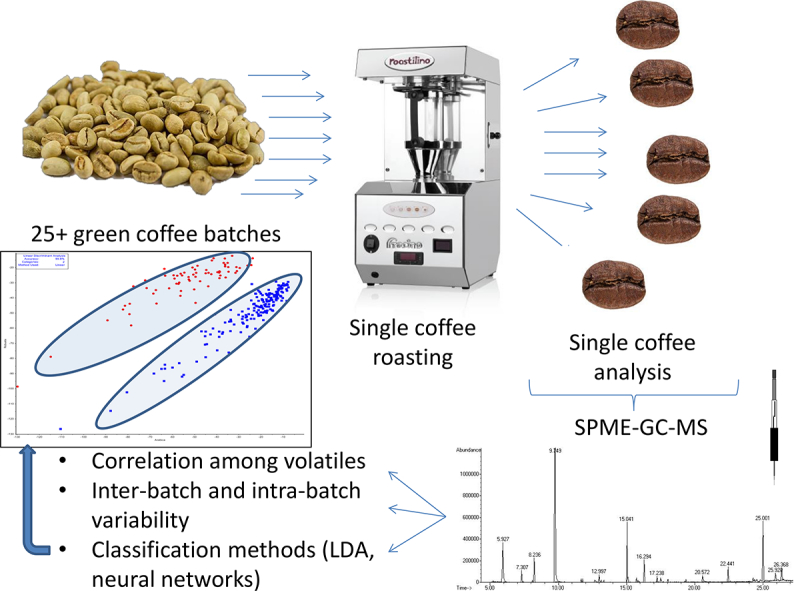
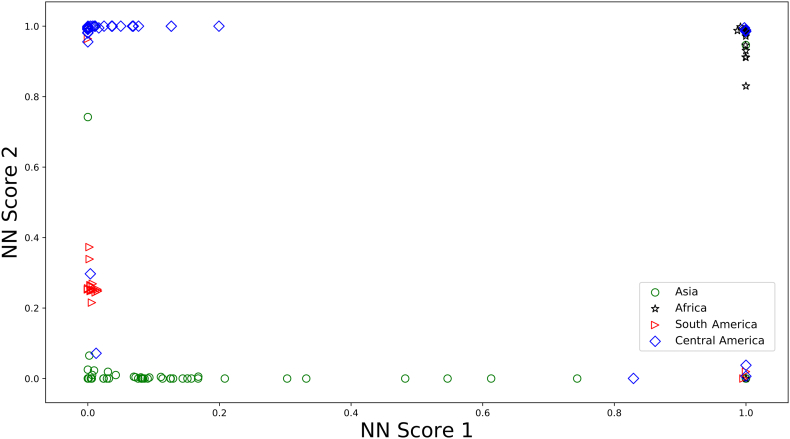
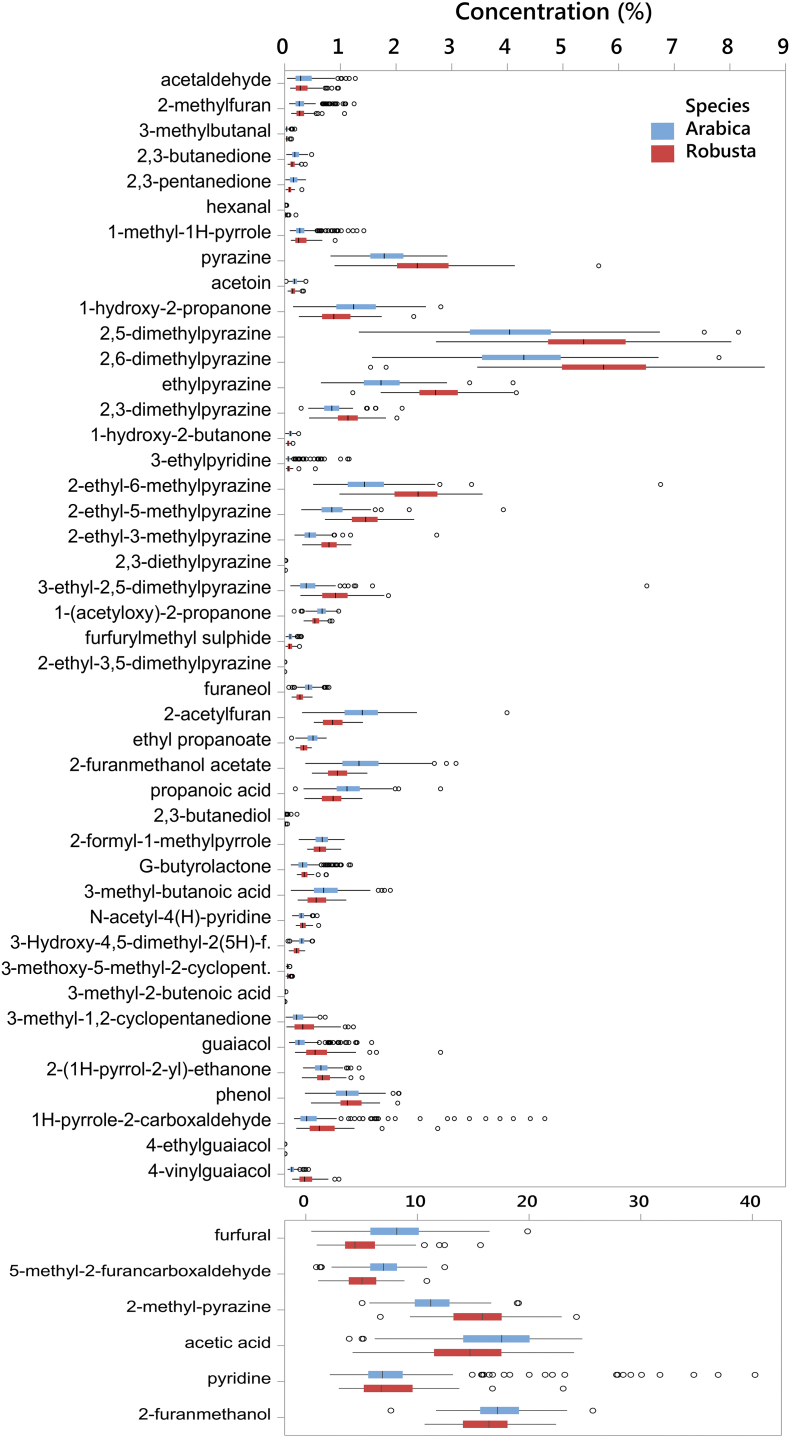
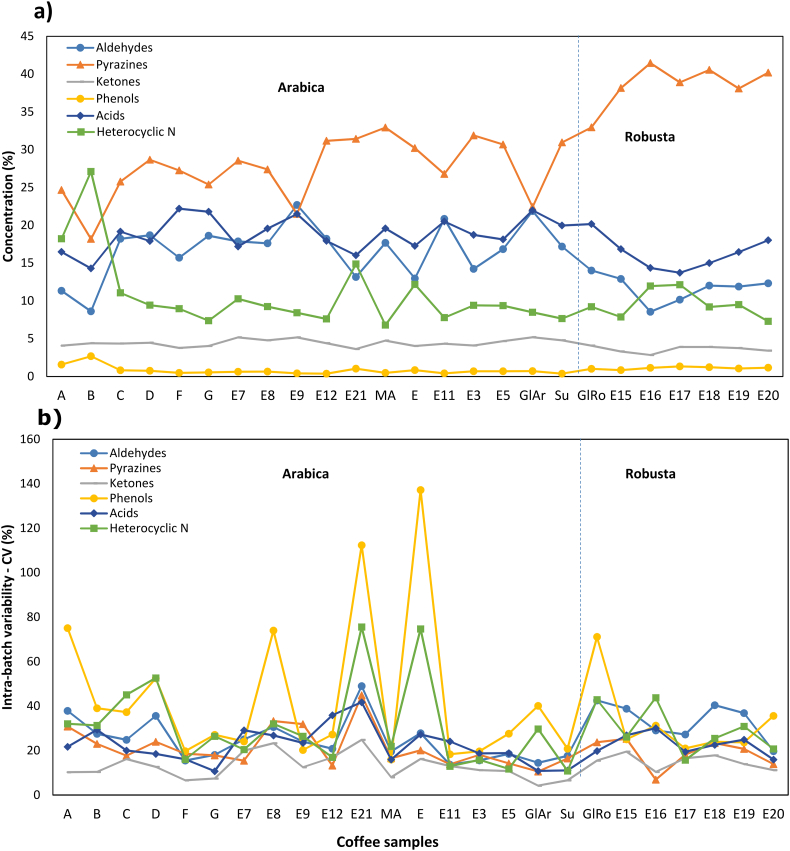
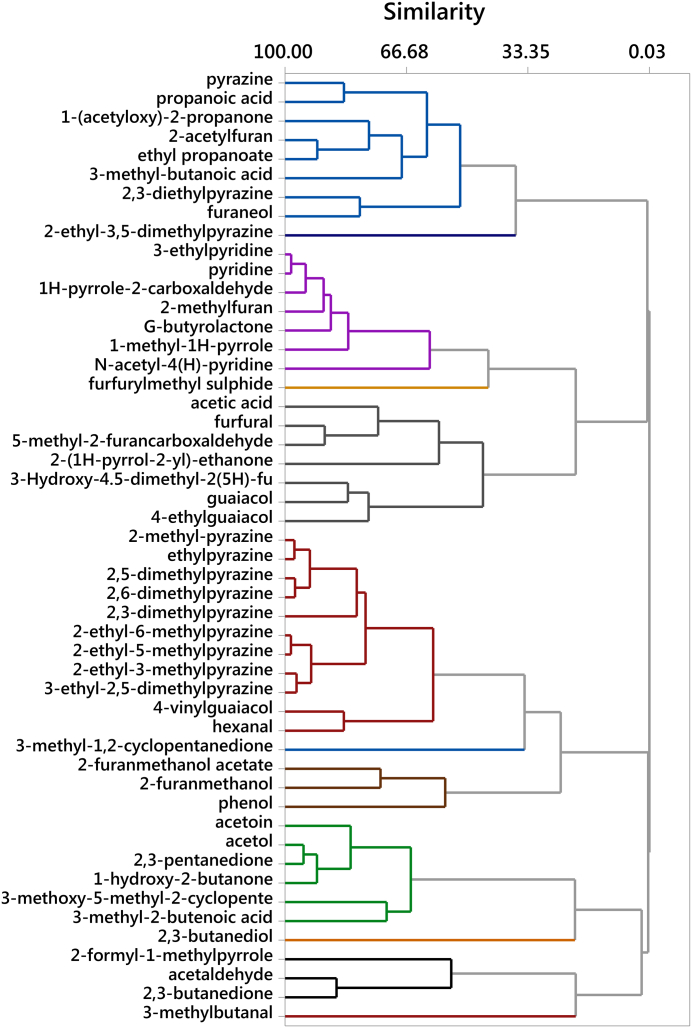
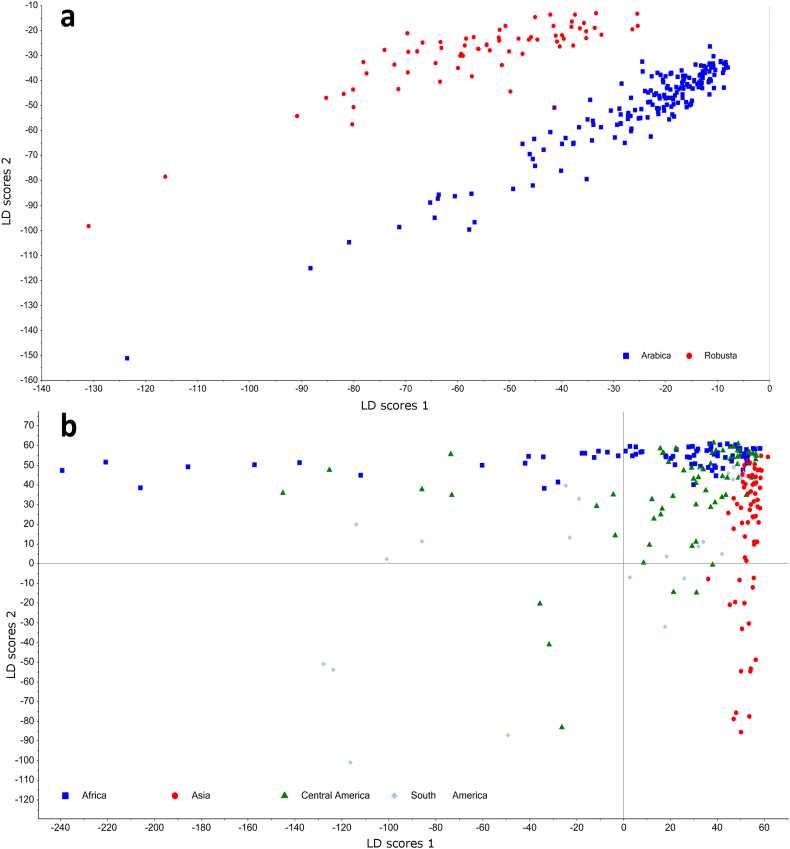
We report on the analysis of volatile compounds by SPME-GC-MS for individual roasted coffee beans. The aim was to understand the relative abundance and variability of volatile compounds between individual roasted coffee beans at constant roasting conditions. Twenty-five batches of Arabica and robusta species were sampled from 13 countries, and 10 single coffee beans randomly selected from each batch were individually roasted in a fluidised-bed roaster at 210 °C for 3 min. High variability (CV = 14.0-53.3%) of 50 volatile compounds in roasted coffee was obtained within batches (10 beans per batch). Phenols and heterocyclic nitrogen compounds generally had higher intra-batch variation, while ketones were the most uniform compounds (CV < 20%). The variation between batches was much higher, with the CV ranging from 15.6 to 179.3%. The highest variation was observed for 2,3-butanediol, 3-ethylpyridine and hexanal. It was also possible to build classification models based on geographical origin, obtaining 99.5% and 90.8% accuracy using LDA or MLR classifiers respectively, and classification between Arabica and robusta beans. These results give further insight into natural variation of coffee aroma and could be used to obtain higher quality and more consistent final products. Our results suggest that coffee volatile concentration is also influenced by other factors than simply the roasting degree, especially green coffee composition, which is in turn influenced by the coffee species, geographical origin, ripening stage and pre- and post-harvest processing.
我们报告了通过 SPME-GC-MS 对单个烘焙咖啡豆中挥发性化合物的分析。目的是了解在恒定烘焙条件下,单个烘焙咖啡豆之间挥发性化合物的相对丰度和可变性。从 13 个国家采集了 25 批阿拉比卡和罗布斯塔品种,从每批中随机选择 10 颗咖啡豆,在流化床烘焙机中以 210°C 烘焙 3 分钟。在批次内(每批 10 颗豆)获得了 50 种挥发性化合物在烘焙咖啡中的高变异性(CV=14.0-53.3%)。酚类和杂环氮化合物通常具有较高的批次内变异性,而酮类是最均匀的化合物(CV<20%)。批次之间的变化要高得多,CV 范围从 15.6 到 179.3%。变化最大的是 2,3-丁二醇、3-乙基吡啶和己醛。也可以基于地理起源建立分类模型,使用 LDA 或 MLR 分类器分别获得 99.5%和 90.8%的准确率,以及阿拉比卡和罗布斯塔豆之间的分类。这些结果进一步深入了解了咖啡香气的自然变化,并可用于获得更高质量和更一致的最终产品。我们的结果表明,咖啡挥发性浓度不仅受到烘焙程度的影响,还受到其他因素的影响,特别是绿咖啡豆的成分,而绿咖啡豆的成分又受到咖啡品种、地理起源、成熟阶段以及收获前后处理的影响。