Caperchione Cristina M, Duncan Mitch J, Rosenkranz Richard R, Vandelanotte Corneel, Van Itallie Anetta K, Savage Trevor N, Hooker Cindy, Maeder Anthony J, Mummery W Kerry, Kolt Gregory S
School of Health and Exercise Sciences, University of British Columbia, Kelowna, Canada.
School of Medicine and Public Health & Priority Research Centre for Physical Activity and Nutrition, University of Newcastle, Newcastle, Australia.
Contemp Clin Trials Commun. 2015 Dec 21;2:25-33. doi: 10.1016/j.conctc.2015.12.004. eCollection 2016 Apr 15.
To describe in detail the recruitment methods and enrollment rates, the screening methods, and the baseline characteristics of a sample of adults participating in the Walk 2.0 Study, an 18 month, 3-arm randomized controlled trial of a Web 2.0 based physical activity intervention.
A two-fold recruitment plan was developed and implemented, including a direct mail-out to an extract from the Australian Electoral Commission electoral roll, and other supplementary methods including email and telephone. Physical activity screening involved two steps: a validated single-item self-report instrument and the follow-up Active Australia Questionnaire. Readiness for physical activity participation was also based on a two-step process of administering the Physical Activity Readiness Questionnaire and, where needed, further clearance from a medical practitioner.
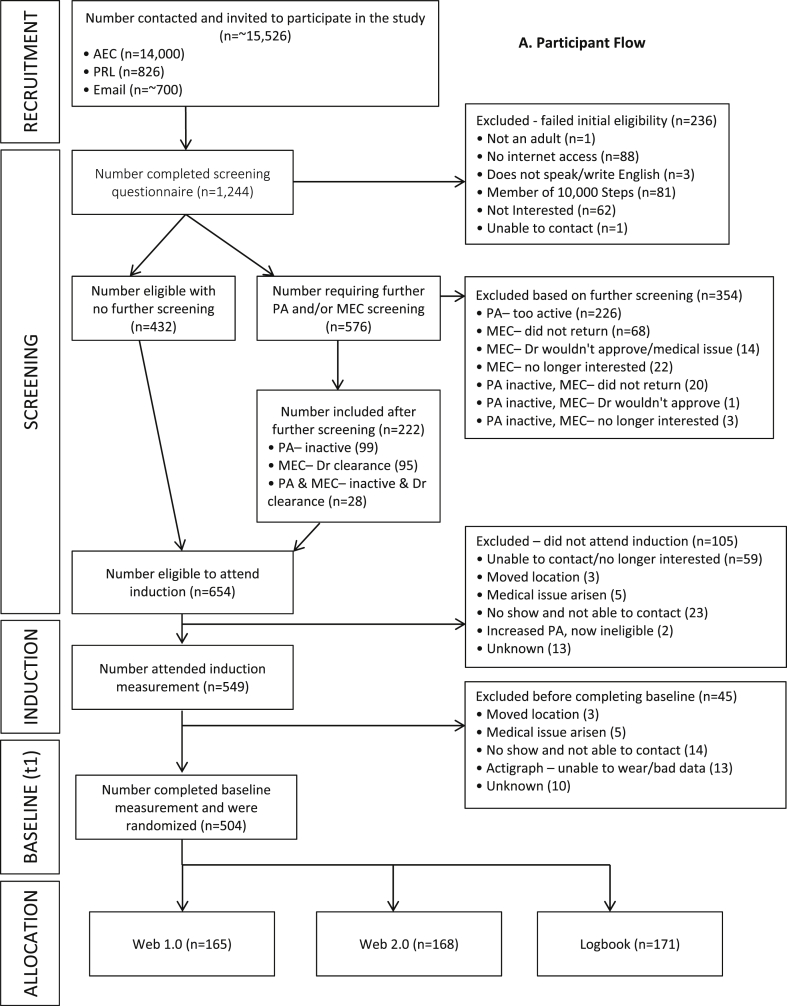
Across all recruitment methods, a total of 1244 participants expressed interest in participating, of which 656 were deemed eligible. Of these, 504 were later enrolled in the Walk 2.0 trial (77% enrollment rate) and randomized to the Walk 1.0 group (n = 165), the Walk 2.0 group (n = 168), or the Logbook group (n = 171). Mean age of the total sample was 50.8 years, with 65.2% female and 79.1% born in Australia.
The results of this recruitment process demonstrate the successful use of multiple strategies to obtain a diverse sample of adults eligible to take part in a web-based physical activity promotion intervention. The use of dual screening processes ensured safe participation in the intervention. This approach to recruitment and physical activity screening can be used as a model for further trials in this area.
详细描述参与“行走2.0研究”的成年人样本的招募方法、入组率、筛查方法及基线特征。“行走2.0研究”是一项为期18个月的三臂随机对照试验,旨在探讨基于网络2.0的体育活动干预措施。
制定并实施了双重招募计划,包括向澳大利亚选举委员会选民名册的一个摘录直接邮寄,以及其他补充方法,如电子邮件和电话。体育活动筛查包括两个步骤:一份经验证的单项自我报告工具和后续的“活跃澳大利亚问卷”。参与体育活动的准备情况也基于一个两步流程,即发放体育活动准备情况问卷,并在需要时获得医生的进一步许可。
在所有招募方法中,共有1244名参与者表示有兴趣参与,其中656名被认为符合条件。在这些人中,504人后来参加了“行走2.0试验”(入组率77%),并被随机分配到“行走1.0组”(n = 165)、“行走2.0组”(n = 168)或“日志组”(n = 171)。总样本的平均年龄为50.8岁,女性占65.2%,79.1%出生在澳大利亚。
本次招募过程的结果表明,成功运用了多种策略来获得一个多样化的成年人样本,这些成年人有资格参与基于网络的体育活动促进干预。双重筛查流程的使用确保了安全参与干预。这种招募和体育活动筛查方法可作为该领域进一步试验的模型。