Vandelanotte Corneel, Kolt Gregory S, Caperchione Cristina M, Savage Trevor N, Rosenkranz Richard R, Maeder Anthony J, Van Itallie Anetta, Tague Rhys, Oldmeadow Christopher, Mummery W Kerry, Duncan Mitch J
Central Queensland University, Rockhampton, Australia.
Western Sydney University, Sydney, Australia.
J Med Internet Res. 2017 Nov 13;19(11):e390. doi: 10.2196/jmir.8484.
The translation of Web-based physical activity intervention research into the real world is lacking and becoming increasingly important.
To compare usage and effectiveness, in real-world settings, of a traditional Web 1.0 Web-based physical activity intervention, providing limited interactivity, to a Web 2.0 Web-based physical activity intervention that includes interactive features, such as social networking (ie, status updates, online "friends," and personalized profile pages), blogs, and Google Maps mash-ups.
Adults spontaneously signing up for the freely available 10,000 Steps website were randomized to the 10,000 Steps website (Web 1.0) or the newly developed WALK 2.0 website (Web 2.0). Physical activity (Active Australia Survey), quality of life (RAND 36), and body mass index (BMI) were assessed at baseline, 3 months, and 12 months. Website usage was measured continuously. Analyses of covariance were used to assess change over time in continuous outcome measures. Multiple imputation was used to deal with missing data.
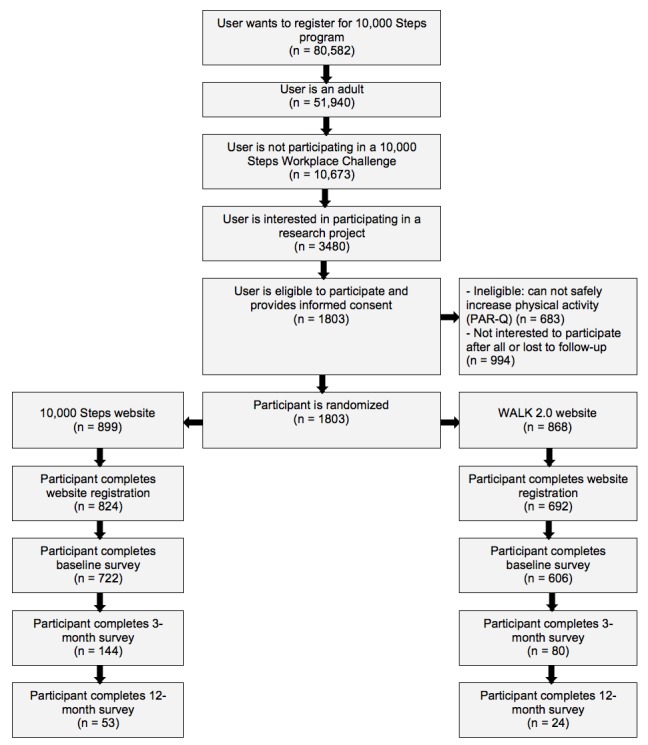
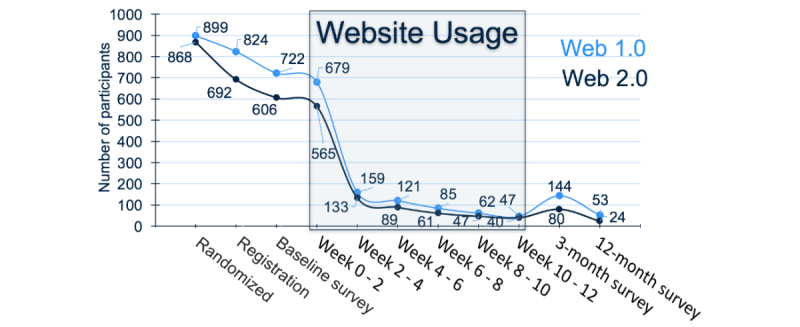
A total of 1328 participants completed baseline assessments. Only 3-month outcomes (224 completers) were analyzed due to high attrition at 12 months (77 completers). Web 2.0 group participants increased physical activity by 92.8 minutes per week more than those in the Web 1.0 group (95% CI 28.8-156.8; P=.005); their BMI values also decreased more (-1.03 kg/m2, 95% CI -1.65 to -0.41; P=.001). For quality of life, only the physical functioning domain score significantly improved more in the Web 2.0 group (3.6, 95% CI 1.7-5.5; P<.001). The time between the first and last visit to the website (3.57 vs 2.22 weeks; P<.001) and the mean number of days the website was visited (9.02 vs 5.71 days; P=.002) were significantly greater in the Web 2.0 group compared to the Web 1.0 group. The difference in time-to-nonusage attrition was not statistically significant between groups (Hazard Ratio=0.97, 95% CI 0.86-1.09; P=.59). Only 21.99% (292/1328) of participants (n=292 summed for both groups) were still using either website after 2 weeks and 6.55% (87/1328) were using either website after 10 weeks.
The website that provided more interactive and social features was more effective in improving physical activity in real-world conditions. While the Web 2.0 website was visited significantly more, both groups nevertheless displayed high nonusage attrition and low intervention engagement. More research is needed to examine the external validity and generalizability of Web-based physical activity interventions.
Australian New Zealand Clinical Trials Registry: ACTRN12611000253909; https://anzctr.org.au /Trial/Registration/TrialReview.aspx?id=336588&isReview=true (Archived by WebCite at http://www.webcitation.org/6ufzw 2HxD).
基于网络的体育活动干预研究在现实世界中的转化较为缺乏,且愈发重要。
在现实环境中,比较提供有限交互性的传统Web 1.0基于网络的体育活动干预与包含社交网络(即状态更新、在线“好友”和个性化个人资料页面)、博客及谷歌地图混搭等交互功能的Web 2.0基于网络的体育活动干预的使用情况和效果。
自发报名参加免费的“万步网”的成年人被随机分为“万步网”(Web 1.0)组或新开发的“WALK 2.0网”(Web 2.0)组。在基线、3个月和12个月时评估体育活动(澳大利亚积极生活调查)、生活质量(兰德36项健康调查)和体重指数(BMI)。持续测量网站使用情况。采用协方差分析评估连续结局指标随时间的变化。使用多重填补法处理缺失数据。
共有1328名参与者完成了基线评估。由于12个月时失访率较高(77名完成者),仅分析了3个月时的结局(224名完成者)。Web 2.0组参与者每周的体育活动增加量比Web 1.0组多92.8分钟(95%可信区间28.8 - 156.8;P = 0.005);他们的BMI值下降也更多(-1.03kg/m²,95%可信区间-1.65至-0.41;P = 0.001)。对于生活质量,仅Web 2.0组的身体功能领域得分显著改善更多(3.6,95%可信区间1.7 - 5.5;P < 0.001)。与Web 1.0组相比,Web 2.0组首次访问和最后访问网站之间的时间(3.57对2.22周;P < 0.001)以及网站被访问的平均天数(9.02对5.71天;P = 0.002)显著更长。两组之间未使用损耗时间的差异无统计学意义(风险比 = 0.97,95%可信区间0.86 - 1.09;P = 0.59)。2周后仍在使用任一网站的参与者仅占21.99%(292/1328)(两组共计n = 292),10周后仍在使用任一网站的参与者占6.55%(87/1328)。
提供更多交互性和社交功能的网站在现实条件下改善体育活动方面更有效。虽然Web 2.0网站的访问量显著更高,但两组的未使用率均较高且干预参与度较低。需要更多研究来检验基于网络的体育活动干预的外部效度和可推广性。
澳大利亚新西兰临床试验注册中心:ACTRN12611000253909;https://anzctr.org.au /Trial/Registration/TrialReview.aspx?id=336588&isReview=true(由WebCite存档于http://www.webcitation.org/6ufzw 2HxD)