Department of Immunology and Infectious Diseases, Harvard School of Public Health, Boston, Massachusetts, USA.
Tropical Medicine Research, Panama City, Panama.
mBio. 2018 May 8;9(3):e00625-18. doi: 10.1128/mBio.00625-18.
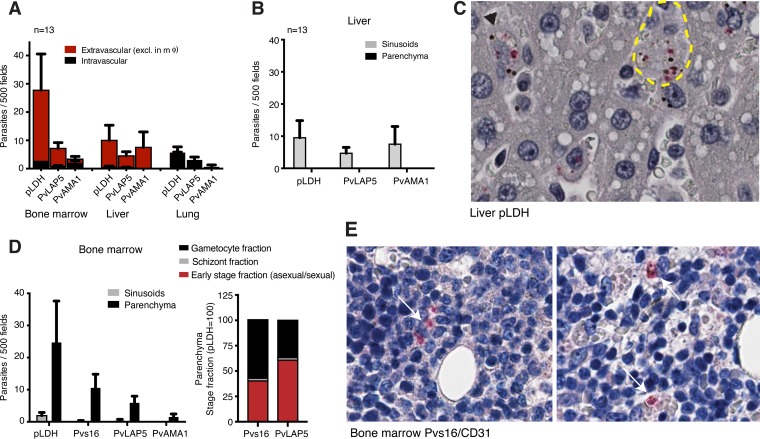
causes heavy burdens of disease across malarious regions worldwide. Mature asexual and transmissive gametocyte stages occur in the blood circulation, and it is often assumed that accumulation/sequestration in tissues is not an important phase in their development. Here, we present a systematic study of stage distributions in infected tissues of nonhuman primate (NHP) malaria models as well as in blood from human infections. In a comparative analysis of the transcriptomes of and blood-stage parasites, we found a conserved cascade of stage-specific gene expression despite the greatly different gametocyte maturity times of these two species. Using this knowledge, we validated a set of conserved asexual- and gametocyte-stage markers both by quantitative real-time PCR and by antibody assays of peripheral blood samples from infected patients and NHP ( sp.). Histological analyses of parasites in organs of 13 infected NHP ( and species) demonstrated a major fraction of immature gametocytes in the parenchyma of the bone marrow, while asexual schizont forms were enriched to a somewhat lesser extent in this region of the bone marrow as well as in sinusoids of the liver. These findings suggest that the bone marrow is an important reservoir for gametocyte development and proliferation of malaria parasites. malaria continues to cause major public health burdens worldwide. Yet, significant knowledge gaps in the basic biology and epidemiology of malaria remain, largely due to limited available tools for research and diagnostics. Here, we present a systematic examination of tissue sequestration during infection. Studies of nonhuman primates and malaria patients revealed enrichment of developing sexual stages (gametocytes) and mature replicative stages (schizonts) in the bone marrow and liver, relative to those present in peripheral blood. Identification of the bone marrow as a major tissue reservoir has important implications for parasite diagnosis and treatment.
疟疾在全球疟疾流行地区造成沉重的疾病负担。成熟的无性和有性传播的配子体阶段出现在血液循环中,人们通常认为在组织中的积累/隔离不是其发育的重要阶段。在这里,我们对非人类灵长类动物(NHP)疟疾模型的感染组织以及来自人类感染的血液中的阶段分布进行了系统研究。在对 和 血液阶段寄生虫的转录组进行比较分析时,我们发现尽管这两个物种的配子体成熟时间有很大差异,但仍存在阶段特异性基因表达的保守级联。利用这一知识,我们通过定量实时 PCR 以及对感染患者和 NHP( 和 种)外周血样本的抗体检测,验证了一组保守的无性和配子体阶段标记物。对 13 只感染 NHP( 和 种)的寄生虫的组织学分析表明,大量未成熟的配子体存在于骨髓的实质中,而无性裂殖体形式在骨髓的这一区域以及肝脏的窦状隙中也有一定程度的富集。这些发现表明骨髓是疟原虫配子体发育和增殖的重要储库。疟疾继续在全球范围内造成重大的公共卫生负担。然而,由于研究和诊断工具的有限可用性,疟疾的基础生物学和流行病学仍然存在重大知识空白。在这里,我们对 感染期间的组织隔离进行了系统检查。对非人类灵长类动物和疟疾患者的研究表明,与外周血中存在的相比,发育中的性阶段(配子体)和成熟的复制阶段(裂殖体)在骨髓和肝脏中富集。将骨髓鉴定为主要的 组织储库对寄生虫诊断和治疗具有重要意义。