Cardiovascular Convergence Research Center of Chonnam National University Hospital Designated by Korea Ministry of Health and Welfare, Gwangju, 61469, Republic of Korea.
Korea Cardiovascular Stent Research Institute, Jangsung, 57248, Republic of Korea.
Sci Rep. 2018 May 9;8(1):7383. doi: 10.1038/s41598-018-25629-9.
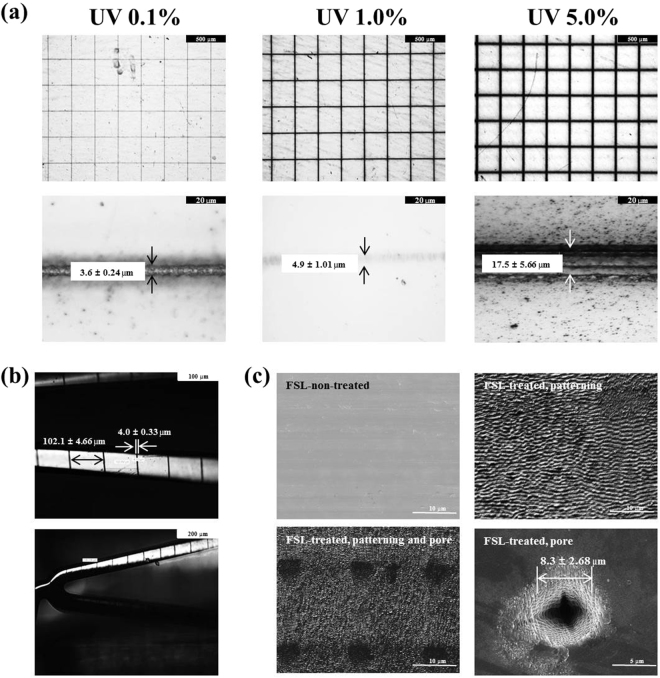
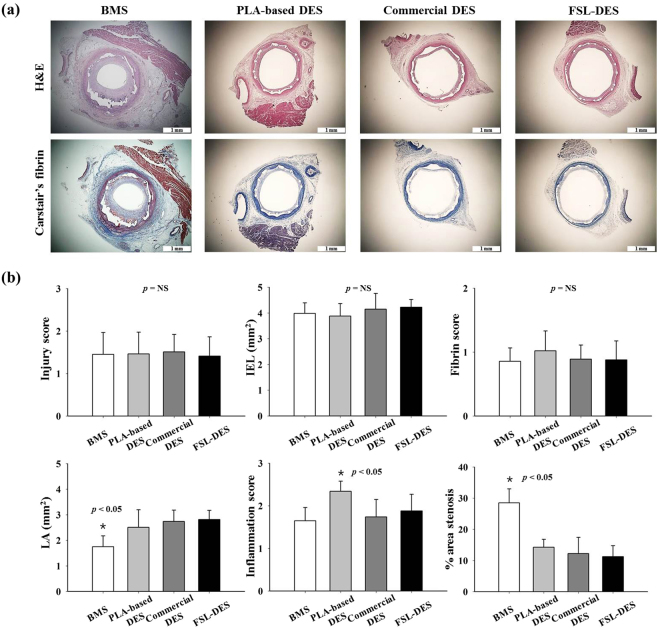
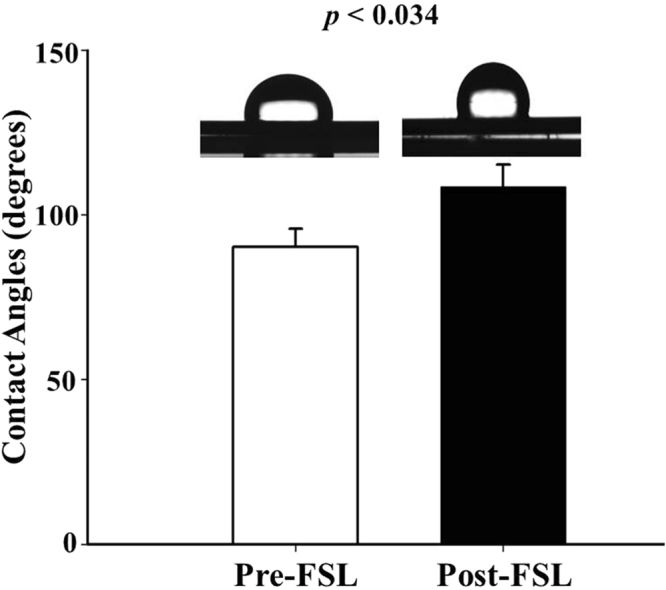
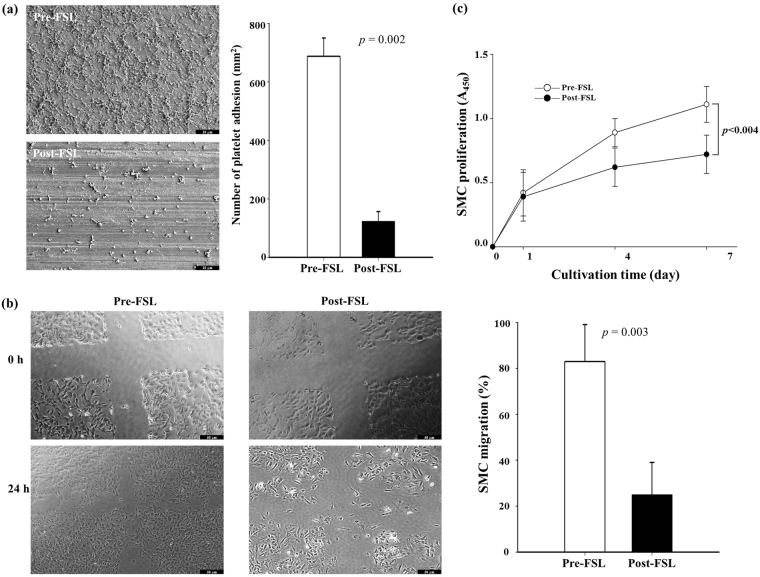
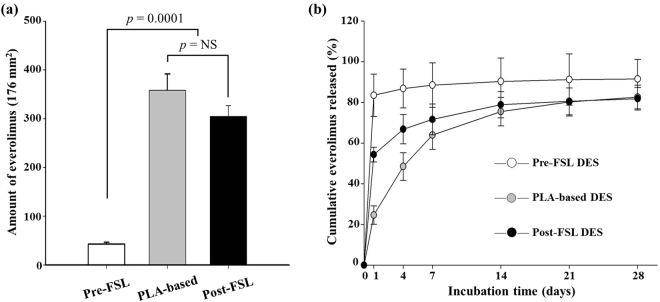
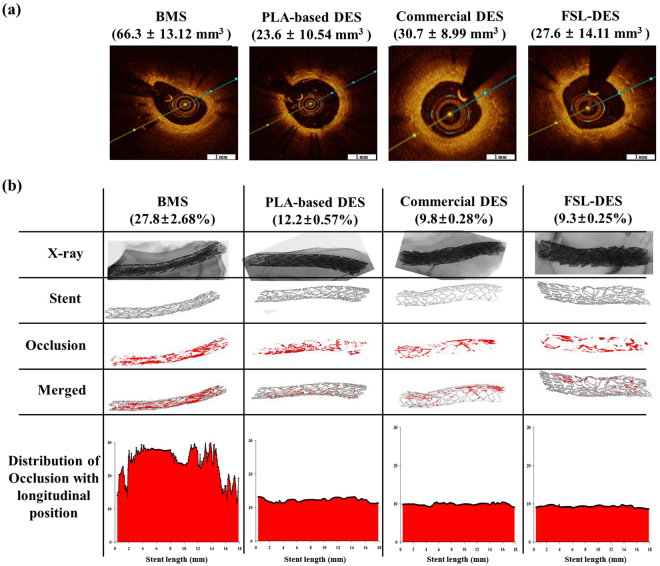
The aim of this study was to fabricate a novel polymer-free everolimus-eluting stent with nanostructure using a femtosecond laser (FSL). The stent were coated with everolimus (EVL) using FSL and electrospinning processes. The surface was rendered hydrophobic, which negatively affected both platelet adhesion (82.1%) and smooth muscle cell response. Animal study was performed using a porcine coronary restenosis model. The study groups were divided into 1) bare metal stent (BMS), 2) poly(L-lactide) (PLA)-based EVL drug eluting stent (DES), 3) commercial EVL-eluting DES, and 4) FSL-EVL-DES. After four weeks of stent implantation, various analyses were performed. Quantitative analysis showed that the amount of in-stent restenosis was higher in the BMS group (BMS; 27.8 ± 2.68%, PLA-based DES; 12.2 ± 0.57%, commercial DES; 9.8 ± 0.28%, and FSL-DES; 9.3 ± 0.25%, n = 10, p < 0.05). Specifically, the inflammation score was reduced in the FSL-DES group (1.9 ± 0.39, n = 10, p < 0.05). The increment in re-endothelialization in the FSL-DES group was confirmed by immunofluorescence analysis. Taken together, the novel polymer-free EVL-eluting stent fabricated using FSL can be an innovative DES with reduced risk of ISR, thrombosis, and inflammation.
本研究旨在使用飞秒激光(FSL)制造具有纳米结构的新型无聚合物依维莫司洗脱支架。支架采用 FSL 和电纺工艺涂覆依维莫司(EVL)。表面呈现疏水性,这对血小板黏附和平滑肌细胞反应都有负面影响。动物研究使用猪冠状动脉再狭窄模型进行。研究组分为 1)裸金属支架(BMS),2)聚(L-丙交酯)(PLA)基 EVL 药物洗脱支架(DES),3)商业 EVL 洗脱 DES,和 4)FSL-EVL-DES。支架植入四周后进行各种分析。定量分析显示,BMS 组的支架内再狭窄量较高(BMS:27.8±2.68%,PLA 基 DES:12.2±0.57%,商业 DES:9.8±0.28%,FSL-EVL-DES:9.3±0.25%,n=10,p<0.05)。具体而言,FSL-DES 组的炎症评分降低(1.9±0.39,n=10,p<0.05)。免疫荧光分析证实了 FSL-DES 组再内皮化的增加。总之,使用 FSL 制造的新型无聚合物 EVL 洗脱支架可以成为一种创新的 DES,降低 ISR、血栓形成和炎症的风险。