Parikh Rohan C, Lorenzo Maria, Hess Lisa M, Candrilli Sean D, Nicol Steven, Kaye James A
1RTI Health Solutions, 200 Park Offices Drive, Research Triangle Park, NC 27560 USA.
2Eli Lilly and Company Limited, Lilly Research Centre, Erl Wood Manor, Sunninghill Road, Windlesham, Surrey, GU20 6PH UK.
Clin Sarcoma Res. 2018 May 3;8:8. doi: 10.1186/s13569-018-0094-x. eCollection 2018.
To describe patient and tumor characteristics, treatments, and survival among older adults in the United States with advanced soft-tissue sarcoma (STS), across and by categories of specifically defined histologic subtypes.
We conducted a retrospective cohort analysis using the SEER. The study population comprised patients ≥ 65 years old with advanced STS (excluding osteosarcoma, Kaposi sarcoma, and gastrointestinal stromal tumors) diagnosed from January 1, 2001 to December 31, 2011.
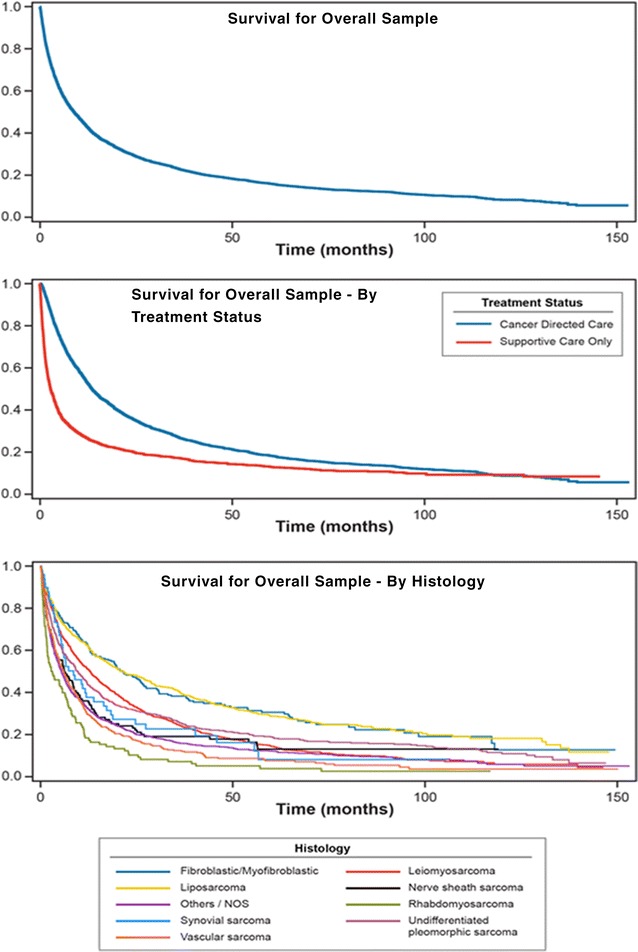
Of 4274 study patients, 2103 (49.2%) were male. Mean age was 77.8 years, and 1539 (36.0%) had distant disease at initial diagnosis. The most common histologic categories were leiomyosarcoma (922[21.6%]), undifferentiated pleomorphic sarcoma (652[15.3%]), and liposarcoma (554[13.0%]). Overall, 1227 (28.7%) patients received first-line systemic therapy. Among these patients, 325 (26.5%) received docetaxel plus gemcitabine and 231 (18.8%) received doxorubicin alone. Only 476 patients received second-line therapy (11.1%), most commonly doxorubicin alone (n = 101). Median overall survival (95% confidence interval) from advanced STS diagnosis was 8.9 (8.3, 9.7) months.
Although previous studies of younger populations reported anthracycline-based therapy predominated in first line, our study of older advanced STS patients found that docetaxel plus gemcitabine was most commonly used. Despite variation by histologic category, prognosis remains poor for older adult patients with advanced STS.
描述美国老年晚期软组织肉瘤(STS)患者的患者和肿瘤特征、治疗方法及生存率,并按特定定义的组织学亚型类别进行分类描述。
我们使用监测、流行病学和最终结果(SEER)数据库进行了一项回顾性队列分析。研究人群包括2001年1月1日至2011年12月31日期间诊断为晚期STS(不包括骨肉瘤、卡波西肉瘤和胃肠道间质瘤)的65岁及以上患者。
4274例研究患者中,2103例(49.2%)为男性。平均年龄为77.8岁,1539例(36.0%)在初次诊断时已有远处转移。最常见的组织学类别为平滑肌肉瘤(922例[21.6%])、未分化多形性肉瘤(652例[15.3%])和脂肪肉瘤(554例[13.0%])。总体而言,1227例(28.7%)患者接受了一线全身治疗。在这些患者中,325例(26.5%)接受了多西他赛加吉西他滨治疗,231例(18.8%)仅接受了阿霉素治疗。只有476例患者接受了二线治疗(11.1%),最常见的是仅接受阿霉素治疗(n = 101)。晚期STS诊断后的中位总生存期(95%置信区间)为8.9(8.3,9.7)个月。
尽管先前针对年轻人群的研究报告一线治疗以蒽环类药物为主,但我们对老年晚期STS患者的研究发现,最常用的是多西他赛加吉西他滨。尽管不同组织学类别存在差异,但老年晚期STS患者的预后仍然很差。