1Public Health Foundation of India, Plot 47, Sector 44, Gurgaon, Haryana 122002 India.
2Department of Public Health Sciences, Faculty of Medicine, University of Liège - Hospital District, Hippocrates Avenue 13 - Building 234000, Liège, Belgium.
Antimicrob Resist Infect Control. 2018 May 2;7:60. doi: 10.1186/s13756-018-0354-9. eCollection 2018.
Antimicrobial resistance (AMR) has been identified as one of the major threats to global health, food security and development today. While there has been considerable attention about the use and misuse of antibiotics amongst human populations in both research and policy environments, there is no definitive estimate of the extent of misuse of antibiotics in the veterinary sector and its contribution to AMR in humans. In this study, we explored the drivers ofirrational usage of verterinary antibiotics in the dairy farming sector in peri-urban India.
The study was conducted in the peri-urban belts of Ludhiana, Guwahati and Bangalore. A total of 54 interviews (formal and non-formal) were carried out across these three sites. Theme guides were developed to explore different drivers of veterinary antimicrobial use. Data was audio recorded and transcribed. Analysis of the coded data set was carried out using AtlasTi. Version 7. Themes emerged inductively from the set of codes.
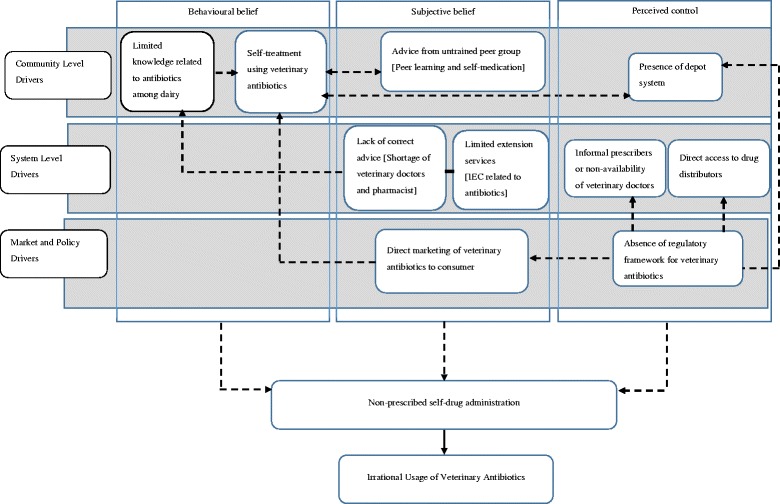
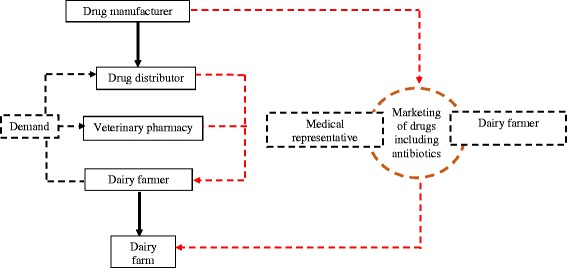
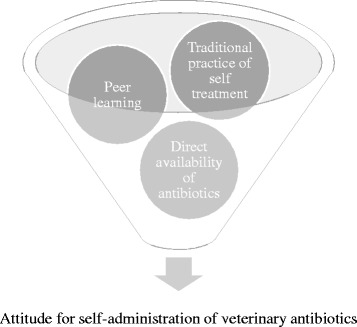
Findings were presented based on concept of 'levels of analyses'. Emergent themes were categorised as individual, health systems, and policy level drivers. Low level of knowledge related to antibiotics among farmers, active informal service providers, direct marketing of drugs to the farmers and easily available antibiotics, dispensed without appropriate prescriptions contributed to easy access to antibiotics, and were identified to be the possible drivers contributing to the non-prescribed and self-administered use of antibiotics in the dairy farms.
Smallholding dairy farmers operated within very small margins of profits. The paucity of formal veterinary services at the community level, coupled with easy availability of antibiotics and the need to ensure profits and minimise losses, promoted non-prescribed antibiotic consumption. It is essential that these local drivers of irrational antibiotic use are understood in order to develop interventions and policies that seek to reduce antibiotic misuse.
抗菌药物耐药性(AMR)已被确认为当今全球健康、粮食安全和发展的主要威胁之一。尽管在研究和政策环境中,人们已经相当关注人类群体中抗生素的使用和滥用问题,但对于兽医领域抗生素滥用的程度及其对人类 AMR 的贡献,尚无明确的估计。在这项研究中,我们探讨了印度城乡结合部奶牛养殖领域兽医抗生素不合理使用的驱动因素。
该研究在 Ludhiana、Guwahati 和 Bangalore 的城乡结合部进行。在这三个地点共进行了 54 次(正式和非正式)访谈。制定了主题指南,以探讨兽医抗菌药物使用的不同驱动因素。对录音和转录的数据进行了分析。使用 AtlasTi 版本 7 对编码数据集进行了分析。主题是从一组代码中归纳出来的。
根据“分析层次”的概念呈现研究结果。新兴主题分为个人、卫生系统和政策层面的驱动因素。农民、活跃的非正规服务提供者、直接向农民推销药品以及抗生素随处可得且无需适当处方就可获得,这些都导致了抗生素的轻易获取,被认为是导致奶牛场非处方和自行使用抗生素的可能驱动因素。
小规模奶牛养殖户的利润微薄。社区一级正规兽医服务的匮乏,加上抗生素的易得性,以及确保利润和尽量减少损失的需要,都促进了抗生素的非处方使用。了解这些导致不合理使用抗生素的地方驱动因素,对于制定旨在减少抗生素滥用的干预措施和政策至关重要。