Hamilton Resource Economics, 7718 Davin Park Dr, Bakersfield, CA, 93308, USA.
Department of Biology, University of Nevada, Reno, NV, 89557, USA.
Environ Manage. 2018 Aug;62(2):365-382. doi: 10.1007/s00267-018-1014-9. Epub 2018 May 9.
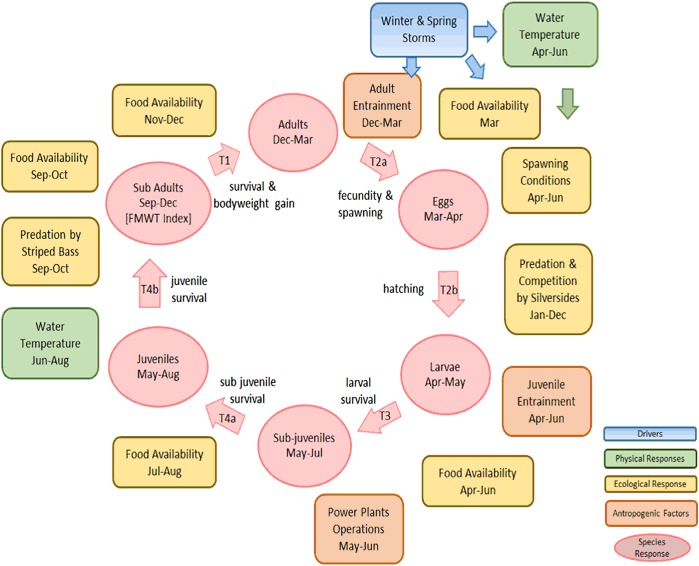
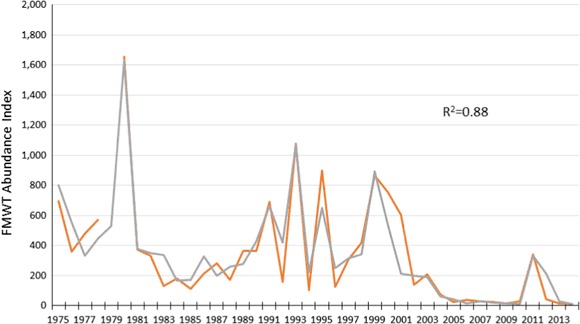
We developed a mechanistic life-cycle model derived from the elicitation of multiple factors influencing the success of individual life-stages of the imperiled delta smelt (Hypomesus transpacificus). We discuss the relevance of limiting factors in population ecology and problems with additive models in detecting them. We identify limiting factors and assess their significance using a non-linear optimization routine, combined with traditional metrics to assess the value of covariates and model performance. After reviewing previous conceptual models and multivariate analyses, we identified a set of factors that were consistent with conceptual models and useful in explaining the erratic fluctuations in a common abundance index: food at certain times in certain locations, predation by introduced species primarily in the spring, and entrainment. The analytical approach provides a transparent and intuitive framework in which to consider the contribution of covariates and consequences for population trends, and has the potential to assist with the evaluation of proposed recovery measures.
我们开发了一种从影响濒危的褐鳟个体生命阶段成功的多个因素的启发中得出的机制生命周期模型。我们讨论了种群生态学中限制因素的相关性以及在检测这些因素时加性模型存在的问题。我们使用非线性优化程序结合传统指标来识别限制因素并评估其重要性,以评估协变量和模型性能的价值。在回顾了以前的概念模型和多元分析之后,我们确定了一组与概念模型一致并有助于解释常见丰度指数波动的因素:在特定时间和地点的食物、主要在春季引入物种的捕食以及夹带。分析方法提供了一个透明直观的框架,可以考虑协变量的贡献以及对种群趋势的影响,并且有可能有助于评估拟议的恢复措施。