Lancet Diabetes Endocrinol. 2018 Jul;6(7):538-546. doi: 10.1016/S2213-8587(18)30079-2. Epub 2018 May 8.
Several studies have shown that diabetes confers a higher relative risk of vascular mortality among women than among men, but whether this increased relative risk in women exists across age groups and within defined levels of other risk factors is uncertain. We aimed to determine whether differences in established risk factors, such as blood pressure, BMI, smoking, and cholesterol, explain the higher relative risks of vascular mortality among women than among men.
In our meta-analysis, we obtained individual participant-level data from studies included in the Prospective Studies Collaboration and the Asia Pacific Cohort Studies Collaboration that had obtained baseline information on age, sex, diabetes, total cholesterol, blood pressure, tobacco use, height, and weight. Data on causes of death were obtained from medical death certificates. We used Cox regression models to assess the relevance of diabetes (any type) to occlusive vascular mortality (ischaemic heart disease, ischaemic stroke, or other atherosclerotic deaths) by age, sex, and other major vascular risk factors, and to assess whether the associations of blood pressure, total cholesterol, and body-mass index (BMI) to occlusive vascular mortality are modified by diabetes.
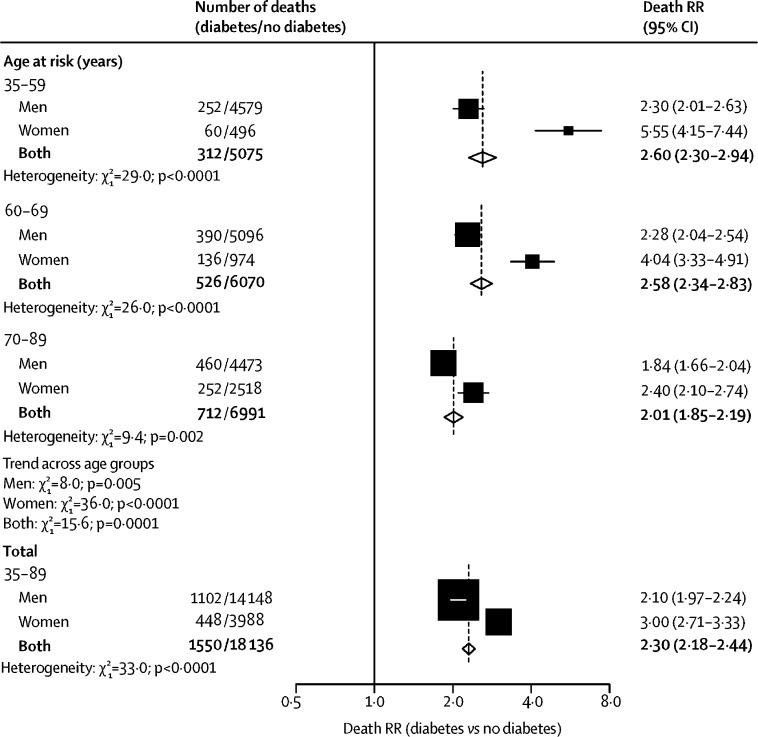
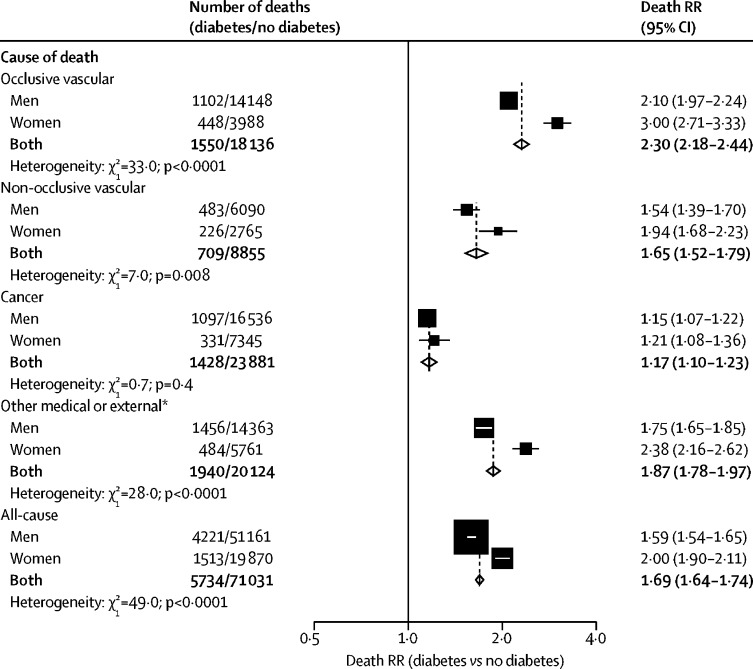
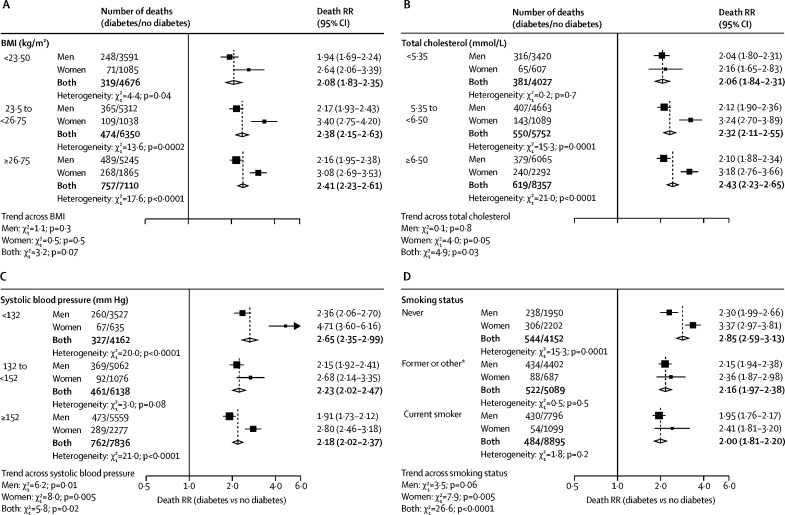
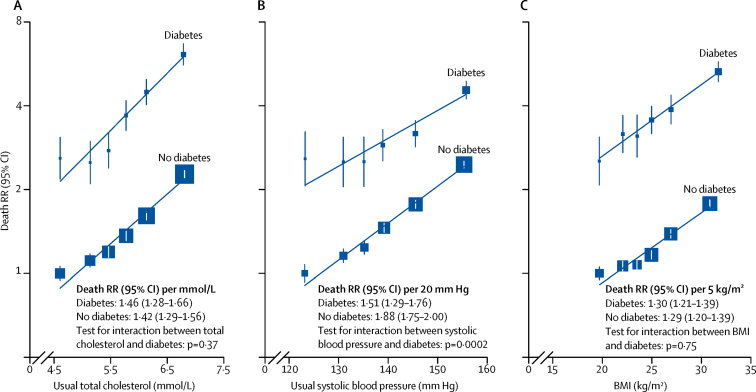
Individual participant-level data were analysed from 980 793 adults. During 9·8 million person-years of follow-up, among participants aged between 35 and 89 years, 19 686 (25·6%) of 76 965 deaths were attributed to occlusive vascular disease. After controlling for major vascular risk factors, diabetes roughly doubled occlusive vascular mortality risk among men (death rate ratio [RR] 2·10, 95% CI 1·97-2·24) and tripled risk among women (3·00, 2·71-3·33; χ test for heterogeneity p<0·0001). For both sexes combined, the occlusive vascular death RRs were higher in younger individuals (aged 35-59 years: 2·60, 2·30-2·94) than in older individuals (aged 70-89 years: 2·01, 1·85-2·19; p=0·0001 for trend across age groups), and, across age groups, the death RRs were higher among women than among men. Therefore, women aged 35-59 years had the highest death RR across all age and sex groups (5·55, 4·15-7·44). However, since underlying confounder-adjusted occlusive vascular mortality rates at any age were higher in men than in women, the adjusted absolute excess occlusive vascular mortality associated with diabetes was similar for men and women. At ages 35-59 years, the excess absolute risk was 0·05% (95% CI 0·03-0·07) per year in women compared with 0·08% (0·05-0·10) per year in men; the corresponding excess at ages 70-89 years was 1·08% (0·84-1·32) per year in women and 0·91% (0·77-1·05) per year in men. Total cholesterol, blood pressure, and BMI each showed continuous log-linear associations with occlusive vascular mortality that were similar among individuals with and without diabetes across both sexes.
Independent of other major vascular risk factors, diabetes substantially increased vascular risk in both men and women. Lifestyle changes to reduce smoking and obesity and use of cost-effective drugs that target major vascular risks (eg, statins and antihypertensive drugs) are important in both men and women with diabetes, but might not reduce the relative excess risk of occlusive vascular disease in women with diabetes, which remains unexplained.
UK Medical Research Council, British Heart Foundation, Cancer Research UK, European Union BIOMED programme, and National Institute on Aging (US National Institutes of Health).
多项研究表明,糖尿病使女性的血管死亡率相对于男性更高,但这种女性的相对风险增加是否存在于不同年龄组和特定水平的其他风险因素中尚不确定。我们旨在确定是否存在诸如血压、BMI、吸烟和胆固醇等既定风险因素的差异,解释女性血管死亡率高于男性的情况。
在我们的荟萃分析中,我们从前瞻性研究协作组和亚太队列研究协作组中获得了个体参与者水平的数据,这些数据获得了年龄、性别、糖尿病、总胆固醇、血压、烟草使用、身高和体重的基线信息。死因数据来自医疗死亡证明。我们使用 Cox 回归模型来评估糖尿病(任何类型)与闭塞性血管死亡率(缺血性心脏病、缺血性中风或其他动脉粥样硬化性死亡)的相关性,按年龄、性别和其他主要血管危险因素进行评估,并评估血压、总胆固醇和体重指数(BMI)与闭塞性血管死亡率的相关性是否因糖尿病而改变。
分析了来自 980793 名成年人的个体参与者水平数据。在 980 万个人年的随访期间,在年龄在 35 至 89 岁之间的参与者中,76965 例死亡中有 19686 例(25.6%)归因于闭塞性血管疾病。在控制主要血管危险因素后,糖尿病使男性的闭塞性血管死亡率风险大致增加两倍(死亡率比[RR]2.10,95%CI 1.97-2.24),使女性的风险增加三倍(3.00,2.71-3.33;χ检验异质性 p<0.0001)。对于男性和女性的总和,在较年轻的个体(35-59 岁:2.60,2.30-2.94)中,闭塞性血管死亡 RR 高于年龄较大的个体(70-89 岁:2.01,1.85-2.19;p=0.0001 用于跨年龄组的趋势),并且在整个年龄组中,女性的死亡 RR 高于男性。因此,女性 35-59 岁的死亡 RR 在所有年龄和性别组中最高(5.55,4.15-7.44)。然而,由于任何年龄的基础调整后的闭塞性血管死亡率在男性中都高于女性,因此糖尿病相关的调整后绝对闭塞性血管死亡率在男性和女性中相似。在 35-59 岁年龄组,女性每年的超额绝对风险为 0.05%(95%CI 0.03-0.07),而男性每年的超额绝对风险为 0.08%(0.05-0.10);在 70-89 岁年龄组,女性的超额绝对风险为每年 1.08%(0.84-1.32),而男性每年的超额绝对风险为 0.91%(0.77-1.05)。总胆固醇、血压和 BMI 均与闭塞性血管死亡率呈连续对数线性关系,无论男女,无论是否患有糖尿病,这种关系在个体之间均相似。
独立于其他主要血管危险因素,糖尿病在男性和女性中均显著增加了血管风险。减少吸烟和肥胖的生活方式改变,以及使用针对主要血管风险的经济有效的药物(如他汀类药物和降压药),对男性和女性的糖尿病患者都很重要,但可能无法降低女性糖尿病患者中闭塞性血管疾病的相对超额风险,这仍有待解释。
英国医学研究理事会、英国心脏基金会、英国癌症研究中心、欧盟 BIOMED 计划和美国国立卫生研究院国家老龄化研究所(美国国立卫生研究院)。