Institute of Cellular Medicine, 4th Floor William Leech Building, Newcastle University, Newcastle upon Tyne, NE2 4HH, UK.
Liver Unit, Freeman Hospital, Newcastle Upon Tyne Hospitals NHS Trust, Newcastle Upon Tyne, UK.
Diabetologia. 2018 Aug;61(8):1700-1711. doi: 10.1007/s00125-018-4632-0. Epub 2018 May 12.
AIMS/HYPOTHESIS: Despite improved understanding of the pathophysiology of type 2 diabetes mellitus, explanations for individual variability in disease progression and response to treatment are incomplete. The gut microbiota has been linked to the pathophysiology of type 2 diabetes mellitus and may account for this variability. We conducted a systematic review to assess the effectiveness of dietary and physical activity/exercise interventions in modulating the gut microbiota and improving glucose control in adults with type 2 diabetes mellitus.
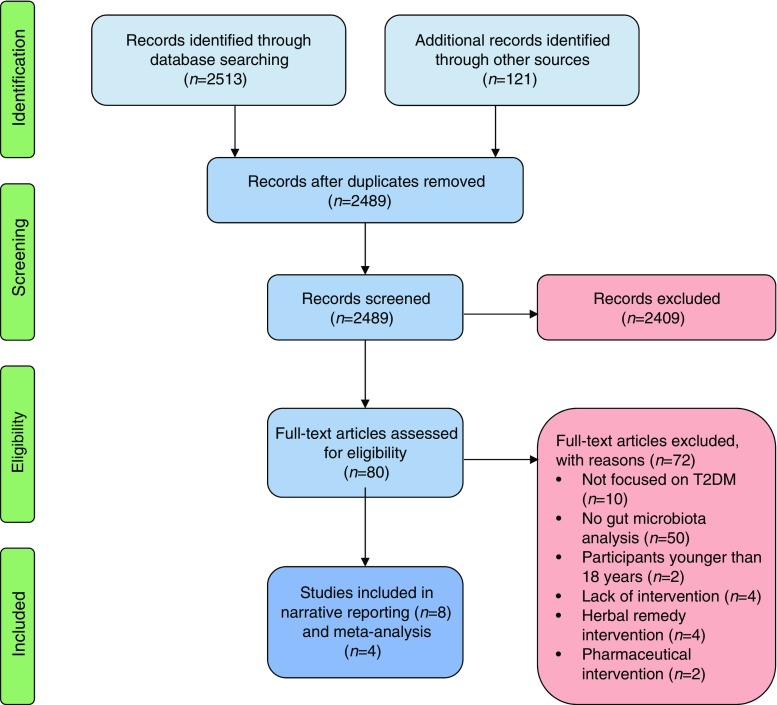
A systematic search was conducted to identify studies reporting on the effect of dietary and physical activity/exercise interventions on the gut microbiota and glucose control in individuals with a confirmed diagnosis of type 2 diabetes mellitus. Study characteristics, methodological quality and details relating to interventions were captured using a data-extraction form. Meta-analyses were conducted where sufficient data were available, and other results were reported narratively.
Eight studies met the eligibility criteria of the systematic review. No studies were found that reported on the effects of physical activity/exercise on the gut microbiota and glucose control. However, studies reporting on dietary interventions showed that such interventions were associated with modifications to the composition and diversity of the gut microbiota. There was a statistically significant improvement in HbA (standardised mean difference [SMD] -2.31 mmol/mol [95% CI -2.76, -1.85] [0.21%; 95% CI -0.26, -0.16]; I = 0%, p < 0.01), but not in fasting blood glucose (SMD -0.25 mmol/l [95% CI -0.85, 0.35], I = 87%, p > 0.05), fasting insulin (SMD -1.82 pmol/l [95% CI -7.23, 3.60], I = 54%, p > 0.05) or HOMA-IR (SMD -0.15 [95% CI -0.63, 0.32], I = 69%, p > 0.05) when comparing dietary interventions with comparator groups. There were no significant changes in the relative abundance of bacteria in the genera Bifidobacterium (SMD 1.29% [95% CI -4.45, 7.03], I = 33%, p > 0.05), Roseburia (SMD -0.85% [95% CI -2.91, 1.21], I = 79%, p > 0.05) or Lactobacillus (SMD 0.04% [95% CI -0.01, 0.09], I = 0%, p > 0.05) when comparing dietary interventions with comparator groups. There were, however, other significant changes in the gut microbiota, including changes at various taxonomic levels, including phylum, family, genus and species, Firmicutes:Bacteroidetes ratios and changes in diversity matrices (α and β). Dietary intervention had minimal or no effect on inflammation, short-chain fatty acids or anthropometrics.
CONCLUSIONS/INTERPRETATION: Dietary intervention was found to modulate the gut microbiota and improve glucose control in individuals with type 2 diabetes. Although the results of the included studies are encouraging, this review highlights the need for further well-conducted interventional studies to inform the clinical use of dietary interventions targeting the gut microbiota.
目的/假设:尽管人们对 2 型糖尿病的病理生理学有了更深入的了解,但对疾病进展和治疗反应的个体差异的解释仍不完整。肠道微生物群与 2 型糖尿病的病理生理学有关,可能是这种变异性的原因。我们进行了一项系统评价,评估饮食和体育活动/运动干预在调节肠道微生物群和改善 2 型糖尿病患者血糖控制方面的有效性。
系统检索了报告饮食和体育活动/运动干预对确诊为 2 型糖尿病患者的肠道微生物群和血糖控制影响的研究。使用数据提取表格捕获研究特征、方法学质量和与干预相关的详细信息。如果有足够的数据,进行了荟萃分析,并以叙述的方式报告了其他结果。
有 8 项研究符合系统评价的纳入标准。没有发现报告体育活动/运动对肠道微生物群和血糖控制影响的研究。然而,报告饮食干预的研究表明,这种干预与肠道微生物群的组成和多样性的改变有关。HbA 有统计学显著改善(标准化均数差 [SMD] -2.31 mmol/mol [95% CI -2.76, -1.85] [0.21%;95% CI -0.26, -0.16];I=0%,p<0.01),但空腹血糖(SMD -0.25 mmol/l [95% CI -0.85, 0.35],I=87%,p>0.05)、空腹胰岛素(SMD -1.82 pmol/l [95% CI -7.23, 3.60],I=54%,p>0.05)或 HOMA-IR(SMD -0.15 [95% CI -0.63, 0.32],I=69%,p>0.05)无统计学显著改善,与对照组相比,饮食干预。双歧杆菌属(SMD 1.29% [95% CI -4.45, 7.03],I=33%,p>0.05)、罗氏菌属(SMD -0.85% [95% CI -2.91, 1.21],I=79%,p>0.05)或乳杆菌属(SMD 0.04% [95% CI -0.01, 0.09],I=0%,p>0.05)的相对丰度无显著变化与对照组相比,饮食干预。然而,肠道微生物群中还存在其他显著变化,包括在门、科、属和种等各种分类水平上的变化,厚壁菌门/拟杆菌门比值和多样性矩阵(α和β)的变化。饮食干预对炎症、短链脂肪酸或人体测量学几乎没有或没有影响。
结论/解释:饮食干预被发现可以调节 2 型糖尿病患者的肠道微生物群并改善血糖控制。尽管纳入研究的结果令人鼓舞,但这篇综述强调需要进一步进行良好设计的干预性研究,以告知针对肠道微生物群的饮食干预的临床应用。
