Balfegó Mariona, Canivell Silvia, Hanzu Felicia A, Sala-Vila Aleix, Martínez-Medina Margarita, Murillo Serafín, Mur Teresa, Ruano Elena G, Linares Francisca, Porras Nuria, Valladares Silvia, Fontalba Maria, Roura Elena, Novials Anna, Hernández Cristina, Aranda Gloria, Sisó-Almirall Antoni, Rojo-Martínez Gemma, Simó Rafael, Gomis Ramon
CIBER in Diabetes and Associated Metabolic Disorders (CIBERDEM), c/ Monforte de Lemos 3-5 Pabellón 11 planta 0, 28029, Madrid, Spain.
Diabetes and Obesity Research Laboratory, August Pi i Sunyer Biomedical Research Institute (IDIBAPS), c/ Roselló 149 planta 5, 08036, Barcelona, Spain.
Lipids Health Dis. 2016 Apr 18;15:78. doi: 10.1186/s12944-016-0245-0.
Nutrition therapy is the cornerstone of treating diabetes mellitus. The inclusion of fish (particularly oily fish) at least two times per week is recommended by current international dietary guidelines for type 2 diabetes. In contrast to a large number of human studies examining the effects of oily fish on different cardiovascular risk factors, little research on this topic is available in patients with type 2 diabetes. The aims of this pilot study were to investigate the effects of a sardine-enriched diet on metabolic control, adiponectin, inflammatory markers, erythrocyte membrane fatty acid (EMFA) composition, and gut microbiota in drug-naïve patients with type 2 diabetes.
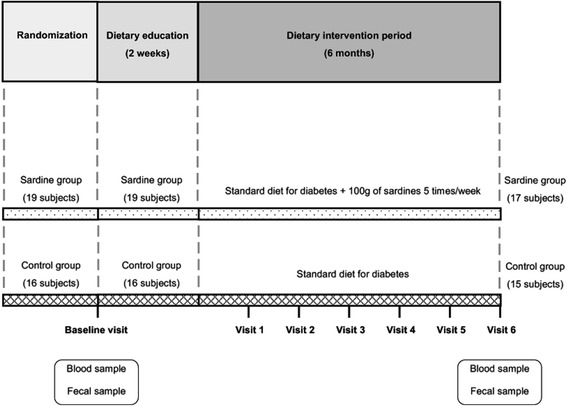
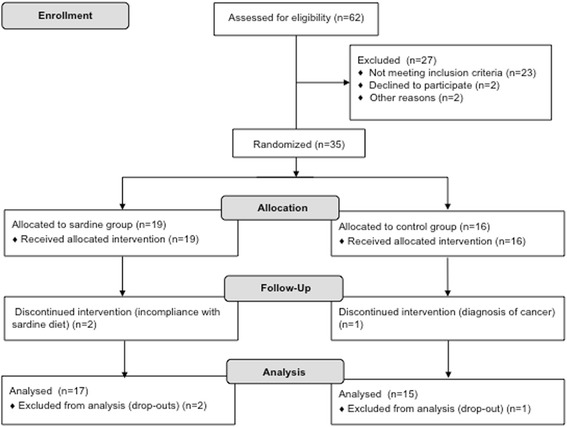
35 drug-naïve patients with type 2 diabetes were randomized to follow either a type 2 diabetes standard diet (control group: CG), or a standard diet enriched with 100 g of sardines 5 days a week (sardine group: SG) for 6 months. Anthropometric, dietary information, fasting glycated hemoglobin, glucose, insulin, adiponectin, inflammatory markers, EMFA and specific bacterial strains were determined before and after intervention.
There were no significant differences in glycemic control between groups at the end of the study. Both groups decreased plasma insulin (SG: -35.3%, P = 0.01, CG: -22.6%, P = 0.02) and homeostasis model of assessment--insulin resistance (HOMA-IR) (SG: -39.2%, P = 0.007, CG: -21.8%, P = 0.04) at 6-months from baseline. However only SG increased adiponectin in plasma compared to baseline level (+40.7%, P = 0.04). The omega-3 index increased 2.6% in the SG compared to 0.6% in the CG (P = 0.001). Both dietary interventions decreased phylum Firmicutes (SG and CG: P = 0.04) and increased E. coli concentrations (SG: P = 0.01, CG: P = 0.03) at the end of the study from baseline, whereas SG decreased Firmicutes/Bacteroidetes ratio (P = 0.04) and increased Bacteroides-Prevotella (P = 0.004) compared to baseline.
Although enriching diet with 100 g of sardines 5 days a week during 6 months to a type 2 diabetes standard diet seems to have neutral effects on glycemic control in drug-naïve patients with type 2 diabetes, this nutritional intervention could have beneficial effects on cardiovascular risk. Furthermore, both dietary interventions decreased HOMA-IR and altered gut microbiota composition of drug-naïve patients with type 2 diabetes.
Trial number and name of the registry: NCT02294526, ClinicalTrials.gov.
营养治疗是糖尿病治疗的基石。当前国际2型糖尿病饮食指南建议每周至少食用两次鱼类(尤其是油性鱼类)。与大量研究油性鱼类对不同心血管危险因素影响的人体研究不同,关于2型糖尿病患者这一主题的研究较少。本初步研究的目的是调查富含沙丁鱼的饮食对初治2型糖尿病患者代谢控制、脂联素、炎症标志物、红细胞膜脂肪酸(EMFA)组成和肠道微生物群的影响。
35例初治2型糖尿病患者被随机分为两组,一组遵循2型糖尿病标准饮食(对照组:CG),另一组遵循每周5天添加100克沙丁鱼的标准饮食(沙丁鱼组:SG),为期6个月。在干预前后测定人体测量指标、饮食信息、空腹糖化血红蛋白、血糖、胰岛素、脂联素、炎症标志物、EMFA和特定细菌菌株。
研究结束时,两组间血糖控制无显著差异。两组在基线后6个月时血浆胰岛素(SG:-35.3%,P = 0.01;CG:-22.6%,P = 0.02)和稳态模型评估-胰岛素抵抗(HOMA-IR)(SG:-39.2%,P = 0.007;CG:-21.8%,P = 0.04)均下降。然而,与基线水平相比,只有SG组血浆脂联素增加(+40.7%,P = 0.04)。SG组的ω-3指数增加了2.6%,而CG组增加了0.6%(P = 0.001)。在研究结束时,与基线相比,两种饮食干预均使厚壁菌门减少(SG和CG:P = 0.04),大肠杆菌浓度增加(SG:P = 0.01,CG:P = 0.03),而SG组与基线相比,厚壁菌门/拟杆菌门比例降低(P = 0.04),拟杆菌-普雷沃菌属增加(P = 0.004)。
虽然在6个月内每周5天在2型糖尿病标准饮食中添加100克沙丁鱼对初治2型糖尿病患者的血糖控制似乎没有显著影响,但这种营养干预可能对心血管风险有有益影响。此外,两种饮食干预均降低了初治2型糖尿病患者的HOMA-IR并改变了其肠道微生物群组成。
试验编号和注册机构名称:NCT02294526,ClinicalTrials.gov。