Read Jordan E, Cabrera-Sharp Victoria, Kitscha Phoebe, Cartwright Judith E, King Peter J, Fowkes Robert C, de Mestre Amanda M
Department Comparative Biomedical Sciences, Royal Veterinary College, London, United Kingdom.
St. Georges Medical School, Molecular and Clinical Sciences Research Institute, University of London, London, United Kingdom.
Front Endocrinol (Lausanne). 2018 Apr 26;9:195. doi: 10.3389/fendo.2018.00195. eCollection 2018.
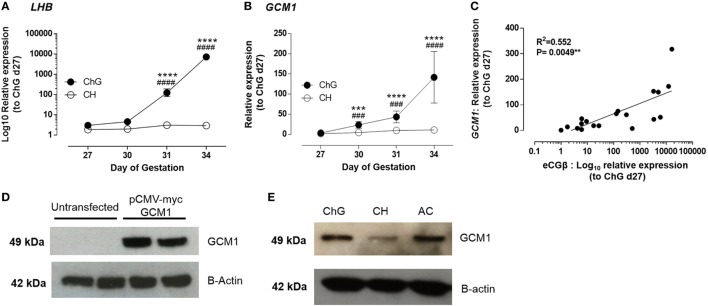
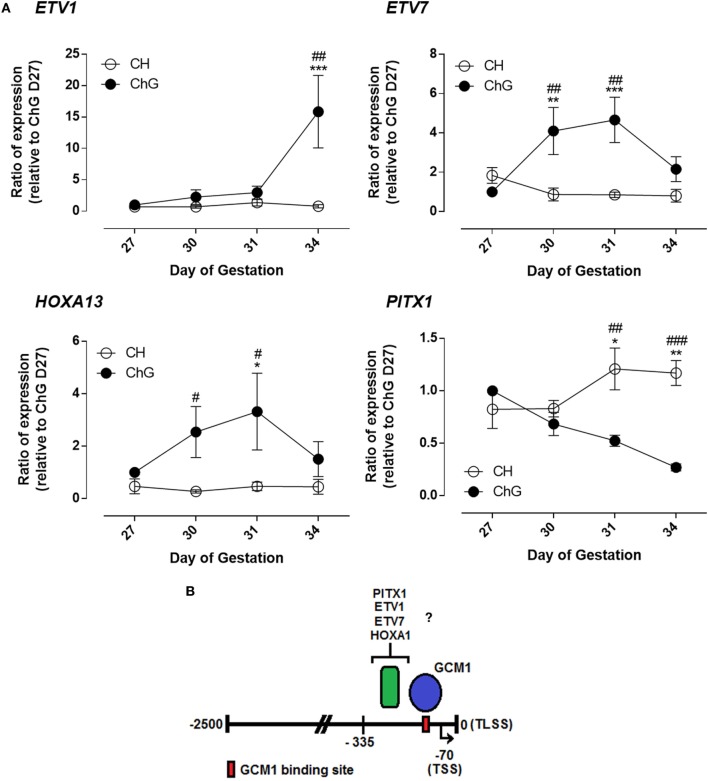
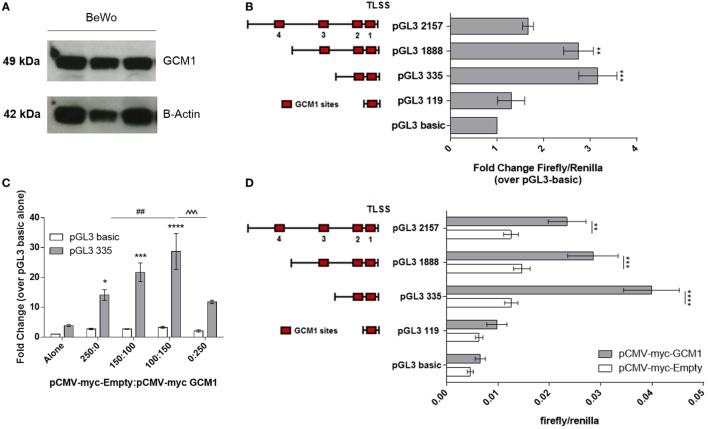
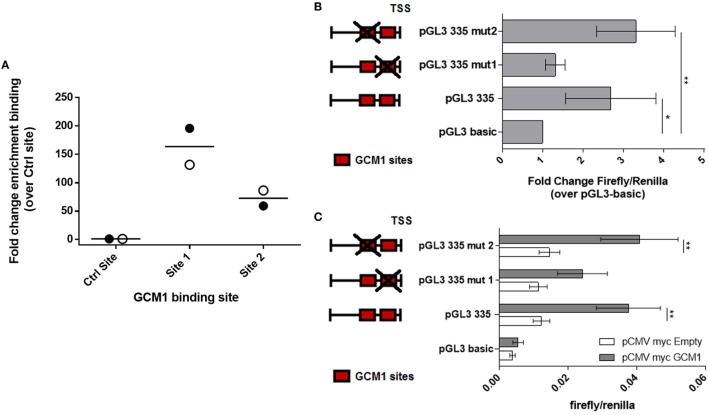
Equine chorionic gonadotrophin (eCG) is a placental glycoprotein critical for early equine pregnancy and used therapeutically in a number of species to support reproductive activity. The factors in trophoblast that transcriptionally regulate eCGβ-subunit (), the gene which confers the hormones specificity for the receptor, are not known. The aim of this study was to determine if glial cells missing 1 regulates promoter activity. Here, studies of the proximal promoter identified four binding sites for glial cells missing 1 (GCM1) and western blot analysis confirmed GCM1 was expressed in equine chorionic girdle (ChG) and surrounding tissues. Luciferase assays demonstrated endogenous activity of the promoter in BeWo choriocarcinoma cells with greatest activity by a proximal 335 bp promoter fragment. Transactivation studies in COS7 cells using an equine GCM1 expression vector showed GCM1 could transactivate the proximal 335 bp promoter. Chromatin immunoprecipitation using primary ChG trophoblast cells showed GCM1 to preferentially bind to the most proximal GCM1-binding site over site 2. Mutation of site 1 but not site 2 resulted in a loss of endogenous promoter activity in BeWo cells and failure of GCM1 to transactivate the promoter in COS-7 cells. Together, these data show that GCM1 binds to site 1 in the promoter but also requires the upstream segment of the promoter between -119 bp and -335 bp of the translation start codon for activity. GCM1 binding partners, ETV1, ETV7, HOXA13, and PITX1, were found to be differentially expressed in the ChG between days 27 and 34 and are excellent candidates for this role. In conclusion, GCM1 was demonstrated to drive the promoter, through direct binding to a predicted GCM1-binding site, with requirement for another factor(s) to bind the proximal promoter to exert this function. Based on these findings, we hypothesize that ETV7 and HOXA13 act in concert with GCM1 to initiate transcription between days 30 and 31, with ETV1 partnering with GCM1 to maintain transcription.
马绒毛膜促性腺激素(eCG)是一种胎盘糖蛋白,对马的早期妊娠至关重要,并在许多物种中用于治疗以支持生殖活动。滋养层中对eCGβ亚基(赋予激素受体特异性的基因)进行转录调控的因子尚不清楚。本研究的目的是确定缺失1的神经胶质细胞是否调节 启动子活性。在此,对 近端启动子的研究确定了四个缺失1的神经胶质细胞(GCM1)结合位点,蛋白质免疫印迹分析证实GCM1在马绒毛膜带(ChG)和周围组织中表达。荧光素酶测定表明,在BeWo绒毛膜癌细胞中 启动子具有内源性活性,其中近端335bp启动子片段活性最强。使用马GCM1表达载体在COS7细胞中进行的反式激活研究表明,GCM1可以反式激活近端335bp 启动子。使用原代ChG滋养层细胞进行的染色质免疫沉淀显示,GCM1优先结合最近端的GCM1结合位点而非位点2。位点1而非位点2的突变导致BeWo细胞中内源性启动子活性丧失,且GCM1无法在COS-7细胞中反式激活启动子。总之,这些数据表明GCM1结合到 启动子中的位点1,但还需要 启动子翻译起始密码子-119bp至-335bp之间的上游片段来发挥活性。发现GCM1结合伙伴ETV1、ETV7、HOXA13和PITX1在第27天至34天之间的ChG中差异表达,是发挥此作用的极佳候选者。总之,通过直接结合预测的GCM1结合位点,证明GCM1驱动 启动子,但需要另一种因子结合近端启动子来发挥此功能。基于这些发现,我们假设ETV7和HOXA13与GCM1协同作用,在第30天至31天之间启动 转录,而ETV1与GCM1合作维持转录。