Kersbergen Inge, Oldham Melissa, Jones Andrew, Field Matt, Angus Colin, Robinson Eric
Department of Psychological Sciences, University of Liverpool, Liverpool, UK.
UK Centre for Tobacco and Alcohol Studies, UK.
Addiction. 2018 May 14;113(9):1598-608. doi: 10.1111/add.14228.
To test whether reducing the standard serving size of alcoholic beverages would reduce voluntary alcohol consumption in a laboratory (study 1) and a real-world drinking environment (study 2). Additionally, we modelled the potential public health benefit of reducing the standard serving size of on-trade alcoholic beverages in the United Kingdom.
Studies 1 and 2 were cluster-randomized experiments. In the additional study, we used the Sheffield Alcohol Policy Model to estimate the number of deaths and hospital admissions that would be averted per year in the United Kingdom if a policy that reduces alcohol serving sizes in the on-trade was introduced.
A semi-naturalistic laboratory (study 1), a bar in Liverpool, UK (study 2).
Students and university staff members (study 1: n = 114, mean age = 24.8 years, 74.6% female), residents from local community (study 2: n = 164, mean age = 34.9 years, 57.3% female).
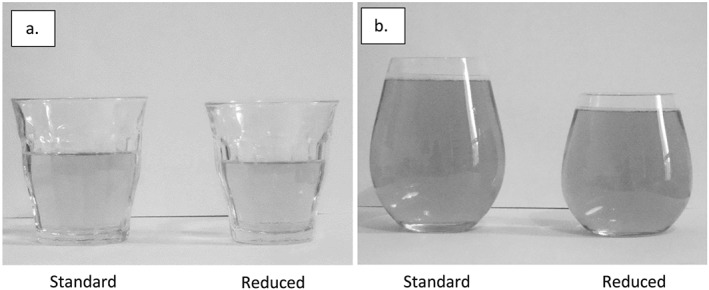
In study 1, participants were assigned randomly to receive standard or reduced serving sizes (by 25%) of alcohol during a laboratory drinking session. In study 2, customers at a bar were served alcohol in either standard or reduced serving sizes (by 28.6-33.3%).
Outcome measures were units of alcohol consumed within 1 hour (study 1) and up to 3 hours (study 2). Serving size condition was the primary predictor.
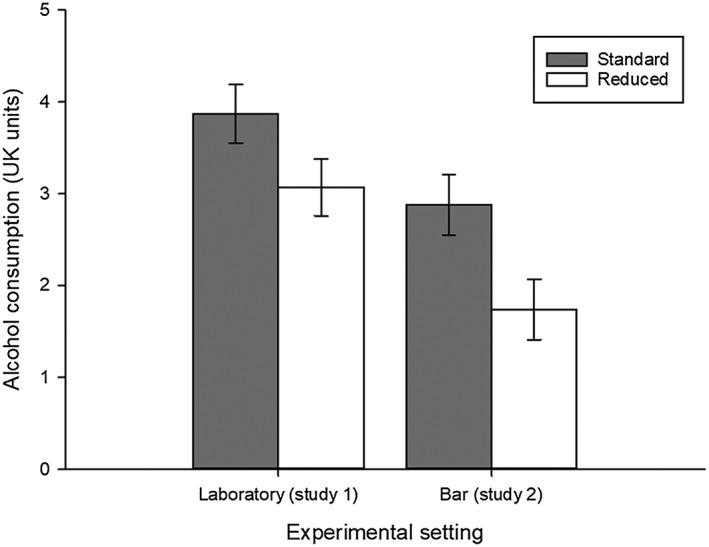
In study 1, a 25% reduction in alcohol serving size led to a 20.7-22.3% reduction in alcohol consumption. In study 2, a 28.6-33.3% reduction in alcohol serving size led to a 32.4-39.6% reduction in alcohol consumption. Modelling results indicated that decreasing the serving size of on-trade alcoholic beverages by 25% could reduce the number of alcohol-related hospital admissions and deaths per year in the United Kingdom by 4.4-10.5% and 5.6-13.2%, respectively.
Reducing the serving size of alcoholic beverages in the United Kingdom appears to lead to a reduction in alcohol consumption within a single drinking occasion.
在实验室环境(研究1)和现实饮酒环境(研究2)中,测试减少酒精饮料标准份量是否会降低酒精的自愿摄入量。此外,我们模拟了在英国减少餐饮场所酒精饮料标准份量可能带来的公共卫生效益。
研究1和研究2为整群随机试验。在附加研究中,我们使用谢菲尔德酒精政策模型来估计,如果在英国实施一项减少餐饮场所酒精份量的政策,每年可避免的死亡人数和住院人数。
一个半自然主义实验室(研究1),英国利物浦的一家酒吧(研究2)。
学生和大学工作人员(研究1:n = 114,平均年龄 = 24.8岁,74.6%为女性),当地社区居民(研究2:n = 164,平均年龄 = 34.9岁,57.3%为女性)。
在研究1中,参与者在实验室饮酒环节被随机分配接受标准份量或减少25%的酒精份量。在研究2中,酒吧顾客被提供标准份量或减少28.6 - 33.3%的酒精份量。
结果指标为1小时内(研究1)和3小时内(研究2)摄入的酒精单位量。份量条件是主要预测因素。
在研究1中,酒精份量减少25%导致酒精摄入量减少20.7 - 22.3%。在研究2中,酒精份量减少28.6 - 33.3%导致酒精摄入量减少32.4 - 39.6%。模型结果表明,将餐饮场所酒精饮料份量减少25%,在英国每年可使与酒精相关的住院人数和死亡人数分别减少4.4 - 10.5%和5.6 - 13.2%。
在英国减少酒精饮料份量似乎会导致单次饮酒场合中酒精摄入量减少。