Division of Graduate Studies and Asia Pacific Institute of Ageing Studies, Lingnan University, Hong Kong, China.
Centre for Settlements Studies, Kwame Nkrumah University of Science and Technology, PMB, Kumasi, Ghana.
Int J Environ Res Public Health. 2018 May 13;15(5):973. doi: 10.3390/ijerph15050973.
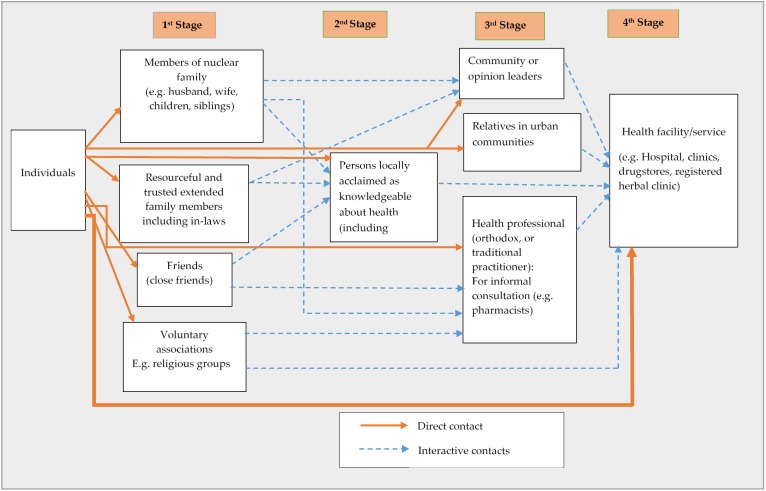
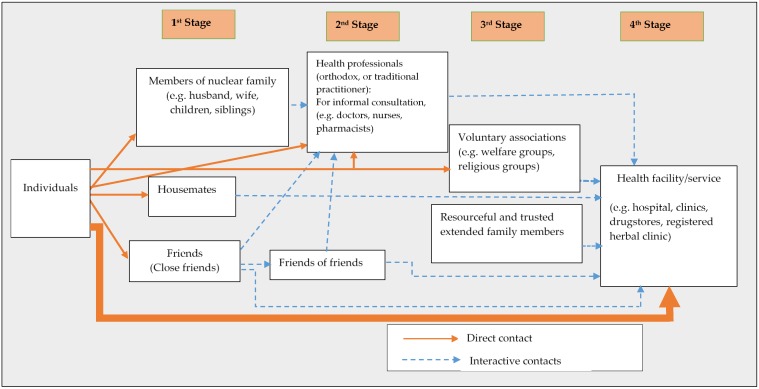
Communities and individuals in many sub-Saharan African countries often face limited access to healthcare. Hence, many rely on social networks to enhance their chances for adequate health care. While this knowledge is well-established, little is known about the nuances of how different population groups activate these networks to improve access to healthcare. This paper examines how rural and urban dwellers in the Ashanti Region in Ghana distinctively and systematically activate their social networks to enhance access to healthcare. It uses a qualitative cross-sectional design, with in-depth interviews of 79 primary participants (28 urban and 51 rural residents) in addition to the views of eight community leaders and eight health personnel. It was discovered that both intimate and distanced social networks for healthcare are activated at different periods by rural and urban residents. Four main stages of social networks activation, comprising different individuals and groups were observed among rural and urban dwellers. Among both groups, physical proximity, privacy, trust and sense of fairness, socio-cultural meaning attached to health problems, and perceived knowledge and other resources (mainly money) held in specific networks inherently influenced social network activation. The paper posits that a critical analysis of social networks may help to tailor policy contents to individuals and groups with limited access to healthcare.
在许多撒哈拉以南非洲国家,社区和个人经常面临获得医疗保健服务的机会有限。因此,许多人依赖社交网络来提高获得充分医疗保健的机会。尽管这方面的知识已经得到充分证实,但对于不同人群如何利用这些网络来改善获得医疗保健的机会,知之甚少。本文探讨了加纳阿散蒂地区的农村和城市居民如何以不同的方式系统地利用他们的社交网络来改善获得医疗保健的机会。该研究采用了定性的横剖设计,对 79 名主要参与者(28 名城市居民和 51 名农村居民)进行了深入访谈,此外还征求了 8 名社区领导和 8 名卫生人员的意见。研究发现,农村和城市居民在不同时期都会激活亲密和疏远的医疗保健社交网络。在农村和城市居民中观察到社交网络激活的四个主要阶段,包括不同的个人和群体。在这两个群体中,物理接近度、隐私、信任和公平感、与健康问题相关的社会文化意义,以及在特定网络中感知到的知识和其他资源(主要是金钱),都对社交网络的激活产生了内在影响。本文认为,对社交网络进行批判性分析可能有助于针对那些获得医疗保健服务有限的个人和群体制定政策内容。