
远程康复游戏能否使帕金森病患者的上肢功能得到改善?
Can telerehabilitation games lead to functional improvement of upper extremities in individuals with Parkinson's disease?
作者信息
Cikajlo Imre, Hukić Alma, Dolinšek Irena, Zajc Dejana, Vesel Mateja, Krizmanič Tatjana, Blažica Bojan, Biasizzo Anton, Novak Franc, Peterlin Potisk Karmen
机构信息
University Rehabilitation Institute, Research and Development Unit.
University of Nova Gorica, School of Engineering and Management, Nova Gorica, Slovenia.
出版信息
Int J Rehabil Res. 2018 Sep;41(3):230-238. doi: 10.1097/MRR.0000000000000291.
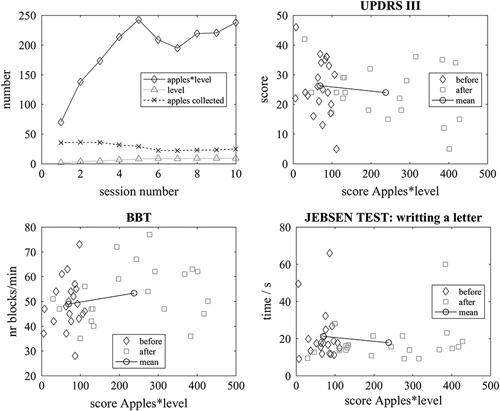
Parkinson's disease (PD) is treated by medication, less with deep brain stimulation and physiotherapy. Different opinions on the clinical meaningfulness of the physiotherapy or recommended intensive physiotherapy were found. Our objectives were to design intensive target-based physiotherapy for upper extremities suitable for telerehabilitation services and examine the clinical meaningfulness of the exergaming at an unchanged medication plan. A telerehabilitation exergaming system using the Kinect sensor was developed; 28 patients with PD participated in the study. The system followed the participants' movements and adapted the difficulty level of the game in real time. The outcomes of the study showed that seven out of 26 participants could set up the equipment at home alone. Clinical outcomes of Box and Blocks Test (mean: 47 vs. 52, P=0.002, Cohen's d=0.40), UPDRS III (mean: 27 vs. 29, P=0.001, d=0.22), and daily activity Jebsen's test; writing a letter (mean: 24.0 vs. 20.6, P=0.003, d=0.23); and moving light objects (mean: 4.4 vs. 3.9, P=0.006, d=0.46) were statistically significant (P<0.05) and considered clinically meaningful. The Nine-Hole Peg Test showed a statistically nonsignificant improvement (mean: 28.0 vs. 26.5, P=0.089, d=0.22). The participants claimed problems with mobility but less with activities of daily living and emotional well-being (PDQ-39). The findings lead to preliminary conclusions that exergaming is feasible, but may require technical assistance, whereas clinically meaningful results could be achieved according to validated instruments and an unchanged medication plan in individuals with PD.
帕金森病(PD)的治疗方法包括药物治疗,较少采用深部脑刺激和物理治疗。对于物理治疗的临床意义或推荐的强化物理治疗,存在不同观点。我们的目标是设计适合远程康复服务的上肢强化目标导向物理治疗,并在药物治疗方案不变的情况下,检验运动游戏的临床意义。开发了一种使用Kinect传感器的远程康复运动游戏系统;28名帕金森病患者参与了该研究。该系统跟踪参与者的动作,并实时调整游戏难度级别。研究结果显示,26名参与者中有7人能够独自在家中设置设备。箱块测试(平均:47对52,P = 0.002,科恩d值 = 0.40)、统一帕金森病评定量表第三部分(平均:27对29,P = 0.001,d = 0.22)以及日常活动杰布森测试的临床结果;写信(平均:24.0对20.6,P = 0.003,d = 0.23);以及移动轻质物体(平均:4.4对3.9,P = 0.006,d = 0.46)具有统计学显著性(P < 0.05),并被认为具有临床意义。九孔插板测试显示有统计学意义但不显著的改善(平均:28.0对26.5,P = 0.089,d = 0.22)。参与者称存在行动不便问题,但日常生活活动和情绪健康方面(帕金森病问卷-39)的问题较少。研究结果得出初步结论,运动游戏是可行的,但可能需要技术协助,而根据经过验证的工具和帕金森病患者不变的药物治疗方案,可以取得具有临床意义的结果。



 Zotero 插件