Eaton-Peabody Laboratories, Massachusetts Eye and Ear, Boston, MA 02114.
Department of Otolaryngology, Harvard Medical School, Boston, MA 02115.
Proc Natl Acad Sci U S A. 2018 May 29;115(22):5762-5767. doi: 10.1073/pnas.1720979115. Epub 2018 May 14.
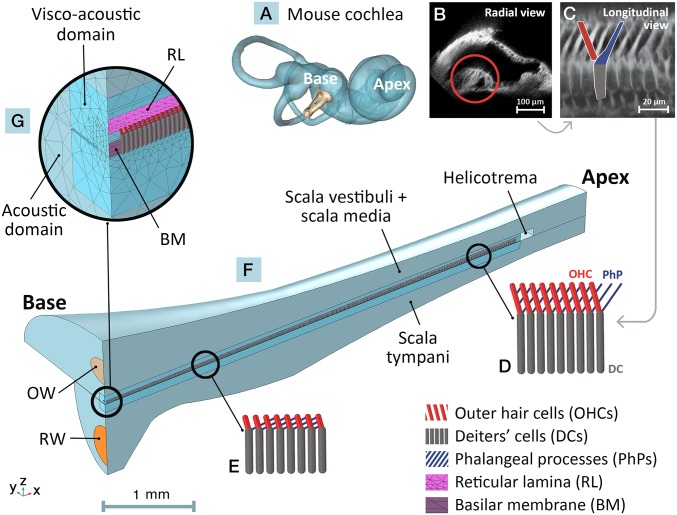
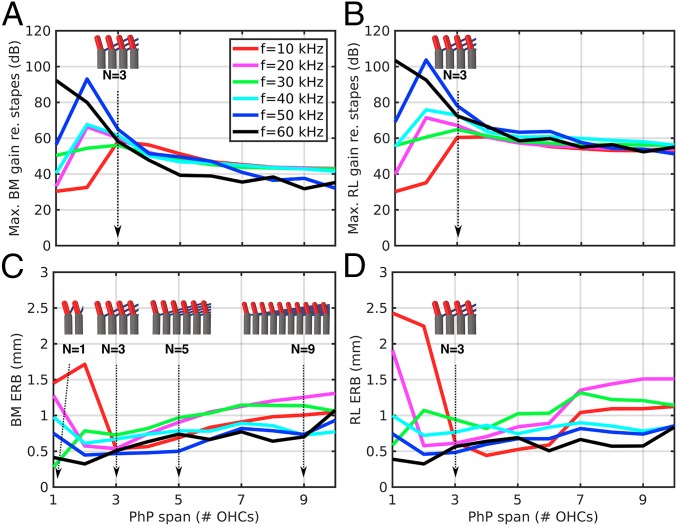
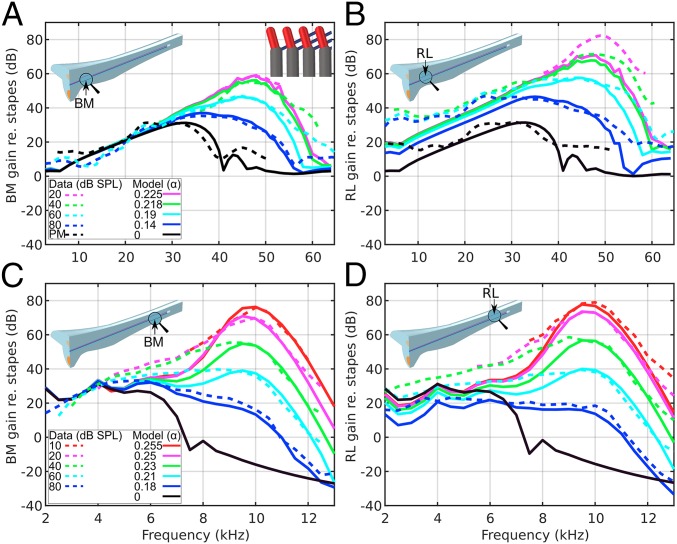
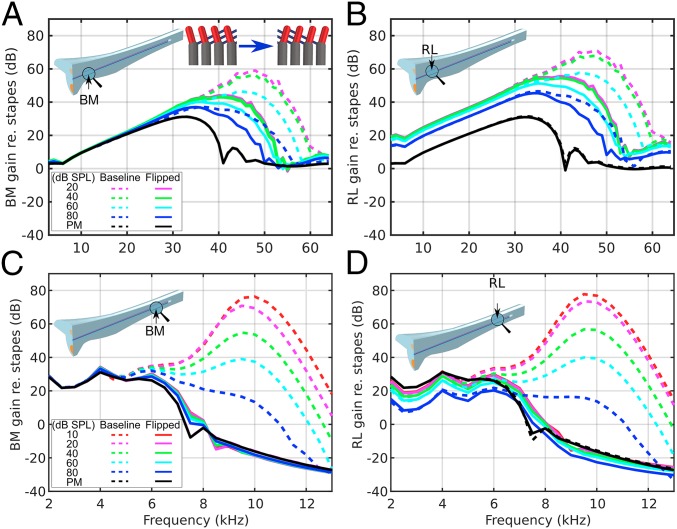
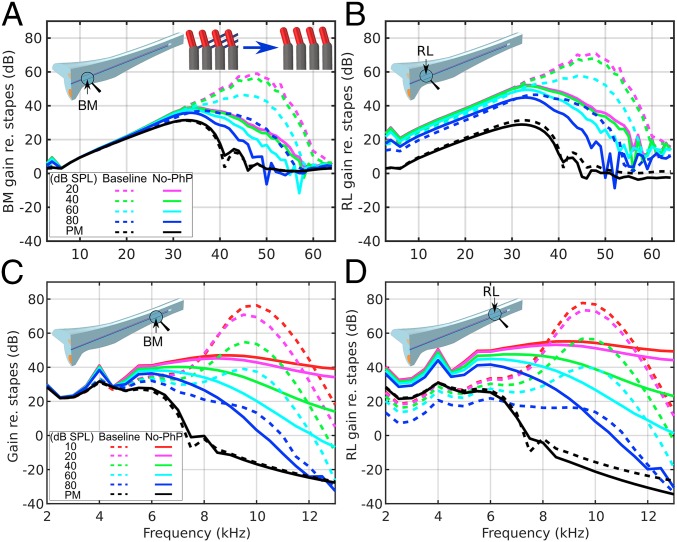
The field of cochlear mechanics has been undergoing a revolution due to recent findings made possible by advancements in measurement techniques. While it has long been assumed that basilar-membrane (BM) motion is the most important determinant of sound transduction by the inner hair cells (IHCs), it turns out that other parts of the sensory epithelium closer to the IHCs, such as the reticular lamina (RL), move with significantly greater amplitude for weaker sounds. It has not been established how these findings are related to the complex cytoarchitecture of the organ of Corti between the BM and RL, which is composed of a lattice of asymmetric Y-shaped elements, each consisting of a basally slanted outer hair cell (OHC), an apically slanted phalangeal process (PhP), and a supporting Deiters' cell (DC). Here, a computational model of the mouse cochlea supports the hypothesis that the OHC micromotors require this Y-shaped geometry for their contribution to the exquisite sensitivity and frequency selectivity of the mammalian cochlea. By varying only the OHC gain parameter, the model can reproduce measurements of BM and RL gain and tuning for a variety of input sound levels. Malformations such as reversing the orientations of the OHCs and PhPs or removing the PhPs altogether greatly reduce the effectiveness of the OHC motors. These results imply that the DCs and PhPs must be properly accounted for in emerging OHC regeneration therapies.
由于测量技术的进步,耳蜗力学领域发生了革命性的变化。虽然长期以来人们一直认为基底膜(BM)运动是内毛细胞(IHC)声转导的最重要决定因素,但事实证明,感觉上皮中更靠近 IHC 的其他部分,如网状层(RL),对于较弱的声音,其运动幅度要大得多。目前尚不清楚这些发现与 BM 和 RL 之间的 Corti 器官的复杂细胞结构有何关系,该结构由一系列不对称的 Y 形元素组成,每个元素都由一个基底倾斜的外毛细胞(OHC)、一个顶倾斜的指状突(PhP)和一个支持的 Deiters 细胞(DC)组成。在这里,一个小鼠耳蜗的计算模型支持了这样的假设,即 OHC 微马达需要这种 Y 形几何形状才能为哺乳动物耳蜗的高灵敏度和频率选择性做出贡献。通过仅改变 OHC 增益参数,该模型可以重现各种输入声级下 BM 和 RL 增益和调谐的测量值。畸形,如反转 OHC 和 PhP 的方向或完全去除 PhP,会大大降低 OHC 马达的效率。这些结果表明,在新兴的 OHC 再生治疗中,必须正确考虑 DC 和 PhP。