Department of Infectious Diseases, University of Rochester Medical Center, New York.
School of Public Health, The University of Hong Kong.
J Infect Dis. 2018 Aug 24;218(7):1054-1060. doi: 10.1093/infdis/jiy291.
Influenza A pandemics cause significant mortality and morbidity. H2N2 viruses have caused a prior pandemic, and are circulating in avian reservoirs. The age-related frequency of current population immunity to H2 viruses was evaluated.
Hemagglutinin inhibition (HAI) assays against historical human and recent avian influenza A(H2N2) viruses were performed across age groups in Rochester, New York, and Hong Kong, China. The impact of existing cross-reactive HAI immunity on the effective reproduction number was modeled.
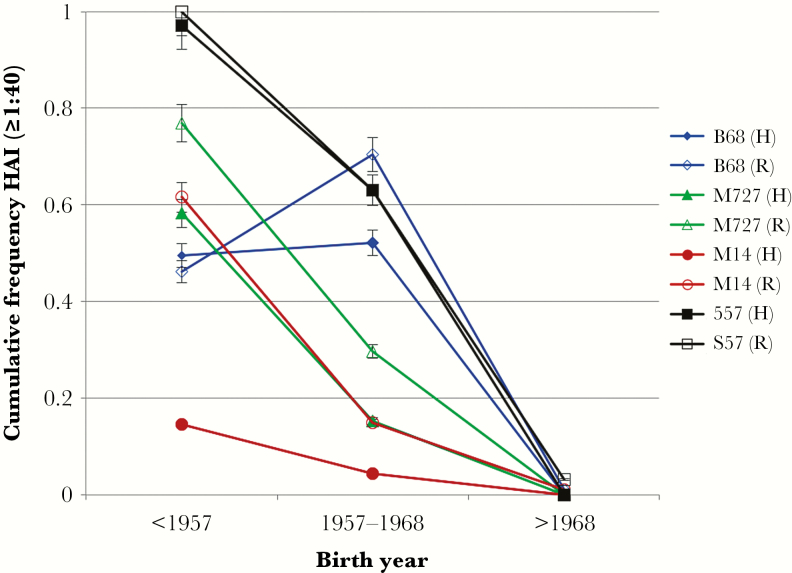
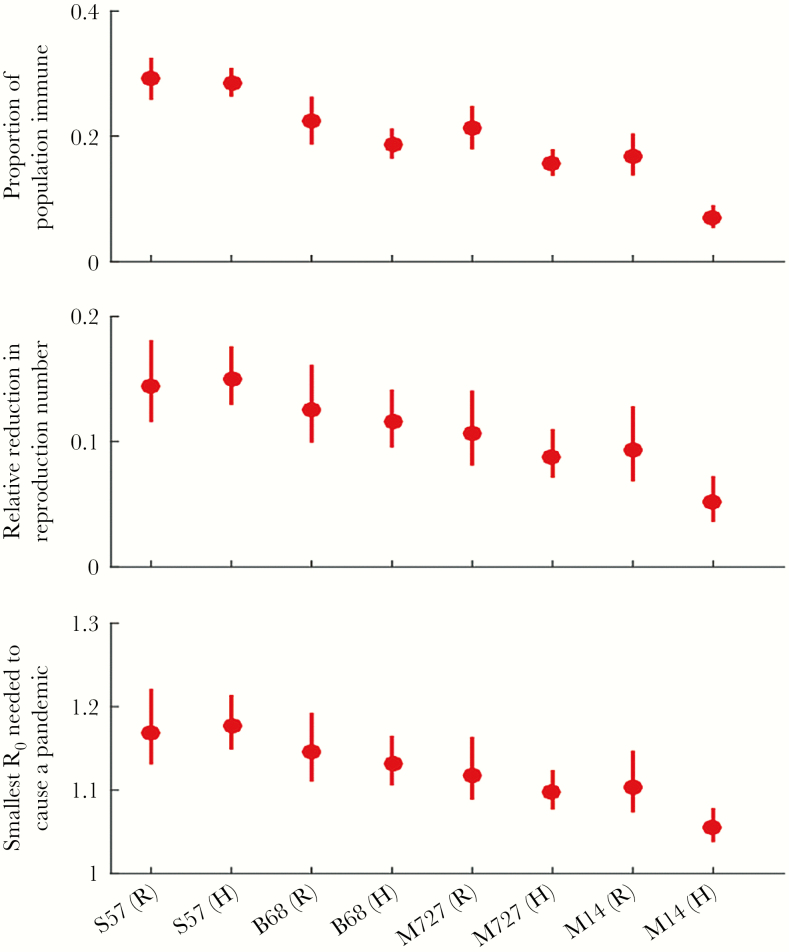
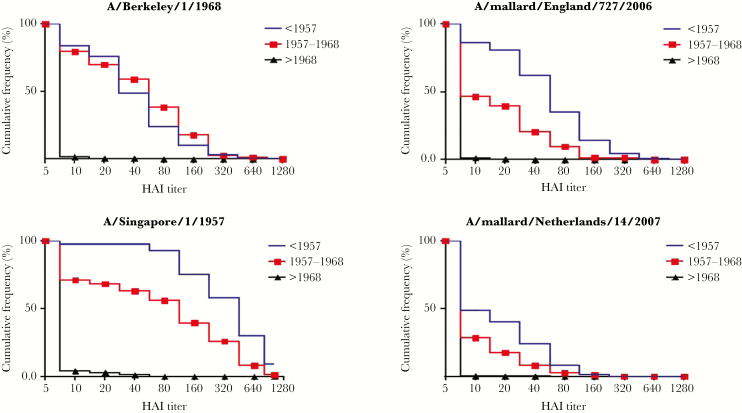
One hundred fifty individual sera from Rochester and 295 from Hong Kong were included. Eighty-five percent of patients born in Rochester and Hong Kong before 1968 had HAI titers ≥1:40 against A/Singapore/1/57, and >50% had titers ≥1:40 against A/Berkeley/1/68. The frequency of titers ≥1:40 to avian H2N2 A/mallard/England/727/06 and A/mallard/Netherlands/14/07 in subjects born before 1957 was 62% and 24%, respectively. There were no H2 HAI titers >1:40 in individuals born after 1968. These levels of seroprevalence reduce the initial reproduction number of A/Singapore/1/1957 or A/Berkeley/1/68 by 15%-20%. A basic reproduction number (R0) of the emerging transmissible virus <1.2 predicts a preventable pandemic.
Population immunity to H2 viruses is insufficient to block epidemic spread of H2 virus. An H2N2 pandemic would have lower impact in those born before 1968.
甲型流感大流行可导致严重的死亡率和发病率。H2N2 病毒曾引发过一次大流行,目前存在于禽类储库中。本研究评估了当前人群对 H2 病毒的年龄相关免疫频率。
在纽约罗切斯特和中国香港,对各年龄段人群进行了针对历史上的人类和近期的甲型流感 A(H2N2)病毒的血凝抑制(HAI)检测。对现有交叉反应性 HAI 免疫对有效繁殖数的影响进行了建模。
罗切斯特和香港各有 150 份和 295 份个体血清被纳入研究。1968 年以前在罗切斯特和香港出生的 85%的患者对 A/Singapore/1/57 的 HAI 滴度≥1:40,>50%的患者对 A/Berkeley/1/68 的 HAI 滴度≥1:40。1957 年前出生的受试者对 A/mallard/England/727/06 和 A/mallard/Netherlands/14/07 的 H2N2 禽源 HAI 滴度≥1:40 的频率分别为 62%和 24%。1968 年后出生的个体均无 H2 HAI 滴度>1:40。这些血清阳性率水平使 A/Singapore/1/1957 或 A/Berkeley/1/68 的初始繁殖数减少 15%-20%。具有<1.2 的基本繁殖数(R0)的新发可传播病毒可预防大流行。
人群对 H2 病毒的免疫力不足以阻止 H2 病毒的流行传播。1968 年前出生的人群发生 H2N2 大流行的影响较小。