Emerg Infect Dis. 2022 May;28(5):977-985. doi: 10.3201/eid2805.211965.
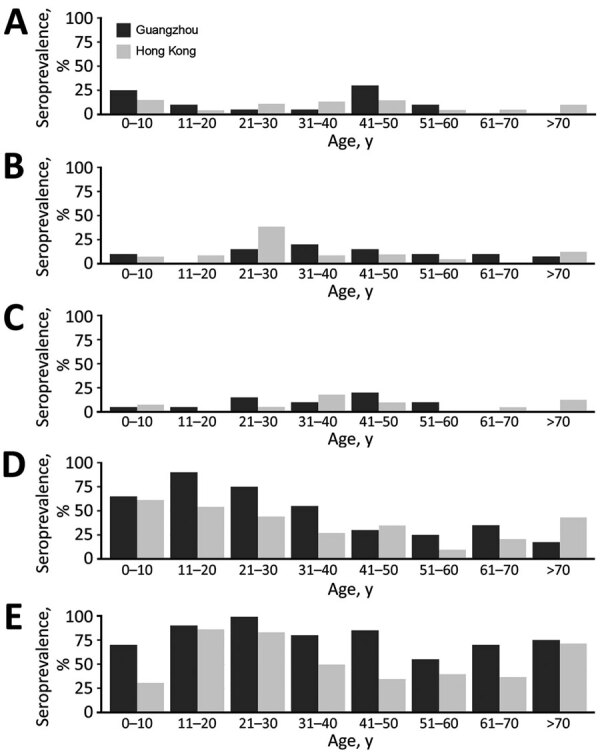
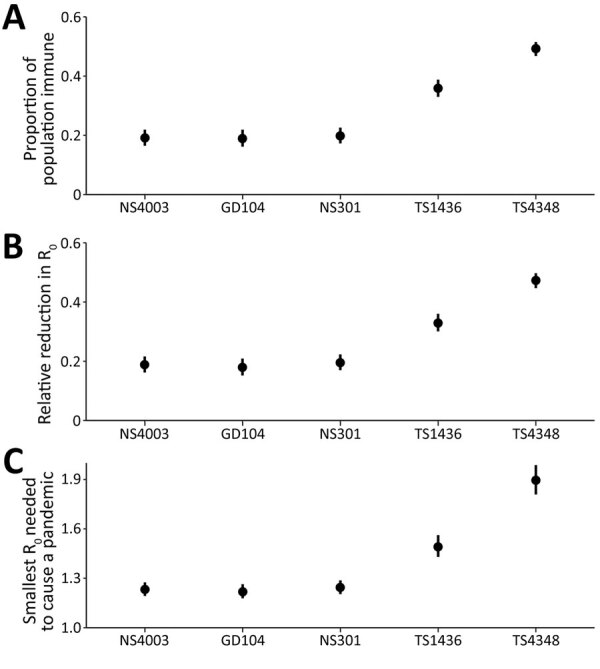
Zoonotic influenza infections continue to threaten human health. Ongoing surveillance and risk assessment of animal viruses are needed for pandemic preparedness, and population immunity is an important component of risk assessment. We determined age-stratified hemagglutinin inhibition seroprevalence against 5 swine influenza viruses circulating in Hong Kong and Guangzhou in China. Using hemagglutinin inhibition seroprevalence and titers, we modeled the effect of population immunity on the basic reproduction number (R) if each virus were to become transmissible among humans. Among 353 individual serum samples, we reported low seroprevalence for triple-reassortant H1N2 and Eurasian avian-like H1N1 influenza viruses, which would reduce R by only 18%-20%. The smallest R needed to cause a pandemic was 1.22-1.24, meaning existing population immunity would be insufficient to block the spread of these H1N1 or H1N2 variants. For human-origin H3N2, existing population immunity could suppress R by 47%, thus reducing pandemic risk.
动物源性流感病毒持续威胁人类健康。为做好大流行防范工作,需对动物病毒进行持续监测和风险评估,人群免疫是风险评估的重要组成部分。本研究测定了 5 种在香港和广州流行的猪流感病毒的血凝素抑制抗体血清阳性率,并按年龄分层。根据血凝素抑制抗体血清阳性率和滴度,我们构建了模型,模拟如果这些病毒在人际间传播,人群免疫对基本再生数(R)的影响。在 353 份个体血清样本中,三重基因重配 H1N2 和欧亚禽源 H1N1 流感病毒的血清阳性率较低,仅降低 R 值 18%-20%。引发大流行所需的最小 R 值为 1.22-1.24,这意味着现有的人群免疫力不足以阻止这些 H1N1 或 H1N2 变异株的传播。对于人源 H3N2,现有的人群免疫力可降低 R 值 47%,从而降低大流行风险。