Department of Oncology, The Third Affiliated Hospital of Anhui Medical University, Hefei, Anhui, China (mainland).
Med Sci Monit. 2018 May 15;24:3193-3203. doi: 10.12659/MSM.909977.
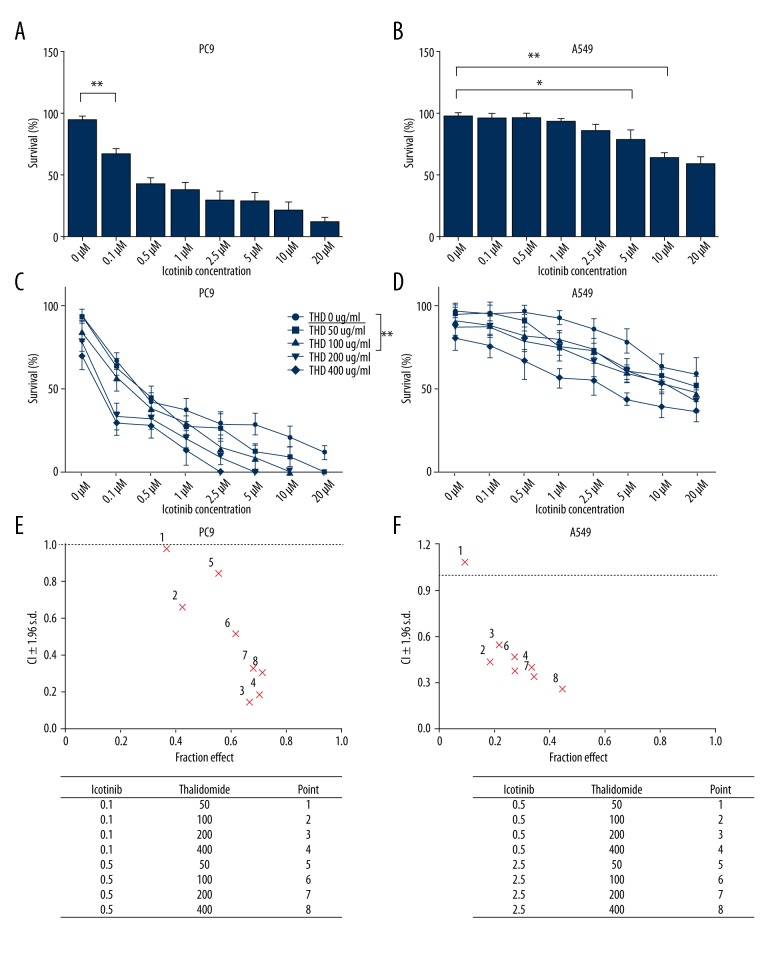
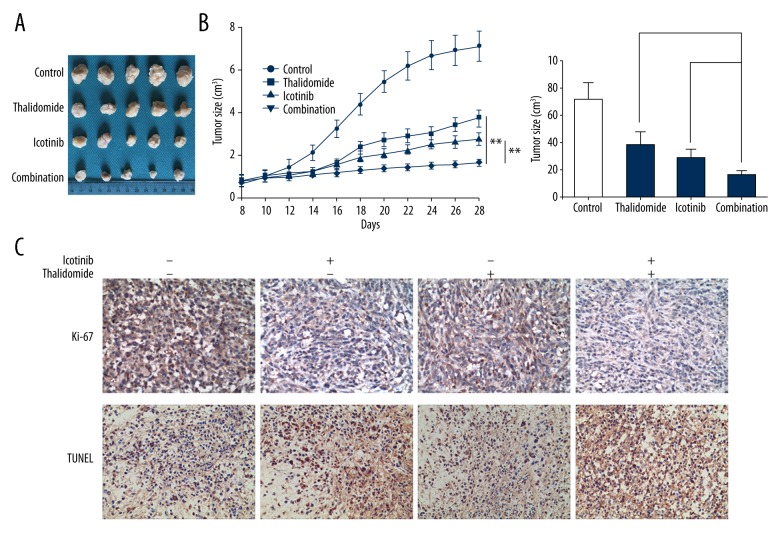
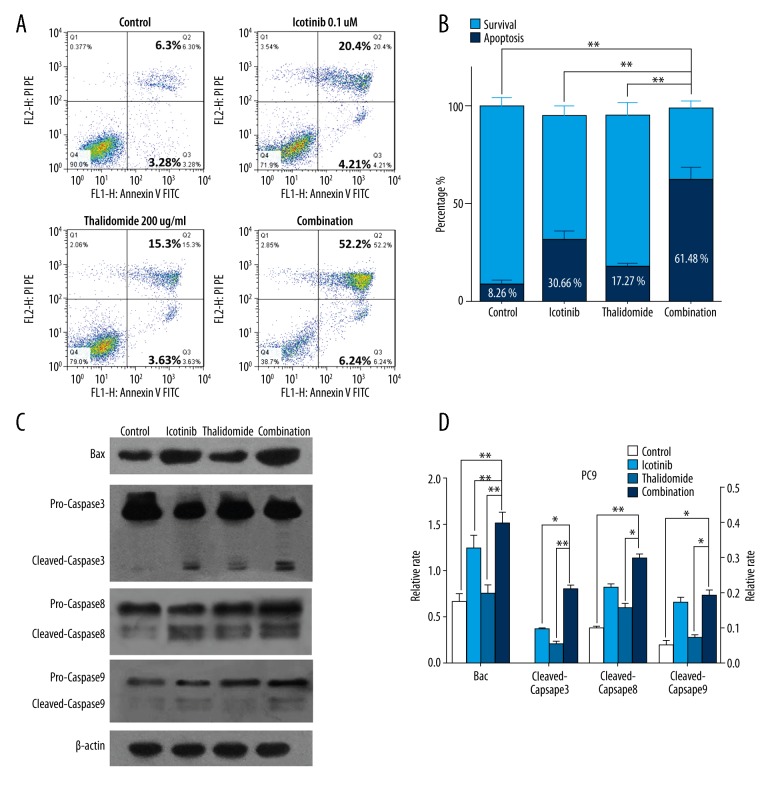
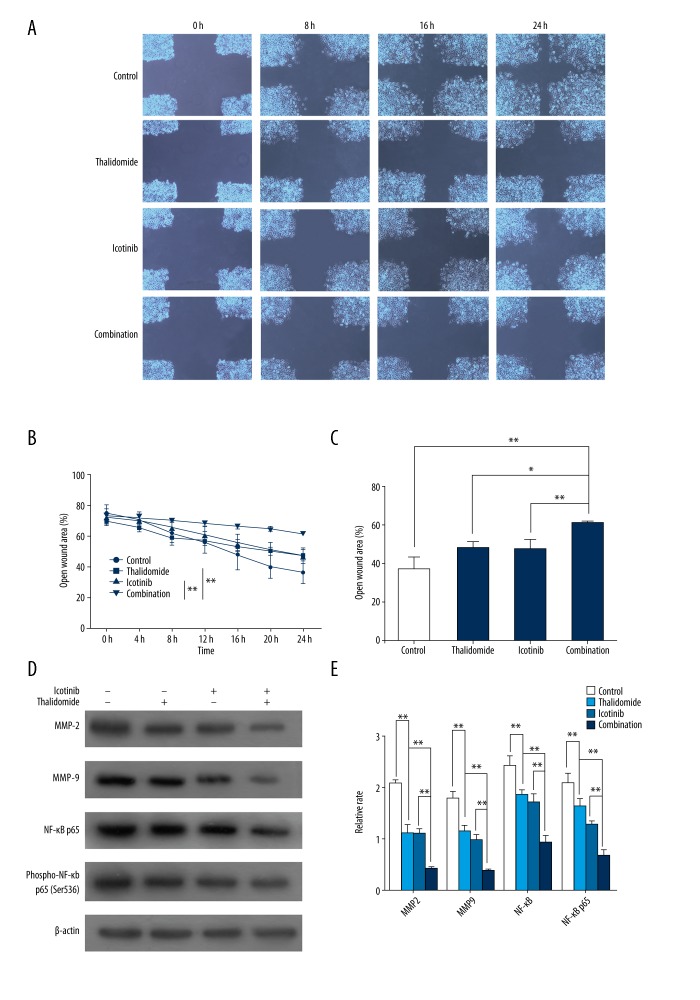
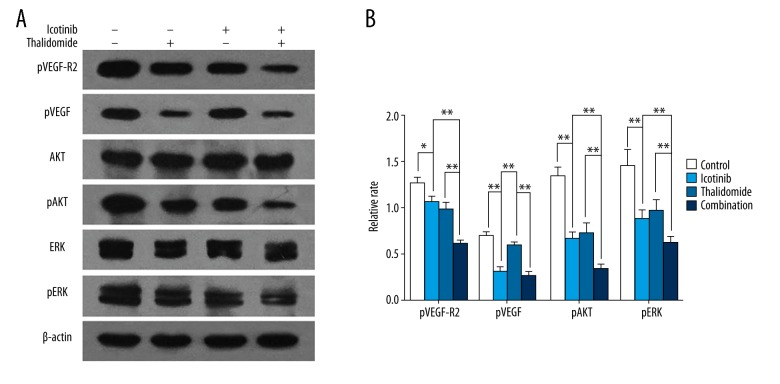
BACKGROUND Epidermal growth factor receptor tyrosine kinase inhibitors (EGFR-TKIs) have been widely used in the treatment of non-small cell lung cancer (NSCLC) patients with sensitive EGFR mutations. However, the survival of patients with EGFR-TKI administration is limited by the inevitable development of acquired drug resistance. Recently, multi-targeted drugs combination has been shown to be a promising strategy to improve the efficacy of EGFR-TKI treatment and enable the reduction of drug resistance in NSCLC. MATERIAL AND METHODS Humanized NSCLC cell lines PC9 and A549 were co-cultured with thalidomide and/or icotinib to test for anti-tumor efficiency. Cell proliferation was measured by MTT assay, cell apoptosis by flow cytometry and cell migration by wound healing assay. Western blot was performed to determine the expression of caspase-3, -8, -9, Bax, EGFR, VEGF-R, AKT, ERK, MMP2, MMP9, and NF-κB. The xenograft mouse model was used to explore the effects of thalidomide and icotinib in vivo. Immunohistochemical testing was used to determine the expression of Ki-67 and TUNEL staining in tumor tissues. RESULTS Treatments of thalidomide and/or icotinib reduced cell viability, induced apoptosis, and suppressed migration. Attenuation of pEGFR and pVEGF-R resulted in deactivation of ERK and AKT pathways, which eventually increased the anti-proliferative response. In PC9 xenograft model, combined administration of thalidomide and icotinib restrained tumor growth with remarkable reduced Ki-67 index and increased TUNEL positive cells. CONCLUSIONS Thalidomide sensitizes icotinib to increase apoptosis and prevent migration, and it may be a potentially promising anti-tumor drug in lung cancer multi-modality therapy.
表皮生长因子受体酪氨酸激酶抑制剂(EGFR-TKIs)已广泛用于治疗具有敏感 EGFR 突变的非小细胞肺癌(NSCLC)患者。然而,接受 EGFR-TKI 治疗的患者的生存时间受到不可避免的获得性耐药发展的限制。最近,多靶点药物联合已被证明是一种有前途的策略,可以提高 EGFR-TKI 治疗的疗效,并减少 NSCLC 中的耐药性。
用人源化 NSCLC 细胞系 PC9 和 A549 与沙利度胺和/或伊可替尼共培养,以测试抗肿瘤效率。通过 MTT 测定法测量细胞增殖,通过流式细胞术测量细胞凋亡,通过划痕愈合试验测量细胞迁移。通过 Western blot 测定法确定 caspase-3、-8、-9、Bax、EGFR、VEGF-R、AKT、ERK、MMP2、MMP9 和 NF-κB 的表达。使用异种移植小鼠模型探索沙利度胺和伊可替尼在体内的作用。免疫组织化学检测用于确定肿瘤组织中 Ki-67 的表达和 TUNEL 染色。
沙利度胺和/或伊可替尼的治疗降低了细胞活力,诱导了细胞凋亡,并抑制了细胞迁移。pEGFR 和 pVEGF-R 的衰减导致 ERK 和 AKT 通路失活,最终增加了抗增殖反应。在 PC9 异种移植模型中,沙利度胺和伊可替尼联合给药可抑制肿瘤生长,显著降低 Ki-67 指数并增加 TUNEL 阳性细胞。
沙利度胺增敏伊可替尼增加细胞凋亡并防止细胞迁移,它可能是肺癌多模式治疗中一种有前途的潜在抗肿瘤药物。