Immune Cells and Antibody Engineering Research Center of Guizhou Province/Key Laboratory of Biology and Medical Engineering, Guizhou Medical University, Guiyang, Guizhou, China (mainland).
School of Biology and Engineering, Guizhou Medical University, Guiyang, Guizhou, China (mainland).
Med Sci Monit. 2021 Mar 8;27:e929004. doi: 10.12659/MSM.929004.
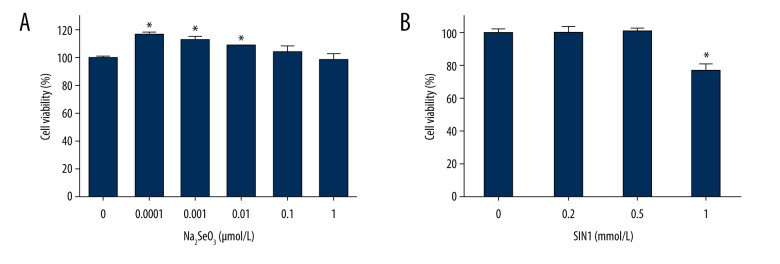
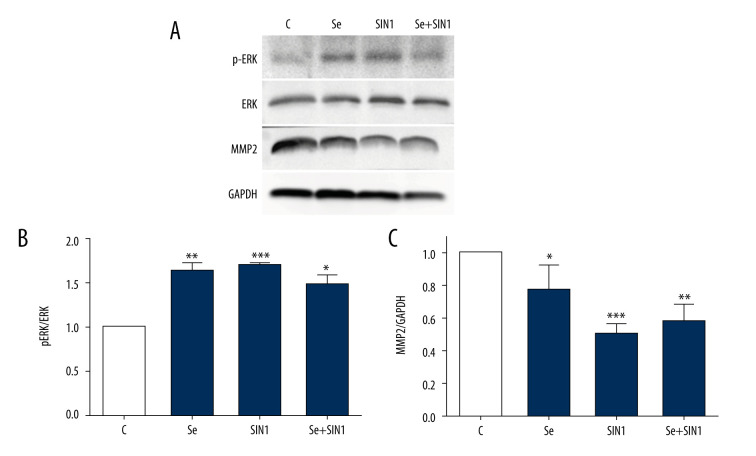
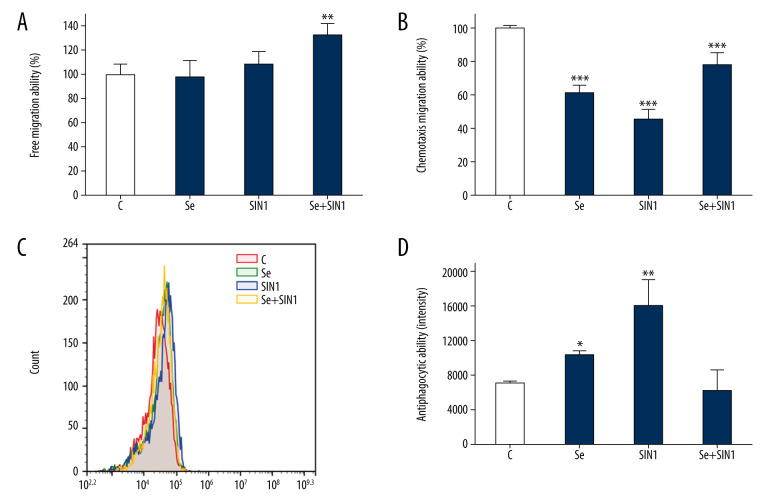
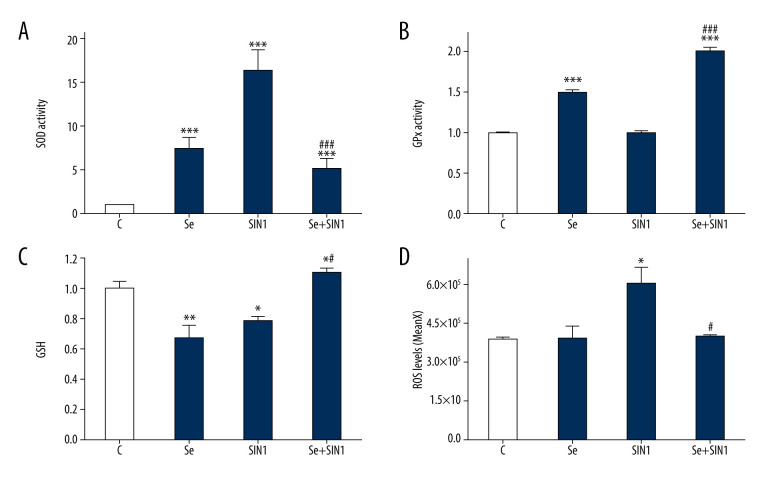
BACKGROUND Selenium and peroxynitrite are known to support the growth and activity of immune cells, including T cells, B cells and macrophages. However, the role of these factors in the immune function of human immature dendritic cells (imDCs) is not clear. MATERIAL AND METHODS Monocytes from a mixture of blood samples were isolated using Ficoll density gradient centrifugation and purified with immunomagnetic beads before being induced into imDCs. Cells then either received no treatment (control group), or treatment with sodium selenite (Na₂SeO₃, Se), 3-morpholinosydnonimine (SIN1, which decomposes into peroxynitrite), or Se+SIN1. Cell viability, migration, and antiphagocytic abilities, oxidative stress, and protein expression of extracellular signal-regulated kinases (ERK) and MMP2 were assessed using a CCK8 assay, cell counter and flow cytometry, microplate spectrophotometer, and Western blot analysis, respectively. RESULTS Viability of imDCs was unaffected by 0.1 μmol/L of Na₂SeO₃, although 1 mmol/L of SIN1 decreased it significantly (P<0.05). Chemotactic migration and antiphagocytic abilities were inhibited and enhanced, respectively, by treatment with Na₂SeO₃ and SIN1 (P<0.05). Activities of superoxide dismutase and glutathione peroxidase were increased by Na2SeO3 and Se+SIN1 (P<0.001). Glutathione content decreased with exposure to Na₂SeO₃ and SIN1 (P<0.05), but increased after treatment with Se+SIN1 (P<0.05). Levels of reactive oxygen species only increased with SIN1 treatment (P<0.05). Treatment with Na₂SeO₃, SIN1 and Se+SIN1 increased ERK phosphorylation and decreased MMP2 protein expression (P<0.05). CONCLUSIONS Selenium and peroxynitrite can influence immune function in imDCs by regulating levels of reactive oxygen species or glutathione to activate ERK and promote antigen phagocytosis, as well as by decreasing MMP2 expression to inhibit chemotactic migration.
硒和过氧亚硝酸盐已知可支持包括 T 细胞、B 细胞和巨噬细胞在内的免疫细胞的生长和活性。然而,这些因素在人类未成熟树突状细胞(imDCs)的免疫功能中的作用尚不清楚。
使用 Ficoll 密度梯度离心法从混合血液样本中分离单核细胞,并使用免疫磁珠进行纯化,然后将其诱导成 imDCs。然后,细胞要么不接受处理(对照组),要么接受亚硒酸钠(Na₂SeO₃,Se)、3-吗啉代-sydnonimine(SIN1,分解为过氧亚硝酸盐)或 Se+SIN1 的处理。使用 CCK8 测定法、细胞计数器和流式细胞术、微量板分光光度计和 Western blot 分析分别评估细胞活力、迁移和抗吞噬能力、氧化应激以及细胞外信号调节激酶(ERK)和 MMP2 的蛋白表达。
虽然 1mmol/L 的 SIN1 显著降低了 imDCs 的活力(P<0.05),但 0.1μmol/L 的 Na₂SeO₃ 对其活力没有影响。Na₂SeO₃ 和 SIN1 的处理分别抑制和增强趋化性迁移和抗吞噬能力(P<0.05)。Na₂SeO₃ 和 Se+SIN1 增加了超氧化物歧化酶和谷胱甘肽过氧化物酶的活性(P<0.001)。暴露于 Na₂SeO₃ 和 SIN1 会降低谷胱甘肽含量(P<0.05),但用 Se+SIN1 处理后会增加(P<0.05)。只有 SIN1 处理会增加活性氧的水平(P<0.05)。Na₂SeO₃、SIN1 和 Se+SIN1 处理增加了 ERK 磷酸化并降低了 MMP2 蛋白表达(P<0.05)。
硒和过氧亚硝酸盐可以通过调节活性氧或谷胱甘肽水平来影响 imDCs 的免疫功能,从而激活 ERK 并促进抗原吞噬作用,并通过降低 MMP2 表达来抑制趋化性迁移。