Soma Mika, Kim Jonghyuk, Kato Asami, Kawato Suguru
Department of Cognitive Neuroscience, Faculty of Pharma-Science, Teikyo University, Itabashi, Japan.
Department of Urology, Graduate School of Medicine, Juntendo University, Hongo, Japan.
Front Neurosci. 2018 May 1;12:282. doi: 10.3389/fnins.2018.00282. eCollection 2018.
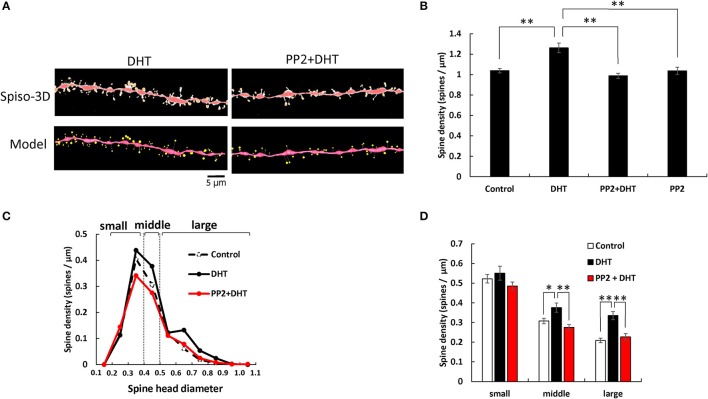
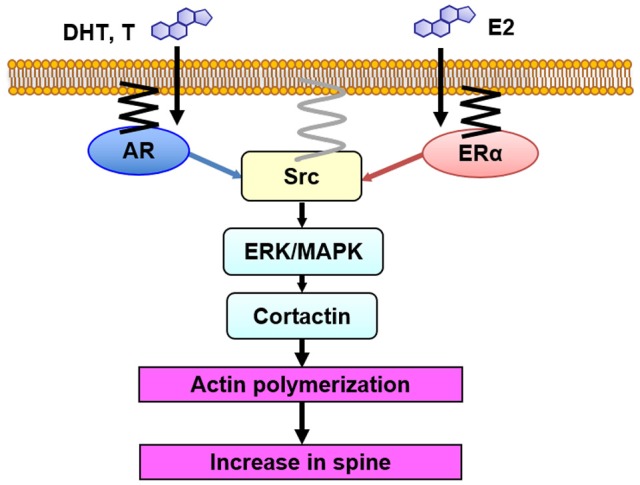
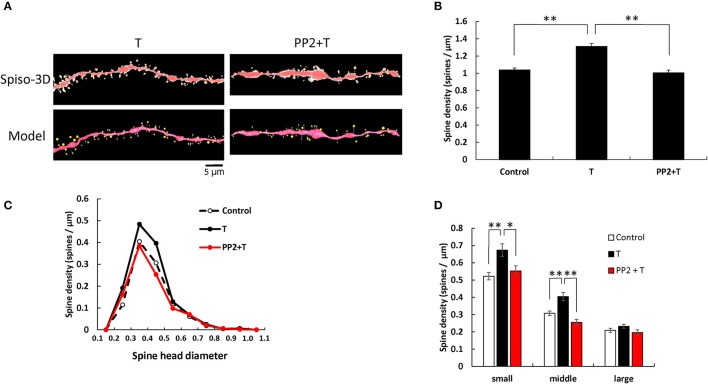
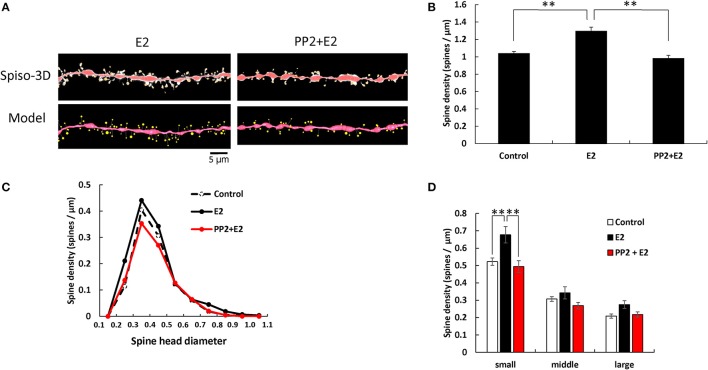
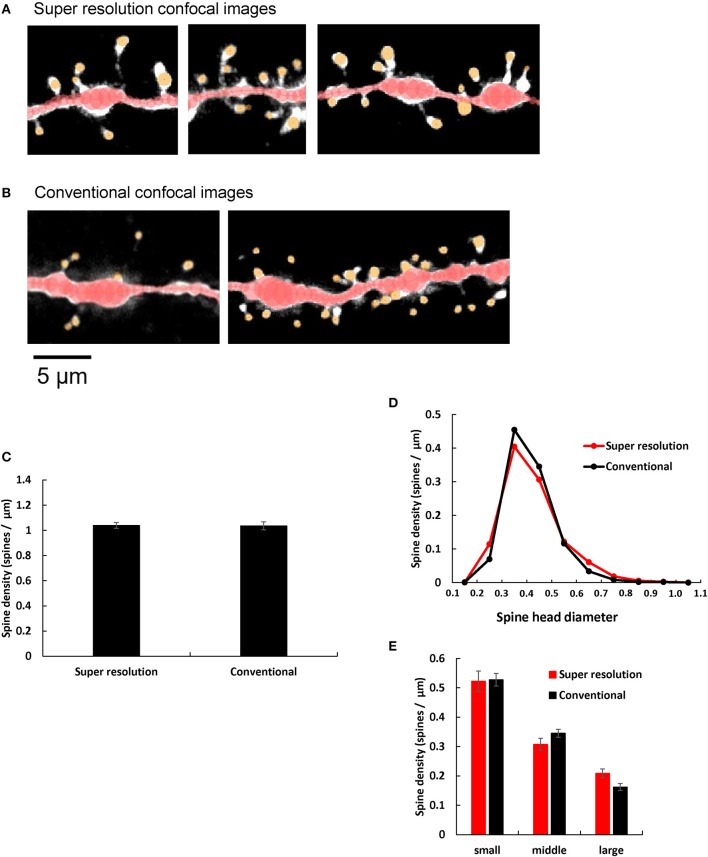
Dendritic spine is a small membranous protrusion from a neuron's dendrite that typically receives input from an axon terminal at the synapse. Memories are stored in synapses which consist of spines and presynapses. Rapid modulations of dendritic spines induced by hippocampal sex steroids, including dihydrotestosterone (DHT), testosterone (T), and estradiol (E2), are essential for synaptic plasticity. Molecular mechanisms underlying the rapid non-genomic modulation through synaptic receptors of androgen (AR) and estrogen (ER) as well as its downstream kinase signaling, however, have not been well understood. We investigated the possible involvement of Src tyrosine kinase in rapid changes of dendritic spines in response to androgen and estrogen, including DHT, T, and E2, using hippocampal slices from adult male rats. We found that the treatments with DHT (10 nM), T (10 nM), and E2 (1 nM) increased the total density of spines by ~1.22 to 1.26-fold within 2 h using super resolution confocal imaging of Lucifer Yellow-injected CA1 pyramidal neurons. We examined also morphological changes of spines in order to clarify differences between three sex steroids. From spine head diameter analysis, DHT increased middle- and large-head spines, whereas T increased small- and middle-head spines, and E2 increased small-head spines. Upon application of Src tyrosine kinase inhibitor, the spine increases induced through DHT, T, and E2 treatments were completely blocked. These results imply that Src kinase is essentially involved in sex steroid-induced non-genomic modulation of the spine density and morphology. These results also suggest that rapid effects of exogenously applied androgen and estrogen can occur in steroid-depleted conditions, including "acute" hippocampal slices and the hippocampus of gonadectomized animals.
树突棘是神经元树突上的一种小的膜状突起,通常在突触处接收来自轴突末端的输入。记忆存储在由树突棘和突触前成分组成的突触中。海马性类固醇,包括二氢睾酮(DHT)、睾酮(T)和雌二醇(E2),对树突棘的快速调节对于突触可塑性至关重要。然而,通过雄激素受体(AR)和雌激素受体(ER)的突触受体以及其下游激酶信号传导的快速非基因组调节的分子机制尚未完全了解。我们使用成年雄性大鼠的海马切片,研究了Src酪氨酸激酶在响应雄激素和雌激素(包括DHT、T和E2)时树突棘快速变化中的可能作用。我们发现,使用注射了路西法黄的CA1锥体神经元的超分辨率共聚焦成像,在2小时内,用DHT(10 nM)、T(10 nM)和E2(1 nM)处理使棘突的总密度增加了约1.22至1.26倍。我们还检查了棘突的形态变化,以阐明三种性类固醇之间的差异。通过棘突头部直径分析,DHT增加了中等和大头部的棘突,而T增加了小和中等头部的棘突,E2增加了小头部的棘突。应用Src酪氨酸激酶抑制剂后,通过DHT、T和E2处理诱导的棘突增加被完全阻断。这些结果表明,Src激酶本质上参与了性类固醇诱导的棘突密度和形态的非基因组调节。这些结果还表明,外源性应用雄激素和雌激素的快速作用可以在类固醇缺乏的条件下发生,包括“急性”海马切片和去势动物的海马。