Rodríguez-Lozano Dulce Carolina, Piña-Medina Ana Gabriela, Hansberg-Pastor Valeria, Bello-Alvarez Claudia, Camacho-Arroyo Ignacio
Unidad de Investigación en Reproducción Humana, Instituto Nacional de Perinatología-Facultad de Química, Universidad Nacional Autónoma de México (UNAM), Mexico City, Mexico.
Departamento de Biología, Facultad de Química, Universidad Nacional Autónoma de México, Mexico City, Mexico.
Front Endocrinol (Lausanne). 2019 Feb 4;10:16. doi: 10.3389/fendo.2019.00016. eCollection 2019.
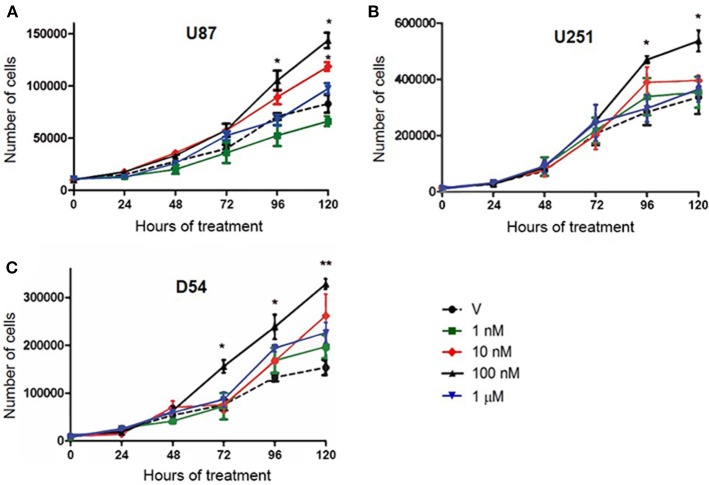
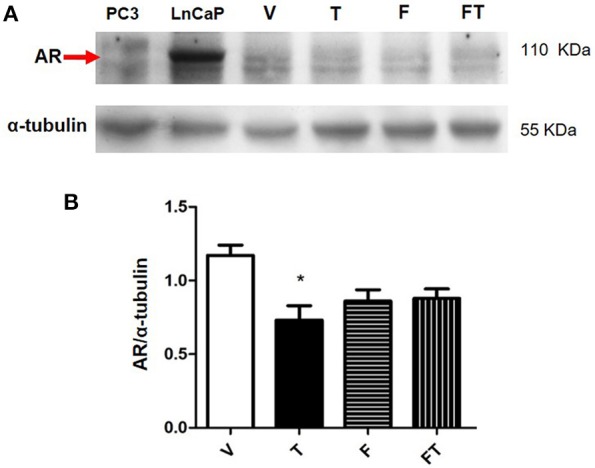
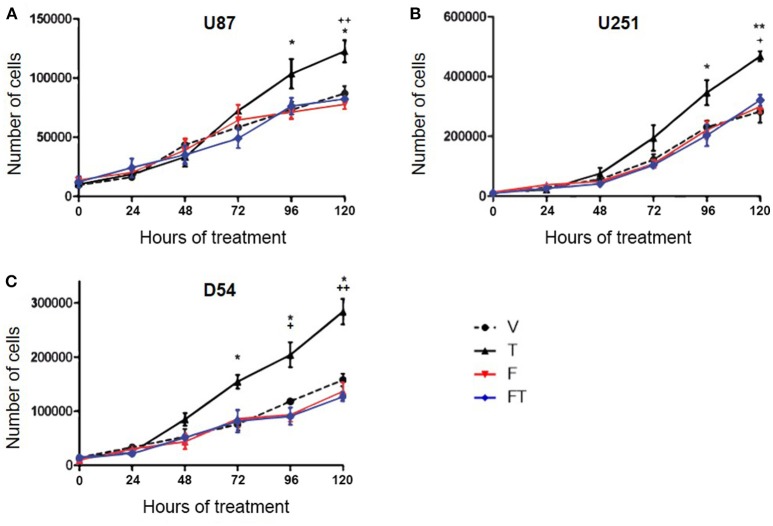
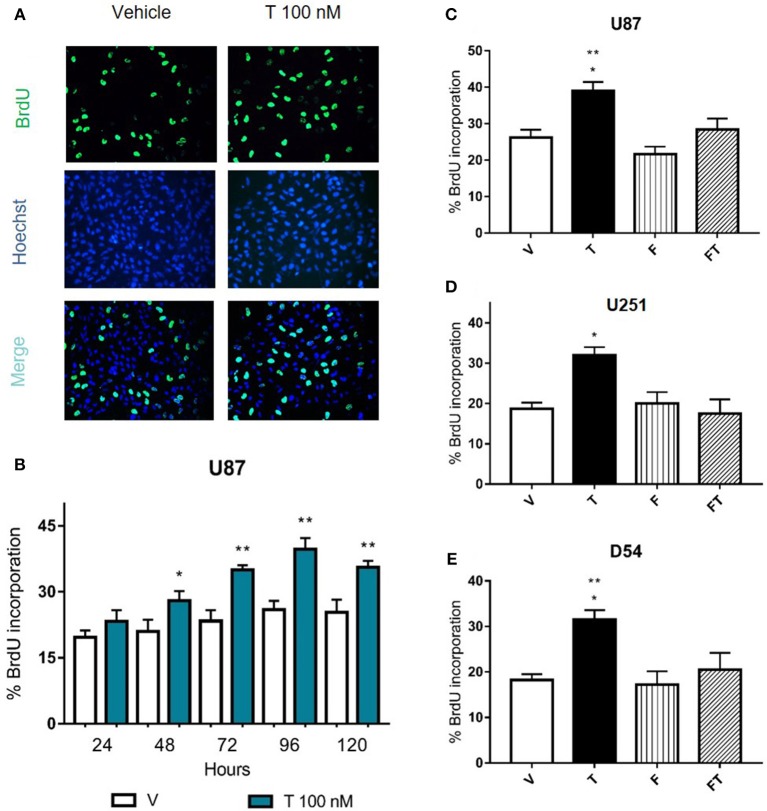
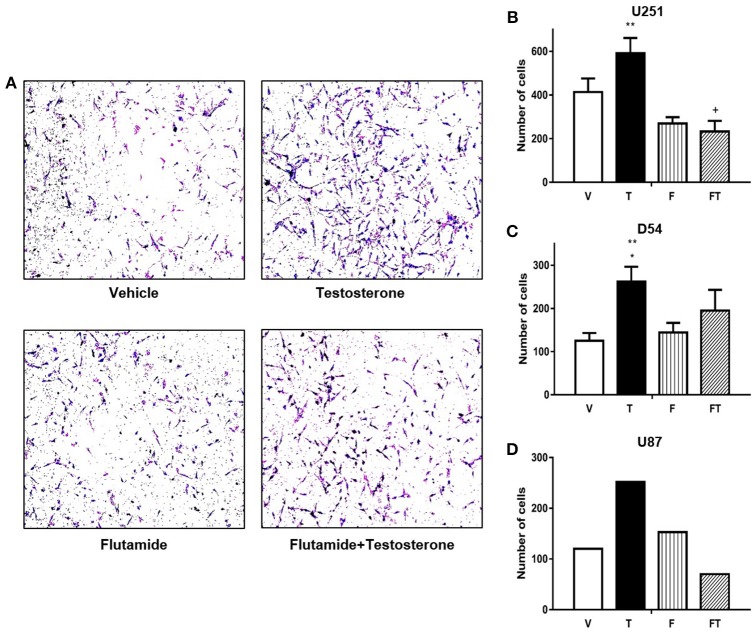
Glioblastomas (GBM) are the most frequent and aggressive human brain tumors due to their high capacity to migrate and invade normal brain tissue. Epidemiological data report that GBM occur in a greater proportion in men than in women (3:2), suggesting the participation of sex hormones in the development of these tumors. It has been reported an increase in testosterone (T) levels in patients with GBM. In addition, androgen receptor (AR) is overexpressed in human GBM, and genetic silencing of AR, and its pharmacological inhibition, induce GBM cell death and . However, the role of T in proliferation, migration and invasion in human GBM cell lines has not been evaluated. We observed that T increased the number of U87, U251, and D54 cells derived from human GBM due to an increase in cell proliferation. This induction was blocked with flutamide, an antagonist of AR. T also induced migration and invasion of GBM cells that flutamide partially blocked. These data suggest that T through AR contributes to the progression of GBM by promoting proliferation, migration, and invasion.
胶质母细胞瘤(GBM)是最常见且侵袭性最强的人类脑肿瘤,因为它们具有高度迁移和侵袭正常脑组织的能力。流行病学数据显示,GBM在男性中的发生率高于女性(3:2),这表明性激素参与了这些肿瘤的发生发展。据报道,GBM患者的睾酮(T)水平有所升高。此外,雄激素受体(AR)在人类GBM中过度表达,AR的基因沉默及其药理抑制作用可诱导GBM细胞死亡。然而,T在人类GBM细胞系增殖、迁移和侵袭中的作用尚未得到评估。我们观察到,由于细胞增殖增加,T增加了源自人类GBM的U87、U251和D54细胞的数量。这种诱导作用被AR拮抗剂氟他胺阻断。T还诱导了GBM细胞的迁移和侵袭,而氟他胺可部分阻断这种作用。这些数据表明,T通过AR促进增殖、迁移和侵袭,从而促进GBM的进展。