Bolijn Simone, Lucassen Paul J
Centre for Neuroscience, Swammerdam Institute of Life Sciences, University of Amsterdam, Amsterdam, The Netherlands.
Brain Plast. 2015 Oct 9;1(1):5-27. doi: 10.3233/BPL-150020.
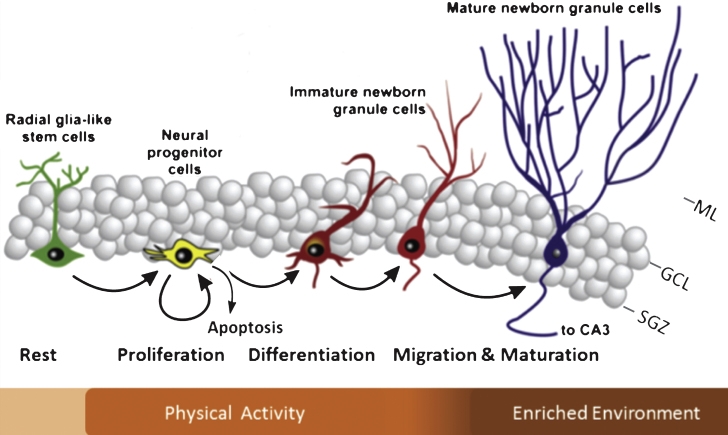
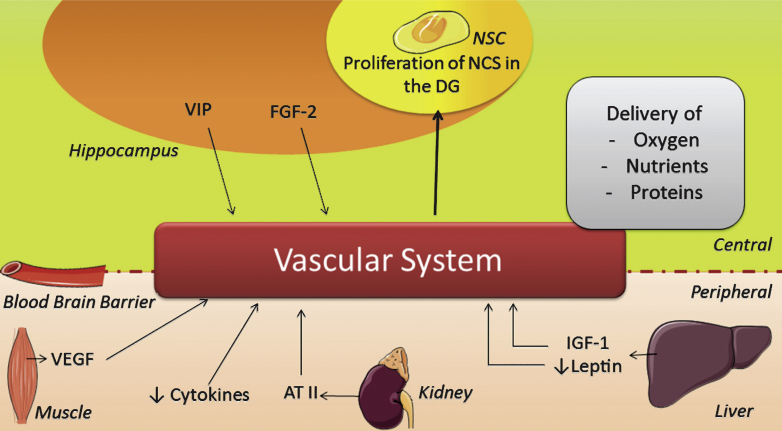
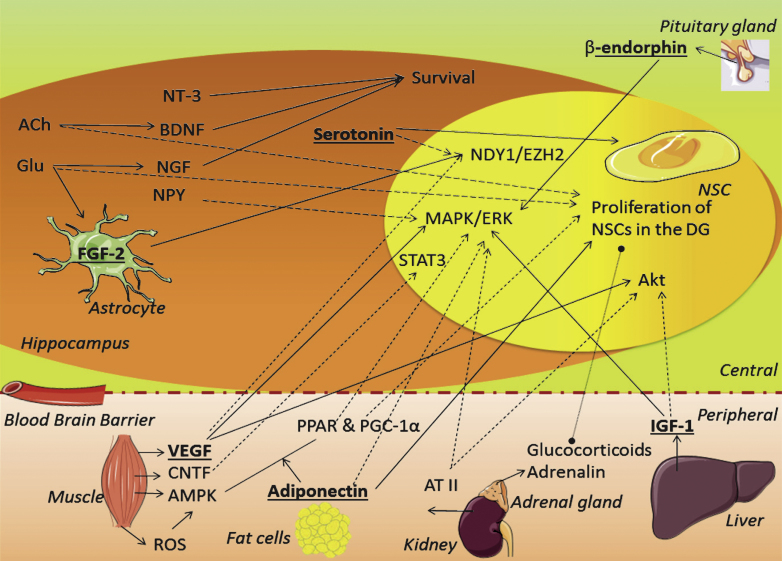
In the hippocampal dentate gyrus, stem cells maintain the capacity to produce new neurons into adulthood. These adult-generated neurons become fully functional and are incorporated into the existing hippocampal circuit. The process of adult neurogenesis contributes to hippocampal functioning and is influenced by various environmental, hormonal and disease-related factors. One of the most potent stimuli of neurogenesis is physical activity (PA). While the bodily and peripheral changes of PA are well known, e.g. in relation to diet or cardiovascular conditions, little is known about which of these also exert central effects on the brain. Here, we discuss PA-induced changes in peripheral mediators that can modify hippocampal proliferation, and address changes with age, sex or PA duration/intensity. Of the many peripheral factors known to be triggered by PA, serotonin, FGF-2, IGF-1, VEGF, -endorphin and adiponectin are best known for their stimulatory effects on hippocampal proliferation. Interestingly, while age negatively affects hippocampal proliferation per se, also the PA-induced response to most of these peripheral mediators is reduced and particularly the response to IGF-1 and NPY strongly declines with age. Sex differences per se have generally little effects on PA-induced neurogenesis. Compared to short term exercise, long term PA may negatively affect proliferation, due to a parallel decline in FGF-2 and the -endorphin receptor, and an activation of the stress system particularly during conditions of prolonged exercise but this depends on other variables as well and remains a matter of discussion. Taken together, of many possible mediators, serotonin, FGF-2, IGF-1, VEGF, -endorphin and adiponectin are the ones that most strongly contribute to the central effects of PA on the hippocampus. For a subgroup of these factors, brain sensitivity and responsivity is reduced with age.
在海马齿状回中,干细胞在成年期仍保持产生新神经元的能力。这些成年后产生的神经元会完全发挥功能,并融入现有的海马回路。成年神经发生过程有助于海马功能的实现,并受到各种环境、激素和疾病相关因素的影响。神经发生最有力的刺激因素之一是体育活动(PA)。虽然体育活动对身体和外周的影响已为人熟知,例如与饮食或心血管状况有关,但对于其中哪些也会对大脑产生中枢作用却知之甚少。在这里,我们讨论体育活动引起的外周介质变化,这些变化可改变海马增殖,并探讨年龄、性别或体育活动持续时间/强度的变化情况。在已知由体育活动触发的众多外周因素中,血清素、成纤维细胞生长因子-2(FGF-2)、胰岛素样生长因子-1(IGF-1)、血管内皮生长因子(VEGF)、β-内啡肽和脂联素因其对海马增殖的刺激作用而最为人所知。有趣的是,虽然年龄本身会对海马增殖产生负面影响,但体育活动对外周介质的反应也会随着年龄增长而降低,尤其是对IGF-1和神经肽Y(NPY)的反应会随着年龄增长而大幅下降。性别差异本身对体育活动诱导的神经发生通常影响不大。与短期运动相比,长期体育活动可能会对增殖产生负面影响,这是由于FGF-2和β-内啡肽受体同时下降,以及应激系统的激活,尤其是在长时间运动的情况下,但这也取决于其他变量,仍是一个有待讨论的问题。综上所述,在众多可能的介质中,血清素、FGF-2、IGF-1、VEGF、β-内啡肽和脂联素对体育活动对海马的中枢作用贡献最大。对于这些因素中的一个亚组,大脑的敏感性和反应性会随着年龄增长而降低。