Matar Maher M, Jewett Brent, Fakhry Samir M, Wilson Dulaney A, Ferguson Pamela L, Anton Raymond F, Sakran Joseph V
Department of Surgery, Medical University of South Carolina, Charleston, South Carolina, USA.
Department of Surgery, Trident Medical Center, Charleston, South Carolina, USA.
Trauma Surg Acute Care Open. 2017 Sep 29;2(1):e000098. doi: 10.1136/tsaco-2017-000098. eCollection 2017.
Chronic heavy alcohol (CHA) use has been associated with perioperative complications. Emergency general surgery (EGS) patients are not routinely screened for CHA. If screened, it is usually for hazardous use of alcohol, using a survey such as the Alcohol Use Disorders Identification Test (AUDIT). This study screened EGS patients for CHA use using serum carbohydrate-deficient transferrin (%dCDT) level, a biomarker that has been validated as an indicator for CHA use, as well as the AUDIT. The purpose of this study was to determine the percent of EGS patients with CHA (as indicated by elevated %dCDT), and the relationship between %dCDT and AUDIT. Secondary aims included comparing the characteristics of EGS patients with and without CHA use, and evaluating the association of CHA use with negative clinical outcomes.
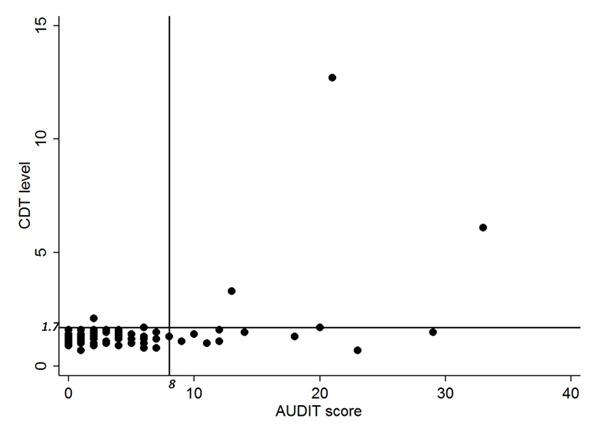
EGS patients aged 21 and older admitted to the general surgery inpatient service of a tertiary hospital from July 2014 to June 2016 were invited to participate in this study. %dCDT levels above 1.7% were considered positive for CHA use, as were AUDIT scores ≥8.
195 EGS patients were screened for inclusion and 91 (46.7%) agreed to participate. 14 (15.4%) were positive for hazardous alcohol use on AUDIT and 5 (5.5%) were positive for CHA by %dCDT. Positive predictive value of AUDIT for CHA was 21.4%. There was no correlation between positive scores on AUDIT and %dCDT.
Identifying at risk patients early on in their hospital course may allow clinicians to institute treatments to mitigate and/or circumvent complications in such patients. This pilot study determined that 17.6% of participating EGS patients were positive for some type of alcohol misuse, but only 5.5% had CHA. Further research is needed to determine whether routine use of %dCDT would be beneficial in reducing perioperative complications in this patient population.
III (diagnostic test).
长期大量饮酒(CHA)与围手术期并发症有关。急诊普通外科(EGS)患者通常未常规筛查CHA。如果进行筛查,通常是使用诸如酒精使用障碍识别测试(AUDIT)等调查来检测危险饮酒情况。本研究使用血清缺糖转铁蛋白(%dCDT)水平(一种已被验证为CHA使用指标的生物标志物)以及AUDIT对EGS患者进行CHA使用情况筛查。本研究的目的是确定CHA阳性(以升高的%dCDT表示)的EGS患者百分比,以及%dCDT与AUDIT之间的关系。次要目标包括比较有和没有CHA使用情况的EGS患者的特征,以及评估CHA使用与不良临床结局的关联。
邀请2014年7月至2016年6月入住一家三级医院普通外科住院部的21岁及以上的EGS患者参加本研究。%dCDT水平高于1.7%被视为CHA使用阳性,AUDIT评分≥8也被视为阳性。
筛选了195例EGS患者纳入研究,91例(46.7%)同意参与。14例(15.4%)AUDIT危险饮酒检测呈阳性,5例(5.5%)%dCDT检测CHA呈阳性。AUDIT对CHA的阳性预测值为21.4%。AUDIT阳性评分与%dCDT之间无相关性。
在患者住院过程早期识别高危患者可能使临床医生能够采取治疗措施减轻和/或避免此类患者的并发症。这项初步研究确定,17.6%的参与研究的EGS患者存在某种类型的酒精滥用阳性,但只有5.5%有CHA。需要进一步研究以确定常规使用%dCDT是否有利于减少该患者群体的围手术期并发症。
III(诊断性试验)