Department of Pathobiology of the Nervous System, Center for Brain Research , Medical University of Vienna , 1090 Vienna , Austria.
Department of Pharmacology and Therapeutics, Faculty of Medicine , Ain Shams University , Cairo , Egypt.
ACS Chem Biol. 2018 Aug 17;13(8):2033-2039. doi: 10.1021/acschembio.8b00144. Epub 2018 Jul 23.
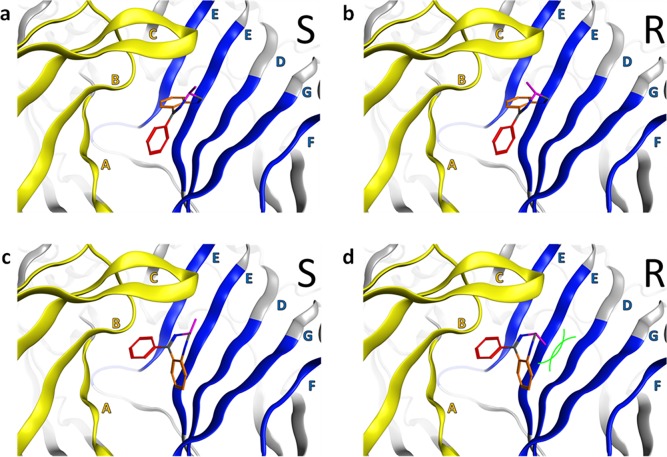
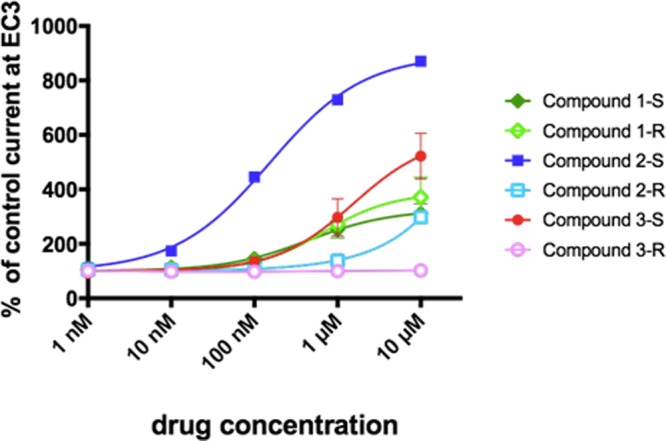
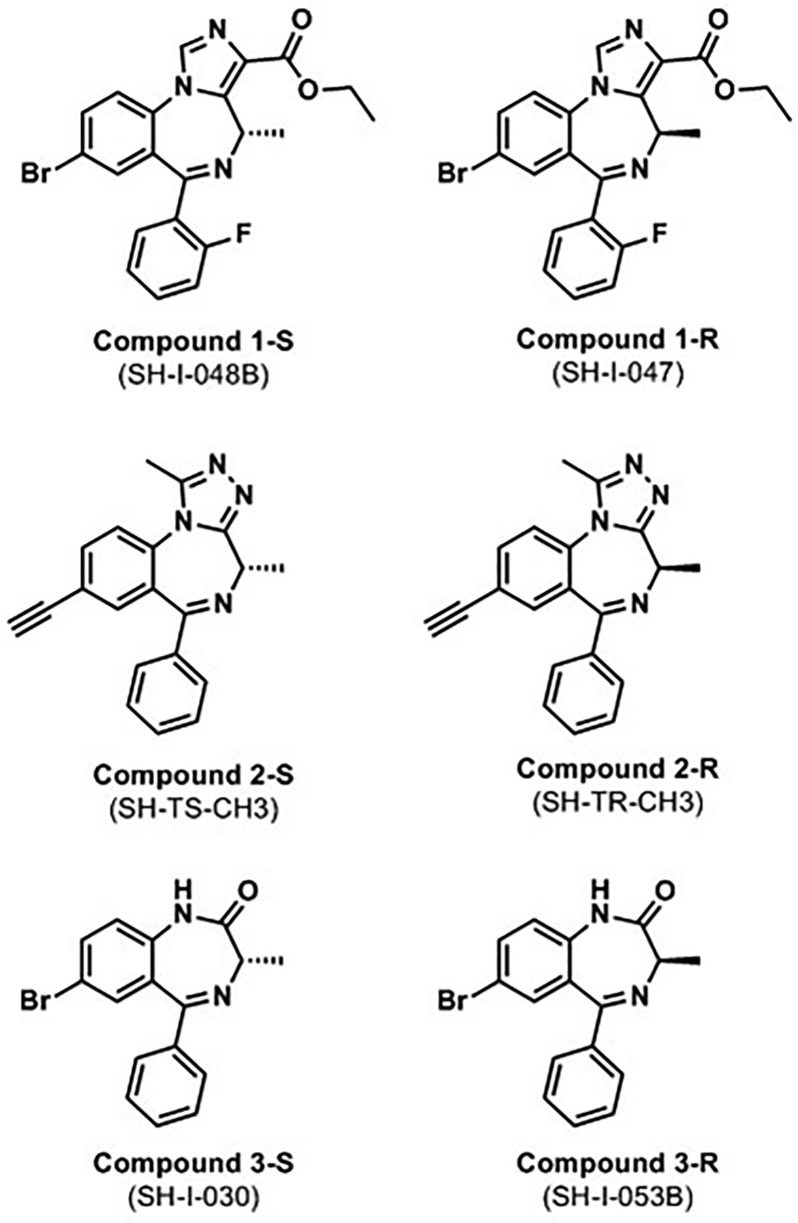
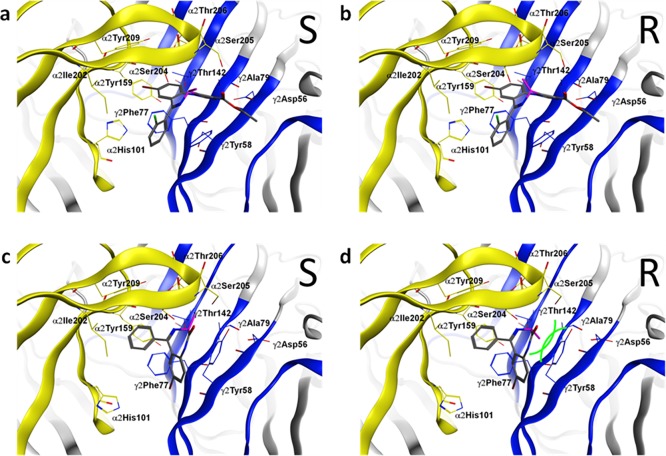
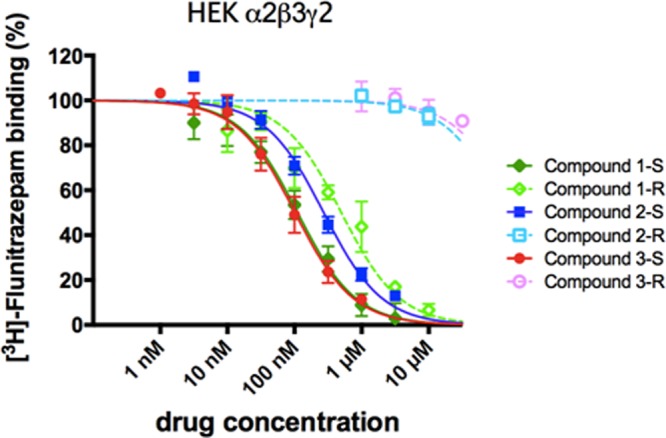
Benzodiazepines are clinically relevant drugs that bind to GABA neurotransmitter receptors at the α+/γ2- interfaces and thereby enhance GABA-induced chloride ion flux leading to neuronal hyperpolarization. However, the structural basis of benzodiazepine interactions with their high-affinity site at GABA receptors is controversially debated in the literature, and in silico studies led to discrepant binding mode hypotheses. In this study, computational docking of diazepam into α+/γ2- homology models suggested that a chiral methyl group, which is known to promote preferred binding to α5-containing GABA receptors (position 3 of the seven-membered diazepine ring), could possibly provide experimental evidence that supports or contradicts the proposed binding modes. Thus, we investigated three pairs of R and S isomers of structurally different chemotypes, namely, diazepam, imidazobenzodiazepine, and triazolam derivatives. We used radioligand displacement studies as well as two-electrode voltage clamp electrophysiology in α1β3γ2-, α2β3γ2-, α3β3γ2-, and α5β3γ2-containing GABA receptors to determine the ligand binding and functional activity of the three chemotypes. Interestingly, both imidazobenzodiazepine isomers displayed comparable binding affinities, while for the other two chemotypes, a discrepancy in binding affinities of the different isomers was observed. Specifically, the R isomers displayed a loss of binding, whereas the S isomers remained active. These findings are in accordance with the results of our in silico studies suggesting the usage of a different binding mode of imidazobenzodiazepines compared to those of the other two tested chemotypes. Hence, we conclude that different chemically related benzodiazepine ligands interact via distinct binding modes rather than by using a common binding mode.
苯二氮䓬类药物是与 GABA 神经递质受体在 α+/γ2-界面结合,从而增强 GABA 诱导的氯离子流,导致神经元超极化的临床相关药物。然而,苯二氮䓬类药物与 GABA 受体高亲和力结合位点的相互作用的结构基础在文献中存在争议,并且计算机模拟研究导致了不同的结合模式假说。在这项研究中,将地西泮计算对接入 α+/γ2-同源模型表明,一个手性甲基,已知可促进与包含 α5 的 GABA 受体的优先结合(七元环苯二氮䓬环的 3 位),可能为支持或反驳所提出的结合模式提供实验证据。因此,我们研究了三种不同化学类型的结构异构体,即地西泮、咪唑并苯二氮䓬和三唑仑衍生物的 R 和 S 对映异构体。我们使用放射性配体置换研究以及在含有 α1β3γ2、α2β3γ2、α3β3γ2 和 α5β3γ2 的 GABA 受体中的双电极电压钳电生理学来确定三种化学类型的配体结合和功能活性。有趣的是,两种咪唑并苯二氮䓬异构体都显示出可比的结合亲和力,而对于其他两种化学类型,观察到不同异构体的结合亲和力存在差异。具体来说,R 异构体显示出结合的丧失,而 S 异构体仍然保持活性。这些发现与我们的计算机模拟研究结果一致,表明咪唑并苯二氮䓬类药物的使用不同于其他两种测试的化学类型的不同结合模式。因此,我们得出结论,不同的化学相关苯二氮䓬类药物通过不同的结合模式相互作用,而不是通过使用共同的结合模式。