Xue Fuguang, Pan Xiaohua, Jiang Linshu, Guo Yuming, Xiong Benhai
State Key Laboratory of Animal Nutrition, Institute of Animal Science, Chinese Academy of Agricultural Sciences, Beijing, 100193, China.
State Key Laboratory of Animal Nutrition, Institute of Animal Science, Chinese Agricultural University, Beijing, China.
Metabolomics. 2018;14(5):67. doi: 10.1007/s11306-018-1362-8. Epub 2018 May 8.
Thiamine is known to attenuate high-concentrate diet induced subacute ruminal acidosis (SARA) in dairy cows, however, the underlying mechanisms remain unclear.
The major objective of this study was to investigate the metabolic mechanisms of thiamine supplementation on high-concentrate diet induced SARA.
Six multiparous, rumen-fistulated Holstein cows were used in a replicated 3 × 3 Latin square design. The treatments included a control diet (CON; 20% starch, dry matter basis), a SARA-inducing diet (SAID; 33.2% starch, dry matter basis) and SARA-inducing diet supplemented with 180 mg of thiamine/kg of dry matter intake (SAID + T). On d21 of each period, ruminal fluid samples were collected at 3 h post feeding, and GC/MS was used to analyze rumen fluid samples.
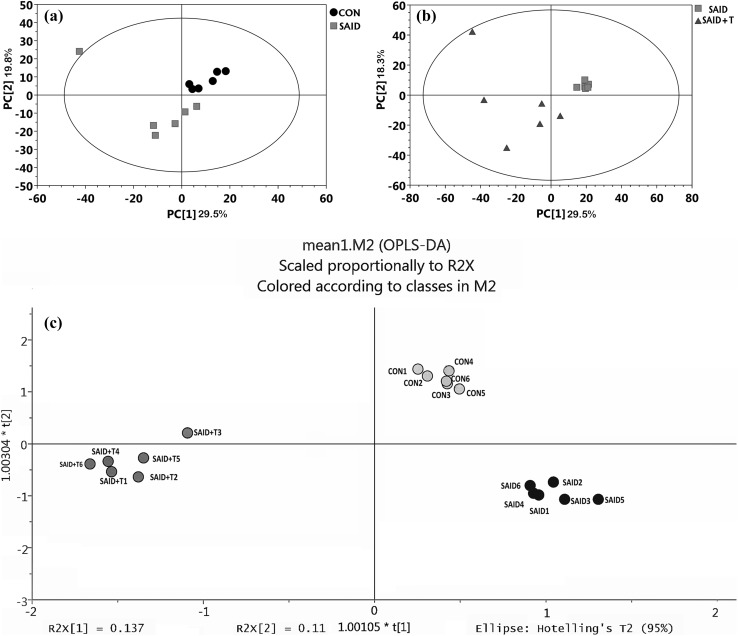
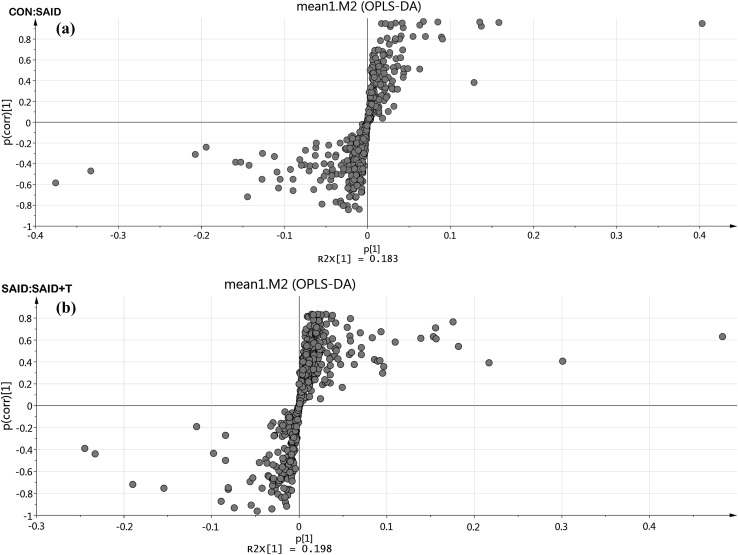
PCA and OPLS-DA analysis demonstrated that the ruminal metabolite profile were different in three treatments. Compared with CON treatment, SAID feeding significantly decreased rumen pH, acetate, succinic acid, increased propionate, pyruvate, lactate, glycine and biogenic amines including spermidine and putrescine. Thiamine supplementation significantly decreased rumen content of propionate, pyruvate, lactate, glycine and spermidine; increase rumen pH, acetate and some medium-chain fatty acids. The enrichment analysis of different metabolites indicated that thiamine supplementation mainly affected carbohydrates, amino acids, pyruvate and thiamine metabolism compared with SAID treatment.
These findings revealed that thiamine supplementation could attenuate high-concentrate diet induced SARA by increasing pyruvate formate-lyase activity to promote pyruvate to generate acetyl-CoA and inhibit lactate generation. Besides, thiamine reduced biogenic amines to alleviate ruminal epithelial inflammatory response.
已知硫胺素可减轻奶牛高浓度日粮诱导的亚急性瘤胃酸中毒(SARA),但其潜在机制尚不清楚。
本研究的主要目的是探讨补充硫胺素对高浓度日粮诱导的SARA的代谢机制。
选用6头经产、瘤胃造瘘的荷斯坦奶牛,采用重复3×3拉丁方设计。处理包括对照日粮(CON;淀粉含量20%,干物质基础)、诱导SARA的日粮(SAID;淀粉含量33.2%,干物质基础)和添加180 mg硫胺素/kg干物质摄入量的诱导SARA日粮(SAID+T)。在每个周期的第21天,在喂食后3小时采集瘤胃液样本,并用气相色谱/质谱联用仪分析瘤胃液样本。
主成分分析(PCA)和正交偏最小二乘法判别分析(OPLS-DA)表明,三种处理的瘤胃代谢物谱不同。与CON处理相比,SAID日粮显著降低了瘤胃pH值、乙酸、琥珀酸,增加了丙酸、丙酮酸、乳酸、甘氨酸和包括亚精胺和腐胺在内的生物胺。补充硫胺素显著降低了瘤胃中丙酸、丙酮酸、乳酸、甘氨酸和亚精胺的含量;提高了瘤胃pH值、乙酸和一些中链脂肪酸的含量。不同代谢物的富集分析表明,与SAID处理相比,补充硫胺素主要影响碳水化合物、氨基酸、丙酮酸和硫胺素代谢。
这些发现表明,补充硫胺素可通过增加丙酮酸甲酸裂解酶活性,促进丙酮酸生成乙酰辅酶A并抑制乳酸生成,从而减轻高浓度日粮诱导的SARA。此外,硫胺素减少生物胺以减轻瘤胃上皮炎症反应。