Gavina Kenneth, Arango Eliana, Larrotta Catalina Alvarez, Maestre Amanda, Yanow Stephanie K
Dept of Medical Microbiology and Immunology, University of Alberta, Edmonton, Alberta, Canada.
Grupo Salud y Comunidad, Universidad de Antioquia, Medellín, Colombia.
Parasite Epidemiol Control. 2017 Apr 6;2(2):70-76. doi: 10.1016/j.parepi.2017.04.001. eCollection 2017 May.
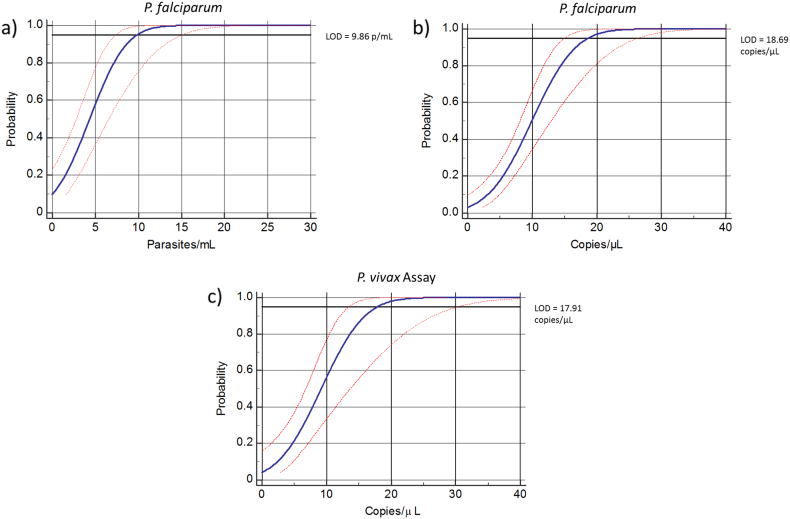
As the global burden of malaria decreases and countries strive towards disease elimination, there is a greater demand for sensitive diagnostics to target the submicroscopic reservoir of infection. We describe here a sensitive species-specific RT-qPCR method to differentiate between and infections at the submicroscopic level. With amplification of the 18S rRNA genes from total nucleic acids (both DNA and RNA), we discern and with a limit of detection of 10 parasites/mL and 18 copies/μL, respectively. This assay was validated with 519 blood samples, negative by thick-smear, from febrile and asymptomatic cohorts from Colombia. These results were directly compared to a qPCR-based method (DNA only) as the gold standard. Of the samples from patients who presented with fever ( = 274), 34 infections were identified by RT-qPCR (16 , 15 , and 3 mixed), of which only 10 infections were identified at the species level by qPCR. Within the asymptomatic cohort ( = 245), 13 infections were identified by RT-qPCR (3 , 3 , and 7 mixed), whereas the species for only one infection was determined by qPCR. We conclude that this species-specific RT-qPCR method provides a more sensitive tool for species identification compared to DNA based qPCR methods.
随着全球疟疾负担的减轻以及各国努力实现疟疾消除,对于针对亚微观感染源的灵敏诊断方法的需求日益增加。我们在此描述一种灵敏的物种特异性逆转录定量聚合酶链反应(RT-qPCR)方法,用于在亚微观水平区分[具体物种1]和[具体物种2]感染。通过从总核酸(DNA和RNA)中扩增18S rRNA基因,我们分别以10个寄生虫/毫升和18个拷贝/微升的检测限辨别[具体物种1]和[具体物种2]。该检测方法用来自哥伦比亚发热和无症状队列的519份厚涂片阴性血样进行了验证。这些结果与基于qPCR的方法(仅检测DNA)作为金标准进行了直接比较。在出现发热症状的患者样本(n = 274)中,RT-qPCR鉴定出34例感染(16例[具体物种1],15例[具体物种2],3例混合感染),其中qPCR仅在物种水平鉴定出10例感染。在无症状队列(n = 245)中,RT-qPCR鉴定出13例感染(3例[具体物种1],3例[具体物种2],7例混合感染),而qPCR仅确定了1例感染的物种。我们得出结论,与基于DNA的qPCR方法相比,这种物种特异性RT-qPCR方法为物种鉴定提供了一种更灵敏的工具。